
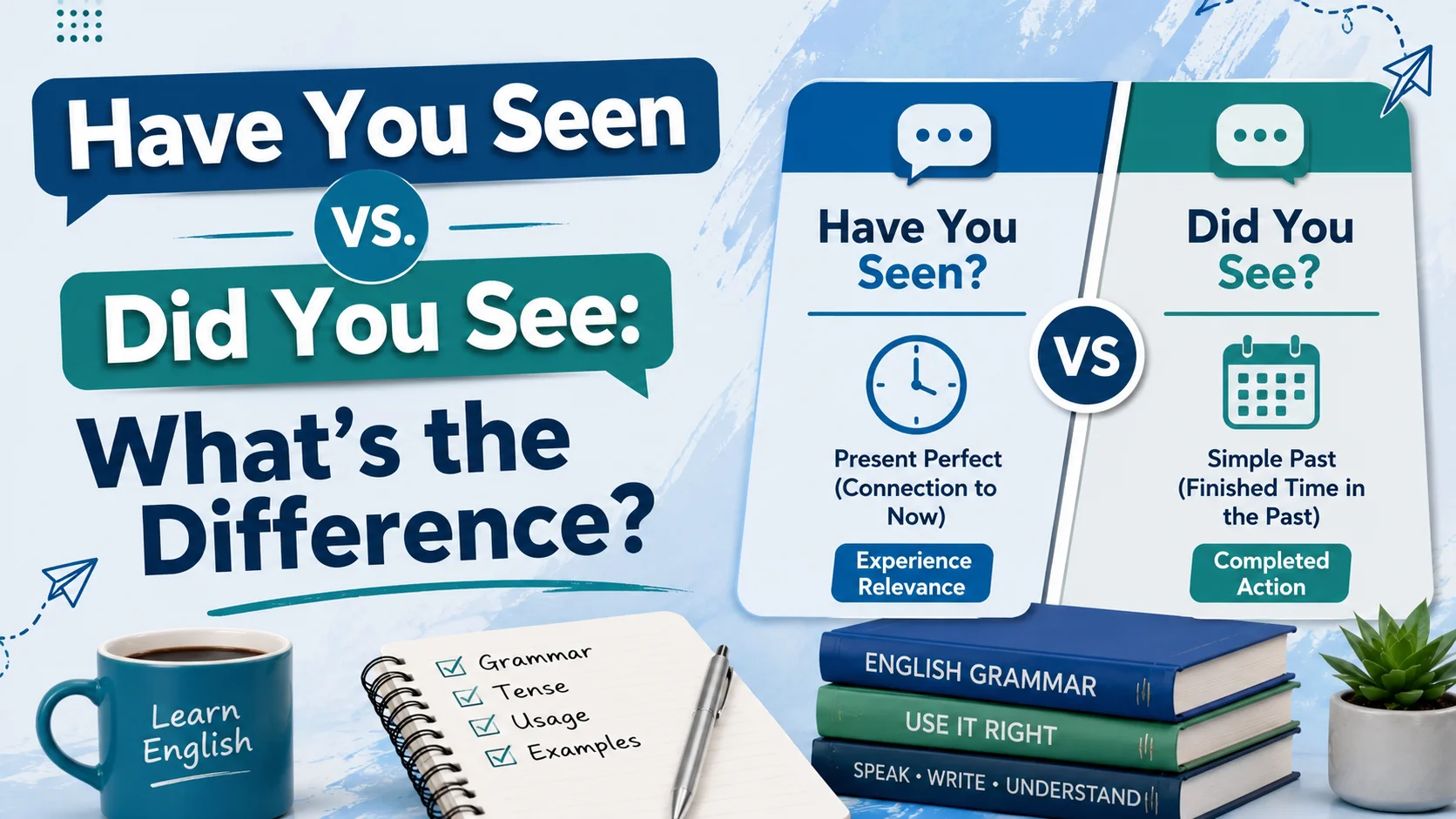
Have You Seen vs. Did You See helps you choose the right tense naturally, making your English clearer, more accurate, and easier to understand.When I started Mastering English, I discovered that Have You Seen vs. Did You See was more than a simple grammar topic. Comparing Have you seen and Did you see in real-life English, spoken English, and conversational English showed me how verb tenses, present perfect tense, present perfect, simple past, past tense, present, past, context, time, timing, time reference, present relevance, connection to the present, completed actions, and finished actions shape sentence meaning.
Steady language learning, grammar learning, grammar practice, language practice, regular practice, practical grammar, practical exercises, practical examples, example sentences, real-life usage, correct usage,grammar comparison, grammar differences, tense comparison, tense usage, grammar mastery, grammar understanding, grammar accuracy, and language improvement helped me understand why different situations, interchangeable choices, and every action matter.
With more conversation, daily speaking practice, formal writing, English writing, English speaking, and guidance from native speakers, I developed natural English, fluent English, confidence, learner confidence, clarity, understanding, grammar usage, language structure, and stronger skills. This journey reduced learner mistakes, helped me avoid mistakes, prepared me for professional situations, personal situations, real-world English, and even improved my performance in exams.
Why This Grammar Choice Matters
English relies heavily on verb tenses to communicate when something happened and whether it still matters now. That means a small change in wording can completely change the meaning of a sentence.
Compare these examples:
- Have you seen my keys?
- Did you see my keys yesterday?
The first question suggests the keys are still missing. The speaker wants to know whether you know where they are now.
The second question refers to a finished moment in the past. The speaker is asking about yesterday specifically.
That small difference helps listeners understand exactly what you’re asking.
Why learners often confuse them
Many languages don’t distinguish between the present perfect and the simple past in the same way English does. As a result, learners often translate directly from their native language instead of thinking about the relationship between the event and the present.
Understanding this difference makes your English sound more natural in conversations, exams, business communication, and academic writing.
The Quick Answer
If you only remember one rule, remember this:
| Use Have You Seen | Use Did You See |
| The time isn’t finished or isn’t mentioned. | The time is finished or specifically mentioned. |
| The action still matters now. | The action belongs completely in the past. |
| Present Perfect | Simple Past |
Simple rule
Ask yourself one question:
Is there a specific finished time?
- Yes → Did you see
- No → Have you seen
Examples:
Have you seen my phone?
Have you seen the new Spider-Man movie?
Did you see my phone yesterday?
Did you see the game last night?
Understanding “Have You Seen”
Meaning and Grammar
Have you seen uses the present perfect tense.
Structure:
Have + subject + past participle
Example:
- Have you seen
- Have they seen
- Have we seen
Notice that seen is the past participle, not the simple past.
Many learners accidentally say:
❌ Have you saw
The correct form is:
✔ Have you seen
Why It Uses the Present Perfect
The present perfect connects the past with the present.
The exact time isn’t important.
Instead, the speaker focuses on one of these ideas:
- Present relevance
- Life experience
- Recent events
- An unfinished period
- A current result
For example:
Have you seen my wallet?
The speaker still needs the wallet.
The situation is happening now.
When Native Speakers Say “Have You Seen”
Native speakers commonly use this form when asking about:
- Missing objects
- Recent news
- Movies
- TV shows
- People
- Emails
- Messages
- New products
- Changes
Examples:
- Have you seen John today?
- Have you seen the latest update?
- Have you seen my glasses?
- Have you seen this article?
Notice that none of these examples include a finished time like yesterday or last week.
Common Situations and Real-Life Examples
Imagine you’re getting ready for work.
You can’t find your car keys.
You ask:
Have you seen my keys?
You’re not asking about a particular moment.
You’re asking whether anyone knows where they are now.
Another example:
A new movie has just been released.
You ask your friend:
Have you seen the new Superman movie?
You’re asking whether they have watched it at any point up to now.
Sentence Patterns and Formula
| Pattern | Example |
| Have + subject + seen | Have you seen this book? |
| Have + subject + ever + seen | Have you ever seen snow? |
| Have + subject + seen + object | Have you seen my bag? |
| Have + subject + seen + today | Have you seen Sarah today? |
Understanding “Did You See”
Meaning and Grammar
Did you see uses the simple past tense.
Structure:
Did + subject + base verb
Notice that after did, the verb returns to its base form.
Correct:
✔ Did you see
Incorrect:
❌ Did you saw
Why It Uses the Simple Past
The simple past describes actions that happened during a finished time.
The event started.
The event ended.
The time is over.
Examples:
- yesterday
- last week
- last year
- this morning (if the morning has ended)
- two hours ago
When Native Speakers Say “Did You See”
People use this expression when talking about:
- Yesterday’s news
- A football match
- A concert
- A presentation
- A classroom event
- A conversation
- Something that happened earlier
Examples:
- Did you see the game last night?
- Did you see my email yesterday?
- Did you see what happened after class?
- Did you see the fireworks?
Common Situations and Real-Life Examples
Imagine your favorite basketball team played yesterday.
Today, you ask your friend:
Did you see the game last night?
The game has finished.
The time has finished.
That’s why the simple past is correct.
Sentence Patterns and Formula
| Pattern | Example |
| Did + subject + see | Did you see her? |
| Did + subject + see + object | Did you see the report? |
| Did + subject + see + yesterday | Did you see him yesterday? |
| Did + subject + see + last night | Did you see the show last night? |
Have You Seen vs. Did You See: The Core Difference
The biggest difference isn’t the verb.
It’s the relationship between the event and the present.
Connection to the Present vs. Finished Time
Compare these questions:
Have you seen my laptop?
The laptop is still missing.
The situation continues.
Now compare:
Did you see my laptop yesterday?
The speaker wants information about yesterday only.
Unfinished Time vs. Finished Time
Use Have you seen with:
- today
- this week
- this month
- recently
- ever
- yet
- already
Use Did you see with:
- yesterday
- last night
- last week
- two days ago
- in 2024
- on Monday
Asking About Experience vs. Asking About a Specific Event
Experience:
Have you ever seen the Northern Lights?
Specific event:
Did you see the Northern Lights during your trip to Alaska?
The first asks about life experience.
The second refers to one trip.
Why Time Expressions Change the Correct Answer
Time expressions often decide which tense you need.
| Time Expression | Correct Choice |
| Ever | Have you seen |
| Yet | Have you seen |
| Already | Have you seen |
| Today | Usually Have you seen |
| This week | Usually Have you seen |
| Yesterday | Did you see |
| Last night | Did you see |
| Three hours ago | Did you see |
| In 2025 | Did you see |
Side-by-Side Comparison Table
| Feature | Have You Seen | Did You See |
| Tense | Present Perfect | Simple Past |
| Focus | Present connection | Finished past |
| Time mentioned | Usually no | Usually yes |
| Life experiences | Yes | No |
| Missing objects | Yes | Rarely |
| Finished events | No | Yes |
Time Expressions That Signal the Correct Choice
Certain words almost always point toward one tense.
Ever
Use with the present perfect.
Example:
Have you ever seen a whale?
Yet
Used in questions and negatives.
Example:
Have you seen the report yet?
Already
Shows something happened sooner than expected.
Example:
Have you already seen the announcement?
Today
If the day isn’t over:
Have you seen Emma today?
If the day has clearly finished, context may allow the simple past.
This Week
Usually present perfect.
Example:
Have you seen your manager this week?
Yesterday
Always simple past.
Example:
Did you see her yesterday?
Last Night
Simple past.
Example:
Did you see the concert last night?
An Hour Ago
Simple past.
Example:
Did you see him an hour ago?
In 2024 and Other Finished Dates
Specific years in the past require the simple past.
Example:
Did you see the eclipse in 2024?
Real Conversation Examples
Talking About Movies
Have you seen the latest Marvel movie?
The release is recent.
No specific viewing time matters.
Did you see the movie last Friday?
Now the viewing time is specific.
Talking About TV Shows
- Have you seen the new episode?
- Did you see yesterday’s episode?
Talking About News
- Have you seen today’s headlines?
- Did you see the news this morning?
Context determines which tense fits.
Talking About Friends and Family
- Have you seen Mom today?
- Did you see Mom yesterday?
Workplace Conversations
- Have you seen the updated proposal?
- Did you see the presentation this afternoon?
Classroom Conversations
- Have you seen the assignment instructions?
- Did you see what the teacher wrote on the board?
American English vs. British English
American and British English often follow the same grammar rules. However, everyday speech shows an interesting difference.
How American English Often Uses the Simple Past
American speakers sometimes use the simple past where British speakers prefer the present perfect.
For example:
American English:
Did you eat yet?
British English:
Have you eaten yet?
Both sound natural within their own varieties of English.
Why British English Prefers the Present Perfect
British English more consistently uses the present perfect when the action has a present result and no finished time is mentioned.
This distinction is taught in most grammar books and remains the standard in formal writing.
Which Form Should English Learners Use?
If you’re learning international English, it’s best to follow the traditional grammar rule:
- Use present perfect without a finished time.
- Use simple past with a finished time.
Once you’re comfortable with the rule, you’ll recognize regional variations more easily.
Common Mistakes English Learners Make
Using “Did You See” with Ever
❌ Did you ever see Paris?
✔ Have you ever seen Paris?
Using “Have You Seen Yesterday”
❌ Have you seen her yesterday?
✔ Did you see her yesterday?
Mixing Finished and Unfinished Time Expressions
Avoid combining present perfect with finished time references.
Incorrect:
❌ Have you seen him last week?
Correct:
✔ Did you see him last week?
Forgetting the Past Participle
Incorrect:
❌ Have you saw it?
Correct:
✔ Have you seen it?
Translating Directly From Your Native Language
Instead of translating word for word, think about whether the action still connects to the present or belongs entirely in the past.
Have You Seen, Have You Ever Seen, or Did You See?
These expressions look similar but ask different questions.
| Expression | Meaning |
| Have you seen | Asking about something up to now |
| Have you ever seen | Asking about life experience |
| Did you see | Asking about one finished event |
Examples:
- Have you seen my phone?
- Have you ever seen a volcano?
- Did you see the volcano during your vacation?
Mini Grammar Guide: Present Perfect vs. Simple Past
Formulas
Present Perfect
Subject + have/has + past participle
Example:
She has seen the email.
Simple Past
Subject + past verb
Example:
She saw the email yesterday.
Timeline Diagram
Past ———————- Now
Present Perfect
●──────────────►
Action connects to now
Simple Past
●
Finished action
Visual Comparison
| Question | Time Mentioned | Correct? |
| Have you seen my bag? | No | ✔ |
| Did you see my bag yesterday? | Yes | ✔ |
| Have you seen my bag yesterday? | Yes | ✘ |
Decision Guide: Which One Should You Use?
Whenever you’re unsure, follow this simple process.
Did the question mention yesterday,
last week, last night,
or another finished time?
│
Yes ▼
Use DID YOU SEE
│
No ▼
Does the action still matter now
or is the time unfinished?
│
Yes ▼
Use HAVE YOU SEEN
This decision tree works in most everyday situations.
Practice Sentences With Answers
Choose the correct option.
- _____ the new update yet?
- _____ the meeting yesterday?
- _____ my sunglasses anywhere?
- _____ the game last night?
Answers
- Have you seen
- Did you see
- Have you seen
- Did you see
Frequently Confused Expressions
These pairs follow the same grammar pattern.
| Present Perfect | Simple Past |
| Have you heard | Did you hear |
| Have you watched | Did you watch |
| Have you finished | Did you finish |
| Have you gone | Did you go |
Once you understand have you seen vs. did you see, these other verb pairs become much easier to master.
Key Takeaways
Remember these simple rules:
- Have you seen uses the present perfect and connects the past with the present.
- Did you see uses the simple past for completed actions.
- Finished time expressions like yesterday or last week require did you see.
- Unfinished time periods and present relevance usually require have you seen.
- Avoid using have you seen with finished time expressions.
- Learn common time markers because they often tell you which tense to choose.
Conclusion
Understanding Have You Seen vs. Did You See is really about understanding time, context, and verb tenses in English. Use Have you seen when the action has a connection to the present or when no finished time is mentioned. Use Did you see when you’re referring to a completed action at a specific time in the past. Once you recognize this simple pattern, choosing the correct tense becomes much easier and your spoken English and written English will sound more natural.
The best way to master these expressions is through regular practice, real-life conversations, and example sentences. Pay attention to time expressions, listen to native speakers, and practice using both forms in everyday situations. Over time, you’ll rely less on grammar rules and start using the present perfect and simple past confidently and naturally.
FAQs
Q.1: What is the main difference between Have You Seen and Did You See?
Have you seen uses the present perfect tense and connects the action to the present. Did you see uses the simple past tense and refers to a finished action at a specific time in the past.
Q.2: Can I use Have You Seen with “yesterday”?
No. Yesterday is a finished time expression, so the correct form is Did you see yesterday? You should not say Have you seen yesterday because the present perfect does not pair with finished time references.
Q.3: Which expression is more common in everyday English?
Both expressions are common in everyday English. Have you seen is used when the action still matters now, while Did you see is used for completed events. In American English, the simple past is sometimes preferred in casual conversations.
Q.4: Why do English learners confuse Have You Seen and Did You See?
Many English learners confuse these expressions because their native language may not distinguish between the present perfect and the simple past. Learning how time, context, and sentence meaning work together makes the difference much easier to understand.
Q.5: What’s the easiest way to remember when to use each one?
Think about time. If the question mentions a finished time like yesterday, last night, or last week, use Did you see. If no specific time is mentioned or the action has a connection to the present, use Have you seen. This simple rule works in most everyday situations.
About The Author


1 thought on “Have You Seen vs. Did You See: What’s the Difference?”