
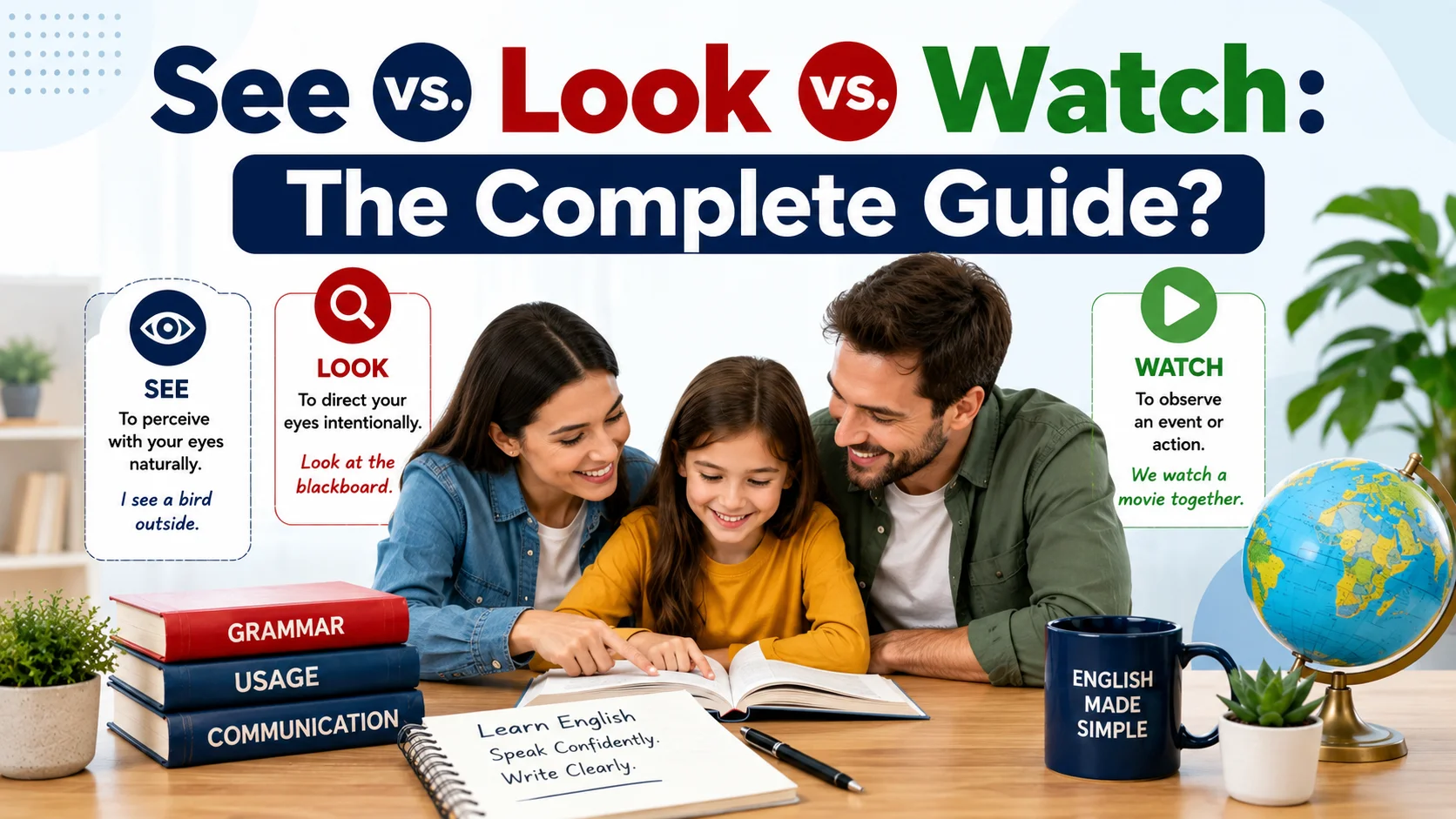
“See” vs. “Look” vs. “Watch” can confuse English learners because all three verbs relate to vision, but they show different levels of intent and attention. See means noticing something, look means directing your eyes toward something, and watch means observing something for a period of time. For example, you may see a bird, look at it, and watch it fly.
The easiest way to remember the difference is through intent and duration. You see something without necessarily trying, look at something intentionally, and watch something as it moves or changes. For example, you might see a car, look at its color, or watch it drive away. These simple patterns can help you use the verbs naturally in everyday English.
Context also matters when choosing the right verb. See focuses on noticing, look focuses on directing your eyes, and watch focuses on continued observation. Compare “I saw a dog,” “I looked at the dog,” and “I watched the dog.” Understanding this small distinction can improve your fluency, accuracy, and confidence in everyday communication.
See vs. Look vs. Watch at a Glance
| Verb | Main idea | Intention | Typical duration | Example |
| See | Notice or perceive something | Usually not deliberate | Often brief | “I saw a bird.” |
| Look | Direct your eyes toward something | Deliberate | Brief or extended | “Look at the bird.” |
| Watch | Observe something carefully | Deliberate | Usually longer | “We watched the bird.” |
What Does “See” Mean?
See as Visual Perception
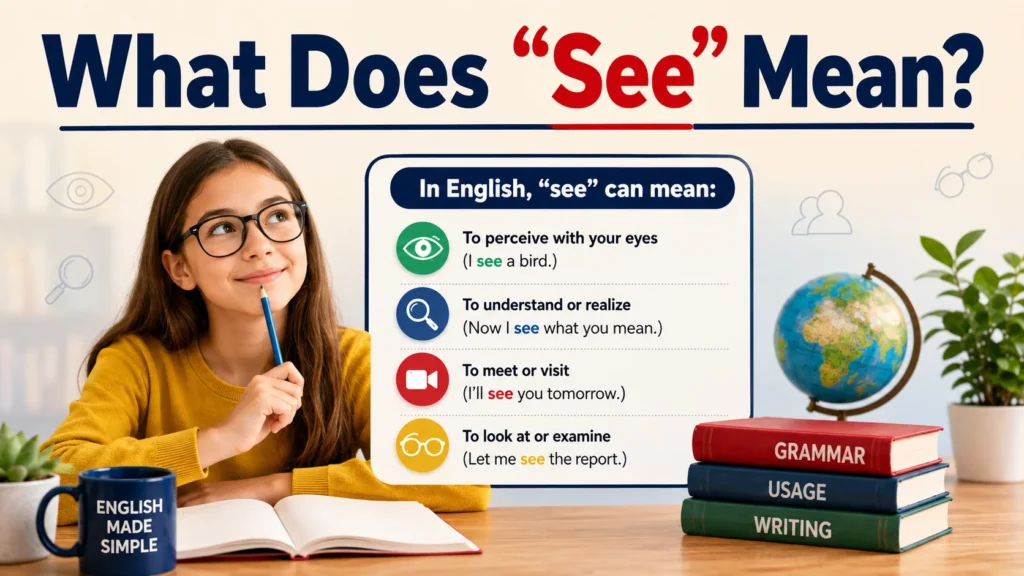
See usually describes the ability to perceive something with your eyes or notice something visually.
You don’t necessarily make a conscious decision to see it.
For example:
- “I see a car outside.”
- “Did you see that bird?”
- “I saw someone near the door.”
- “Can you see the mountains?”
- “She saw a strange light in the distance.”
Suppose you open your curtains in the morning. Several birds are sitting on a wall.
You might say:
“I opened the curtains and saw some birds.”
You didn’t need to search for them. They simply appeared within your visual field.
That’s the central idea behind see.
Cambridge Dictionary defines this use of see as noticing something with your eyes.
See Something Without Intending To
English often uses see when something becomes visible unexpectedly.
Imagine you’re walking down a street. Suddenly, you notice an old friend across the road.
You could say:
“I saw Michael across the street.”
The sentence doesn’t tell us that you deliberately searched for Michael.
You simply noticed him.
Compare that with:
“I looked at Michael.”
Now you’re describing a deliberate act. You directed your eyes toward him.
This distinction becomes clearer in everyday situations:
“I saw a dog in the park.”
You noticed it.
“I looked at the dog.”
You intentionally directed your attention toward it.
“I watched the dog.”
You stayed focused on it and observed what it did.
See Does Not Always Mean a Very Short Glimpse
A common learning shortcut says that see means a quick glance while watch means a long period of time.
That explanation helps beginners, but it’s incomplete.
See can describe an entire experience or event without emphasizing the viewing process.
For example:
“We saw a great movie last night.”
The sentence doesn’t necessarily mean you only looked at the screen for a few seconds. It describes the movie as an experience.
Likewise:
“I saw the entire ceremony.”
The speaker may have been there for hours.
The key distinction is focus, not simply the number of seconds involved.
Other Meanings of “See”
The verb see has several important meanings beyond physical vision.
See Meaning “Understand”
English speakers frequently use see to mean understand.
For example:
- “I see what you mean.”
- “Now I see the problem.”
- “Do you see my point?”
- “I see why you’re concerned.”
Nothing necessarily involves eyesight.
Instead, see describes mental recognition.
When someone explains a complicated idea and you finally understand it, you might simply respond:
“Oh, I see.”
That tiny phrase carries a useful conversational meaning: I understand now.
See Meaning “Meet”
See can also mean meet or spend time with someone.
For example:
“I’m seeing my doctor tomorrow.”
This doesn’t mean you’re simply going to look at your doctor.
It means you have an appointment or meeting.
You might also say:
“I’m seeing my friends tonight.”
Here, see means meet or spend time with them.
This meaning appears frequently in everyday American English.
See Meaning “Experience” or “Attend”
You can use see when talking about movies, plays, performances, exhibitions, and similar experiences.
Examples include:
- “We saw a movie last weekend.”
- “I saw a Broadway show.”
- “They saw a live performance.”
- “Did you see the new exhibit?”
This is particularly important when discussing entertainment in a theater or another public venue.
Cambridge notes that see is commonly used for films and public performances, while watch is natural for television viewing and similar situations.
What Does “Look” Mean?
Look as a Deliberate Action
Look usually means intentionally directing your eyes toward something.
You decide where to place your visual attention.
For example:
“Look at the sky.”
The speaker isn’t necessarily telling you that the sky has suddenly become visible. The speaker is asking you to direct your eyes toward it.
More examples include:
- “Look at this picture.”
- “Look at me.”
- “She looked at the clock.”
- “He looked at the map.”
- “We looked at the painting.”
This makes look more active than see.
BBC Learning English describes this as intentional visual attention.
Look At Someone or Something
One grammar rule deserves special attention.
When look has a direct object, you normally use at.
The basic pattern is:
look + at + object
Correct:
“Look at the picture.”
Correct:
“She looked at me.”
Correct:
“We looked at the house.”
Incorrect:
“Look the picture.”
Cambridge specifically identifies this as a common learner error.
Look Into Means Investigate
Look into has a figurative meaning.
It means investigate or examine a matter.
For example:
“The manager will look into the complaint.”
The manager isn’t necessarily staring at a complaint on paper.
Instead, the manager will investigate what happened.
Other useful expressions include:
- look after = take care of
- look around = examine your surroundings
- look through = examine something
- look up = search for information
- look out = be careful
These expressions show how flexible look can be.
Other Meanings of “Look”
Look Meaning “Appear”
Look can describe appearance rather than eye movement.
For example:
- “You look tired.”
- “She looks happy.”
- “That looks expensive.”
- “The food looks delicious.”
- “It looks like rain.”
In these sentences, look means something like appear.
Consider:
“You look tired.”
You’re not saying the person intentionally directed their eyes toward tiredness.
You’re describing what their appearance suggests.
Look as a Command
Look! can also direct another person’s attention.
For example:
“Look! There’s a rainbow.”
Or:
“Look at this!”
The speaker wants the listener to stop and focus on something.
That’s why look appears so often in conversations when someone wants to point something out.
What Does “Watch” Mean?
Watch as Sustained Visual Attention
Watch usually means looking at something carefully for a period of time.
That’s the biggest difference between look and watch.
Consider:
“Look at the children.”
You’re directing someone’s eyes toward them.
Now compare:
“Watch the children.”
This can mean keep observing them.
The second sentence may also suggest responsibility.
For example, a parent might say:
“Watch the kids while I make dinner.”
The parent expects you to continue paying attention.
Cambridge explains that watch commonly involves looking at something for a period of time, especially when the subject is moving or changing.
Watch Things That Move or Change
Watch commonly describes things that develop over time.
You can watch:
- a soccer game
- a movie
- a bird flying
- children playing
- traffic moving
- a sunset
- an experiment
- someone dancing
- a pot boiling
For example:
“We watched the children play in the yard.”
You aren’t merely noticing the children.
You’re observing their activity.
Likewise:
“She watched the rain fall.”
The focus is on continuing to observe the rain.
Watch Can Mean Monitor
Watch can also mean monitor something carefully.
For example:
“Watch the baby.”
This doesn’t necessarily mean stare continuously at the baby.
It means keep an eye on the baby and pay attention to what happens.
Similarly:
“Watch your step.”
This means be careful about where you place your feet.
And:
“Watch the road.”
This tells a driver to maintain careful attention to road conditions.
Common Uses of Watch
Watch TV, Movies, Sports, and Videos
Watch is extremely common with television and screen-based entertainment.
Examples:
- “I watch TV every evening.”
- “We watched a movie last night.”
- “She watches videos online.”
- “They watched the football game.”
English learners sometimes wonder why we say watch TV rather than see TV.
The reason is that television viewing usually involves sustained attention.
You sit down and watch a program.
You don’t simply notice the television.
Watch Someone Do Something
English has two useful structures after watch.
The first is:
watch + object + base verb
“I watched him cross the street.”
The second is:
watch + object + -ing
“I watched him crossing the street.”
The difference can depend on context and emphasis.
The base form can present the action more completely as an event.
The -ing form emphasizes the action as it unfolds.
For example:
“We watched the players score three goals.”
This can present the scoring events as completed actions.
Meanwhile:
“We watched the players warming up.”
The focus is clearly on an activity in progress.
Watch Out and Watch For
Two common expressions deserve separate attention.
Watch out means be careful.
“Watch out! The car is coming.”
Watch for means remain alert for something expected.
“Watch for the next exit.”
You might tell a passenger:
“Watch for a blue sign.”
You’re not asking them to search randomly.
You’re asking them to stay alert until the expected sign appears.
Conclusion
Understanding the difference between see, look, and watch becomes much easier when you focus on intent and attention. See means noticing something with your eyes, often without making a deliberate effort. Look means intentionally directing your eyes toward someone or something. Watch means observing something for a period of time, especially when it moves, changes, or continues to develop.
Think of these verbs as three stages of visual attention. You might see a bird in a tree, look at the bird to notice its colors, and watch the bird fly away. Once you understand this pattern, choosing the right verb becomes much more natural.
Remember the simple rule: see = notice, look = direct your eyes, watch = observe over time. With regular practice and attention to context, you’ll use all three verbs confidently in everyday English.
FAQs
What is the main difference between see, look, and watch?
See means to notice something with your eyes. Look means to intentionally direct your eyes toward something. Watch means to observe something continuously or for a period of time.
Is see intentional?
Usually, see describes something you notice without deliberately trying to notice it. For example, “I saw a bird outside my window” simply means the bird came into your visual awareness.
Does look always need a preposition?
When look is followed by an object, you usually need at. For example, say “Look at the picture”, not “Look the picture.” However, look can also appear without an object, as in “Look!”
What preposition is used with look?
The most common preposition is at when you mean directing your eyes toward something. For example, “She looked at the painting.” Other expressions, such as look for, look after, and look into, have different meanings.
When should you use watch instead of look?
Use watch when you focus on something for a period of time. For example, you watch a movie, watch a game, or watch a child play. The idea of continued attention is important.
Can you use see and watch for the same thing?
Sometimes, but they don’t express exactly the same idea. “I saw a movie” usually means you experienced or viewed the movie, while “I watched a movie” emphasizes the activity of viewing it for a period of time.
What is an easy way to remember see, look, and watch?
Remember this simple pattern: see = notice, look = direct your eyes, watch = observe over time. For example, you can see a dog, look at the dog, and watch the dog run.
About The Author


1 thought on “See vs. Look vs. Watch: The Complete Guide?”