
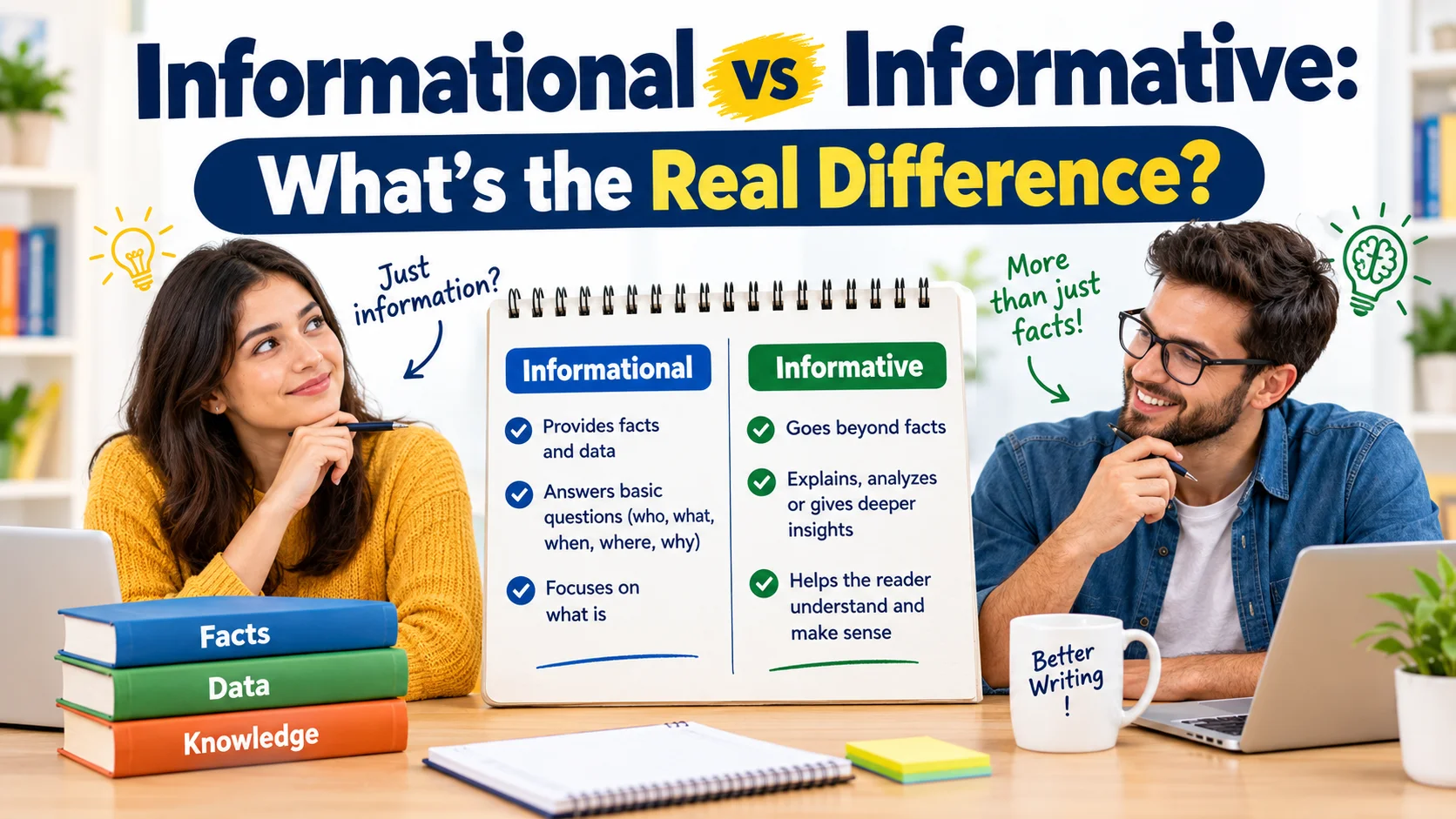
“Informational” vs. “informative” may seem similar, but both words have different uses when describing content, writing, or material that provides useful information and knowledge.
Informational describes something that provides or contains information, while informative describes something that gives useful knowledge and helps readers understand a subject better. Both terms appear in educational and professional writing.
The main difference depends on context and emphasis. An informational brochure provides information, while an informative brochure offers useful or educational content. Choosing the right word improves clarity, accuracy, and communication.
Informational vs. Informative at a Glance
| Informational | Informative |
| Relates to or provides information | Provides useful information or knowledge |
| Often describes the nature or purpose of something | Often describes how useful something is |
| Common with resources, documents, brochures, and pages | Common with books, articles, talks, lectures, and presentations |
| Focuses on information being provided | Focuses on what the audience learns |
| Can describe something designed to communicate facts | Often suggests that the information is valuable or instructive |
Neither word is automatically wrong when the meanings overlap. The right choice depends on what you want to emphasize.
What Does “Informational” Mean?
Informational Definition
“Informational” is an adjective connected directly to information. It generally means containing information or relating to the provision of information.
Think of it as a word that describes the information-related function or nature of something.
An informational brochure, for instance, is a brochure created to provide details. An informational website provides information about a particular subject, organization, service, or topic.
Cambridge Dictionary defines “informational” as “containing information” and also gives the broader sense of something relating to or providing information.
Informational in Simple Words
In everyday English, you can think of informational as meaning:
“This is about giving or providing information.”
The word doesn’t necessarily tell you how useful, detailed, entertaining, or easy to understand that information is.
Consider these examples:
- The museum has several informational brochures.
- We received an informational packet before the event.
- The company created an informational website for new customers.
- The hospital provided informational material about the procedure.
In each sentence, informational identifies the material as something connected with providing information.
Common Collocations With Informational
Some combinations sound especially natural:
- informational brochure
- informational guide
- informational document
- informational material
- informational website
- informational page
- informational resources
- informational meeting
- informational packet
- informational video
Notice the pattern. “Informational” frequently appears before a noun to classify the type or purpose of a resource.
What Does “Informative” Mean?
Informative Definition
“Informative” means providing useful information, knowledge, or ideas.
This word often carries an extra sense of value. Something informative doesn’t merely give you facts. It gives you information that helps you understand something better.
Cambridge Dictionary defines “informative” as providing a lot of useful information. Its American Dictionary definition also describes something informative as providing useful knowledge or ideas.
Informative in Simple Words
A simple way to understand information is
“This taught me something useful.”
For example:
- The lecture was informative.
- I watched an informative documentary about space.
- Her presentation was short but informative.
- That article is surprisingly informative.
Here, the speaker isn’t simply saying that information existed. The speaker is commenting on the value of that information.
That’s the important distinction.
Common Collocations With Informative
You commonly see information with things such as
- informative article
- informative book
- informative lecture
- informative presentation
- informative speech
- informative discussion
- informative documentary
- informative interview
- informative explanation
- informative review
These expressions often describe something that gives the audience useful knowledge.
Informational vs Informative: The Main Difference
The biggest difference between informational and informative is the emphasis.
“Informational” tends to describe something in relation to information itself. Informative tends to highlight the usefulness or educational value of that information.
Compare these sentences:
The company created an informational brochure.
This tells you what the brochure does. It provides information.
The company created an informative brochure.
This suggests that the brochure gives readers useful or helpful information.
Both sentences can be correct. The second one places more emphasis on the reader’s experience.
Informational Focuses on Information
When you use “informational,” you’re often classifying something as information-related.
For example:
The website contains informational resources for new employees.
The phrase tells readers what kind of resources they will find.
Informative Focuses on Useful Knowledge
When you use “informative,” you’re often describing the quality or usefulness of the information.
For example:
The training session was informative and practical.
The speaker isn’t merely saying that the session contained facts. The session gave participants useful knowledge.
The Same Thing Can Be Both
Here’s where the distinction gets interesting.
A single article can be informational and informative at the same time.
Suppose an article explains how credit scores work. It is informational because it provides information about credit scores. It is informative if that information helps readers understand the subject and make sense of unfamiliar concepts.
So don’t treat these words like two teams competing for the same trophy.
They can comfortably coexist.
Informational vs. Informative Examples
Real examples make this distinction much easier to see.
Website
Informational website:
The site provides facts, details, instructions, or background information.
Informative website:
The site gives visitors useful knowledge and helps them understand the subject.
For example:
The government launched an informational website about the new program.
Here, the focus is on the website’s information-providing purpose.
The website contains an informative guide for first-time applicants.
Here, the guide’s usefulness matters more.
Article
The informational article emphasizes that the article provides information.
The informative article emphasizes that the article provides useful knowledge.
For example:
I found an informative article explaining how electric vehicles work.
The natural implication is that the article helped the reader understand the topic.
Brochure
A brochure can be described in either way:
The hotel gave guests an informational brochure.
This simply identifies the brochure as information-providing material.
The hotel gave us an informative brochure about local attractions.
Now the emphasis shifts toward the useful details inside it.
Presentation
Consider:
The manager prepared an informational presentation about the company’s new policy.
The presentation provides information about the policy.
Now compare:
The manager gave an informative presentation about the company’s new policy.
This suggests that employees learned something useful from the presentation.
Informational vs. Informative in Real Sentences
| Example | Main emphasis |
| The school distributed an informational packet. | The packet provides information. |
| The teacher gave an informative lecture. | Students gained useful knowledge. |
| We visited an informational website. | The website contains relevant information. |
| We watched an informative documentary. | The documentary taught us something useful. |
| The company published informational material. | The material provides company information. |
| The training session was informative. | The session increased understanding. |
The difference becomes clearer when you ask one simple question:
Am I describing what something provides, or am I emphasizing how useful the information is?
That question often points you toward the natural choice.
When Should You Use “Informational”?
Use “informational” when you want to describe something as related to information or designed to provide it.
It works especially well for:
- documents
- brochures
- websites
- guides
- resources
- packets
- materials
- pages
- meetings
For example:
The library offers several informational resources for students.
Here, informational classes classify the resources according to their purpose.
Another example:
The company held an informational meeting for new employees.
The meeting’s purpose was to provide information.
Informational Doesn’t Automatically Mean Useful
This point matters.
Something can contain information without being particularly helpful.
A ten-page document filled with technical data is certainly informational. However, it might be confusing, poorly organized, or difficult for ordinary readers to use.
Therefore, “informational” does not automatically mean “excellent,” “useful,” “clear,” or “educational.”
When Should You Use “Informative”?
Choose informative when you want to stress that something gives useful knowledge or helps someone understand a subject.
It works naturally with:
- books
- articles
- lectures
- presentations
- speeches
- documentaries
- discussions
- interviews
- explanations
For example:
The professor gave an informative lecture on climate science.
The important idea is that students gained useful knowledge from the lecture.
Similarly:
Her explanation was clear and informative.
Here, informative evaluates what the explanation accomplished for the listener.
Can “Informational” and “Informative” Be Used Interchangeably?
Sometimes, but not in every situation.
The two adjectives overlap enough that replacing one with the other may not create a serious grammatical problem. However, the resulting sentence can sound less natural or change the emphasis.
For example:
The article was informative.
This is a very natural way to praise an article for its useful information.
Compare:
The article was informational.
This is possible in some contexts, but it doesn’t carry the same natural evaluative sense. It sounds more like you’re classifying the article according to its information-related nature.
The difference is subtle rather than absolute.
A Simple Memory Trick
Remember this:
Informational = information-related or information-providing.
Informative = useful information that helps you learn or understand.
That two-part rule handles most everyday situations.
Common Mistakes With Informational and Informative
Treating Them as Exact Synonyms
Although their meanings overlap, they aren’t always interchangeable in emphasis.
Instead of memorizing a rigid rule, consider what the sentence actually means.
Assuming Informational Means “Detailed”
It doesn’t.
An informational document might contain one page of basic facts or dozens of pages of technical material.
The word describes its relationship to information, not its length.
Assuming Informative Always Means “Educational”
Informative often has an educational quality, but it doesn’t require a classroom.
A conversation, documentary, interview, article, or tour can all be informative.
Choosing Without Considering Context
Context often determines which word sounds more natural.
Compare:
- informational brochure
- informative lecture
- informational resources
- informative discussion
These combinations aren’t unbreakable rules. They’re common patterns that reflect how English speakers normally use the words.
Informational vs. Informative: Which One Should You Choose?
Use this quick guide when you’re stuck:
| If you mean… | Choose |
| Related to information | Informational |
| Designed to provide information | Informational |
| Containing information | Informational |
| Providing useful knowledge | Informative |
| Helping someone understand | Informative |
| Giving useful facts or ideas | Informative |
| Describing something as educational or instructive | Informative |
A useful test is to replace the adjective mentally.
If you mean “information-related,” “informational” will often fit.
If you mean “useful and knowledge-giving,” informative will usually sound better.
Conclusion
Informational and informative are closely related, but they don’t always carry the same emphasis. “Informational” usually refers to something that provides or contains information, while “informative” focuses more on giving useful knowledge or improving understanding. Knowing this small difference can help you choose the right word and make your English writing clearer.
FAQs
Q.1 What is the difference between informational and informative?
Informational describes something related to or providing information, while informative describes something that provides useful knowledge or understanding.
Q.2 Is “informational” a correct English word?
Yes, “informational” is a standard English adjective. It commonly describes content, material, websites, resources, or documents that provide information.
Q.3 Is “informative” better than “informational”?
Neither word is always better. The correct choice depends on the meaning and context of your sentence.
Q.4 Can I use “informational” and “informative” interchangeably?
Sometimes they can overlap, but they aren’t always interchangeable. Informative often emphasizes how useful or educational something is, while informational focuses on its connection to information.
Q.5 What is an example of informational and informative?
An informational brochure provides information about a topic. An informative article gives readers useful knowledge and helps them understand the subject.
About The Author


Hi,
Is your website getting the search visibility it deserves?
With RankFlow-AI, you can get a free SEO & AEO audit of your website and quickly identify what’s holding back your online visibility.
RankFlow-AI helps you:grammarinform.com
Identify SEO & AEO issues
Track keyword performance
Monitor your search visibility
Automate routine SEO tasks
Spend just 5–10 minutes a day reviewing your progress while RankFlow-AI handles the ongoing work in the background.
Create your free account and run your audit today: http://www.RankFlow-AI.Com
RankFlow-AI