
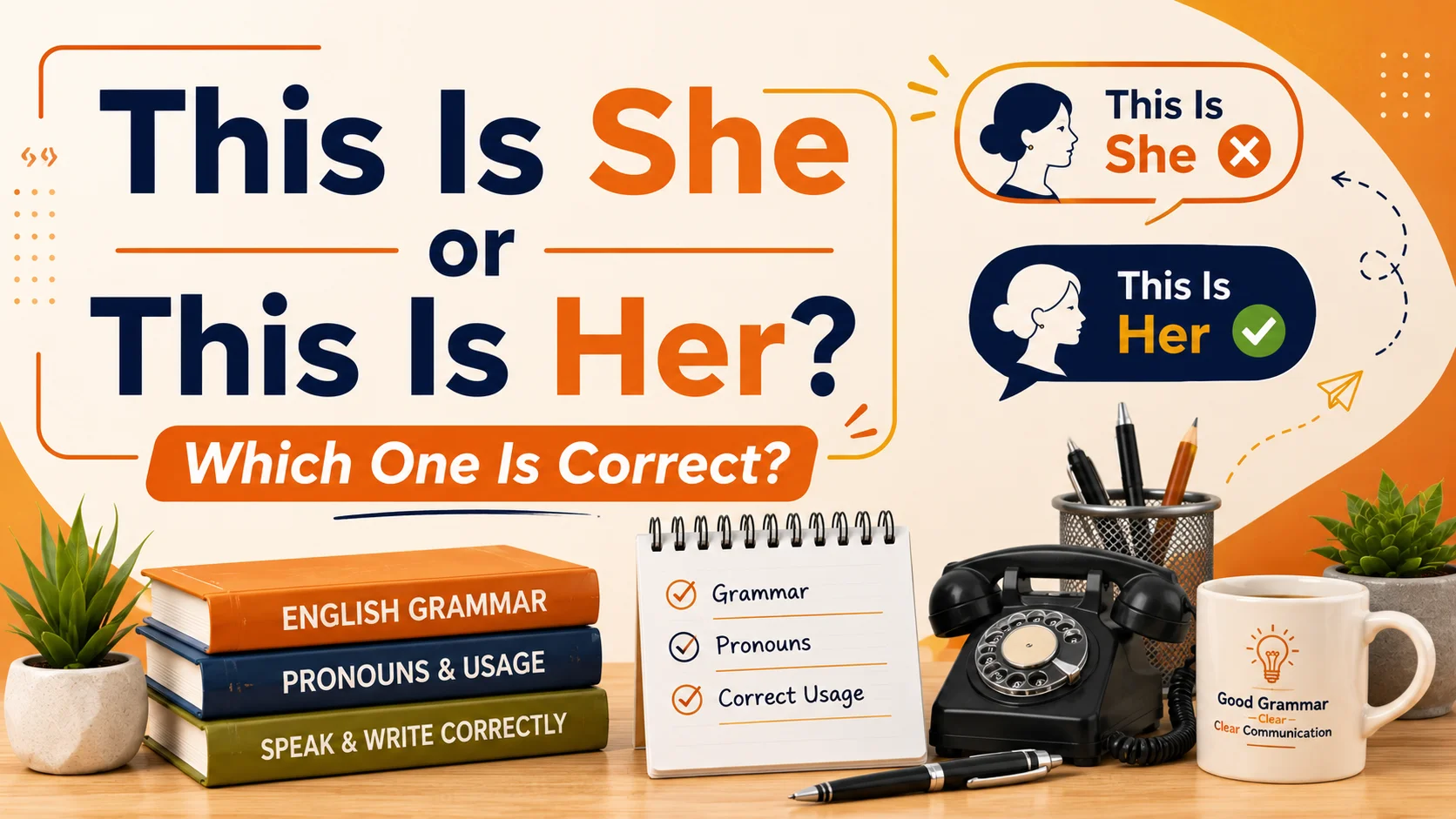
This Is She or This Is Her often seems like a tiny grammar choice, yet it reveals how English grammar changes between formal rules and real conversation every day. From helping English learners, I’ve noticed that this topic creates more questions than many other grammar points because both expressions sound correct in different situations. Traditional grammar books, grammar guides.
Daily conversations follow a different path. During everyday conversation, everyday communication, everyday speech, and everyday life, most native speakers, English speakers, and even millions of native speakers naturally prefer This Is Her. That shift reflects language evolution, language evolves, evolving language, and modern English usage.
Looking at the bigger picture makes the difference much easier to understand. The English language, language, English usage, language usage, practical usage, traditional usage, and practical communication continue to change as people shape the way they speak and write. While learning English, many learners first rely on textbooks, then discover that real conversations often favor businesslike language, shorthand, and a short answer.
The Short Answer: Is It “This Is She” or “This Is Her”?
If you’re looking for the quickest answer, here it is.
| Situation | Best Choice |
| Formal business calls | This is she. |
| Job interviews | This is she. |
| Customer service | Either works, though This is she sounds more formal. |
| Friends and family | This is her. |
| Everyday conversations | This is her. |
| Modern spoken English | This is her is far more common. |
Here’s the key point:
- “This is she” follows traditional grammar rules.
- “This is her” reflects how most native English speakers actually talk today.
Neither phrase will confuse your listener. Instead, the difference lies in formality, style, and context rather than meaning.
For example:
Formal phone call
Caller: May I speak with Sarah?
You: This is she.
Casual phone call
Caller: Is Emma there?
You: This is her.
Both conversations sound perfectly natural within their own settings.
If you’re still unsure, don’t worry. The grammar behind these expressions is much simpler than many people think.
Why People Get Confused About “This Is She” vs. “This Is Her”
At first glance, the debate seems strange.
After all, most people would never say:
This is I.
Instead, they’d naturally say:
This is me.
That instinct makes many English learners wonder why anyone says:
This is she.
The confusion comes from the fact that English grammar and everyday speech don’t always follow the same path.
Traditional grammar developed under strong influence from Latin. Early grammarians believed that the pronoun after the verb to be should match the subject of the sentence.
For example:
- It is I.
- This is he.
- This is she.
From a grammatical standpoint, these pronouns identify the subject rather than receive the action.
However, spoken English gradually evolved.
Native speakers began treating expressions like “It’s me,” “That’s him,” and “This is her” as natural conversation. Over time, these versions became far more common than their formal counterparts.
Today, this creates two competing standards:
| Traditional Grammar | Everyday English |
| This is she. | This is her. |
| It is I. | It’s me. |
| That was he. | That was him. |
Neither side is completely wrong. They simply represent different approaches to English.
Why Both Forms Sound Correct
Most grammar disagreements involve obvious mistakes.
This one doesn’t.
Both expressions communicate exactly the same idea:
“The person you’re asking for is speaking.”
The difference lies in grammar convention, not meaning.
That’s why you’ll hear educated speakers confidently use either version depending on the situation.
Why Native Speakers Prefer “This Is Her”
Language changes because people naturally simplify communication.
Instead of carefully analyzing pronoun cases during every conversation, speakers choose what feels comfortable.
That’s why these expressions dominate everyday English:
- It’s me.
- That’s him.
- This is her.
These phrases sound smooth because they’re the versions people hear throughout childhood.
Grammar rules may explain language, but daily conversation shapes how language evolves.
Why This Debate Has Lasted So Long
Unlike many grammar questions, this one hasn’t completely disappeared because both forms continue to exist.
Schools often teach the traditional rule.
Movies, television, podcasts, customer service calls, and casual conversations usually reflect modern speech.
As a result, English learners receive mixed messages.
One teacher says:
“This is she.”
Another native speaker says:
“Nobody actually talks like that.”
The truth sits comfortably between those opinions.
Is “This Is She” Grammatically Correct?
Yes.
According to traditional English grammar, “This is she” is grammatically correct.
Understanding why requires only one important grammar concept: linking verbs.
How Linking Verbs Work in English
Most verbs describe actions.
For example:
- She writes.
- He runs.
- They study.
The verb to be works differently.
Instead of showing action, it connects two parts of a sentence.
For example:
- Sarah is the manager.
- James is my brother.
- This is she.
Notice what happens.
The verb is doesn’t perform an action. Instead, it links two names or identities together.
Because of this relationship, traditional grammar treats both sides of the sentence as referring to the same subject.
Why Traditional Grammar Prefers Subject Pronouns
English has two common pronoun forms.
| Subject Pronouns | Object Pronouns |
| I | Me |
| He | Him |
| She | Her |
| We | Us |
| They | Them |
Subject pronouns normally perform the action.
Examples:
- She answered the phone.
- He called yesterday.
- They arrived early.
Object pronouns receive the action.
Examples:
- Call her.
- I saw him.
- They invited us.
Traditional grammar argues that after a linking verb like is, the pronoun doesn’t receive any action.
Instead, it identifies the subject.
Therefore:
- This is she.
- That was he.
- It is I.
This explanation follows the same grammatical principle taught in many formal grammar textbooks.
Why Grammar Books Still Teach “This Is She”
Many educational grammar references continue teaching this rule because it preserves consistency.
Consider these examples.
Correct according to traditional grammar
- This is she.
- It is I.
- That was he.
These forms reflect the historical grammatical structure of English.
Although they may sound formal today, they remain grammatically defensible.
Some situations still favor this level of precision, especially:
- Academic writing about grammar
- Formal language instruction
- Certain legal or ceremonial contexts
- Traditional etiquette guides
Examples of Correct Formal Usage
Imagine receiving a call from a recruiter.
Caller: May I speak with Jennifer Collins?
A polished reply would be:
This is she.
Or during a professional conference:
Caller: Is this Dr. Parker?
Response:
Yes, this is she.
These responses sound courteous, confident, and professional.
While many people would answer differently, no grammar expert would criticize this usage.
Why “This Is She” Sounds Formal Today
Language doesn’t stand still.
Many expressions that once appeared in ordinary conversation now sound formal because everyday speech has changed.
Consider these older expressions:
- Whom shall I say is calling?
- To whom may I speak?
- It is I.
They’re still grammatically correct.
However, most people naturally replace them with simpler alternatives.
The same shift has affected “This is she.”
Modern speakers understand it immediately. Yet many associate it with:
- Professional phone etiquette
- Older business practices
- Formal customer service
- Traditional grammar instruction
That doesn’t make it outdated.
It simply places it on the more formal end of today’s English.
Is “This Is Her” Also Correct?
Surprisingly, yes.
Although traditional grammar prefers “This is she,” modern English widely accepts “This is her.” In fact, it’s the version you’ll hear most often in everyday conversation across the United States.
This isn’t a case of people speaking incorrectly. Instead, it’s an example of how English naturally evolves over time.
Why Most Native Speakers Say “This Is Her”
Language follows usage.
When millions of fluent speakers consistently choose one expression, that expression gradually becomes part of standard English.
That’s exactly what happened here.
Imagine these phone conversations.
Caller: Hi, may I speak with Rachel?
Most people instinctively reply:
This is her.
They don’t stop to think about pronoun cases or linking verbs. They simply use the phrase that feels most natural.
Over time, repeated use has made “This is her” the dominant form in casual spoken English.
Descriptive Grammar vs. Prescriptive Grammar
To understand why both forms are accepted today, it helps to know the difference between two approaches to grammar.
| Prescriptive Grammar | Descriptive Grammar |
| Focuses on traditional rules | Focuses on real-world usage |
| Defines how people should write or speak | Describes how people actually communicate |
| Often taught in schools | Based on observation of native speakers |
| Prefers “This is she.” | Accepts “This is her.” |
Neither approach is inherently better.
Prescriptive grammar preserves consistency and teaches established rules.
Descriptive grammar recognizes that language changes as speakers adopt new patterns.
Modern English relies on both perspectives.
Why Modern References Accept “This Is Her”
Many modern dictionaries, usage guides, and linguists acknowledge that “This is her” has become standard in everyday speech.
The reason is simple.
Its meaning is clear. Native speakers understand it instantly. It creates no ambiguity.
As a result, many contemporary style experts no longer consider it a serious grammatical error in conversation.
Instead, they describe it as standard informal English.
Everyday Examples
Here are situations where “This is her” sounds completely natural.
Friend calling
Caller: Is Jessica home?
You: This is her.
Coworker calling
Caller: Can I speak with Emily?
You: This is her.
Family member calling
Caller: Is Mom there?
You: This is her.
In each example, the conversation feels relaxed and natural.
Few native speakers would notice anything unusual.
Does Saying “This Is Her” Sound Unprofessional?
Not necessarily.
Many professionals use “This is her” without any negative consequences.
However, if you’re answering:
- a job interview call,
- an executive meeting,
- a legal consultation, or
- a highly formal business call,
“This is she” may project a slightly more polished and traditional tone.
The difference is subtle, though. In most workplaces today, listeners care far more about your clarity, confidence, and courtesy than which pronoun you choose.
“This Is She” vs. “This Is Her”: Side-by-Side Comparison
The easiest way to remember the difference is to compare the two expressions directly.
| Feature | This Is She | This Is Her |
| Traditional grammar | Preferred | Accepted in modern usage |
| Everyday conversation | Less common | Very common |
| Formality | High | Neutral to casual |
| Naturalness for most speakers | Moderate | High |
| Job interviews | Excellent choice | Acceptable |
| Business calls | Excellent choice | Commonly used |
| Friends and family | Unusual | Most natural |
| Customer service | Common in formal settings | Very common |
| Modern spoken English | Less frequent | Dominant |
| Meaning | Identifies the speaker | Identifies the speaker |
The most important takeaway is this:
Both phrases communicate the same message. The real difference lies in the impression they create. “This is she” aligns with traditional grammar and sounds more formal, while “This is her” reflects modern spoken English and feels more relaxed.
When to Use “This Is She”
Although “This is her” dominates everyday speech, “This is she” still has an important place in modern English. It signals professionalism, attention to detail, and a more formal communication style. While you don’t need to use it in every conversation, certain situations make it the better choice.
Job Interviews
When a recruiter or hiring manager calls, first impressions matter. Your words, tone, and confidence all contribute to how professional you sound.
Imagine your phone rings.
Caller: May I speak with Olivia Thompson?
A polished response would be:
You: This is she.
This response sounds courteous without feeling unnatural. It also demonstrates that you’re comfortable using formal English when the situation calls for it.
That said, if you respond with “This is her,” very few recruiters would view it negatively. Your confidence, clarity, and professionalism matter far more than the pronoun you choose.
Business and Professional Calls
Formal business conversations often follow established etiquette.
These include:
- Speaking with executives
- Calling government offices
- Talking to attorneys
- Communicating with clients
- Discussing contracts
- Answering official workplace calls
In these settings, “This is she” fits naturally because the conversation already has a formal tone.
For example:
Caller: May I speak with Ms. Martinez?
You: This is she. How may I help you?
The response is concise, professional, and respectful.
Customer Service Interactions
Many customer service professionals receive communication training that emphasizes clear and courteous language.
Some organizations encourage representatives to answer:
This is she.
Others simply recommend confirming identity politely.
For example:
This is she. How can I assist you today?
or
Yes, this is she speaking.
Both responses work well because they immediately reassure the caller that they’ve reached the right person.
Formal Introductions
Occasionally, you’ll introduce yourself during conference calls, webinars, or professional meetings.
Examples include:
- Legal consultations
- Academic conferences
- Healthcare appointments
- Corporate meetings
In these situations, “This is she” aligns with the overall level of formality.
Situations Where Precision Matters
Certain professions value precise language.
These include:
- Law
- Education
- Public administration
- Corporate communications
- Academic publishing
Although no one will reject “This is her,” many professionals still prefer the traditional grammatical form during official communication.
Quick Reference
| Situation | Recommended Response |
| Job interview | This is she. |
| Business client | This is she. |
| Government office | This is she. |
| Attorney call | This is she. |
| Academic conference | This is she. |
| Official workplace communication | This is she. |
When to Use “This Is Her”
Most conversations aren’t formal.
They’re quick, relaxed, and conversational. That’s where “This is her” shines.
Conversations With Friends and Family
Nobody expects formal grammar when talking with people they know.
For example:
Caller: Is Megan there?
You: This is her.
The conversation feels effortless because that’s how most native speakers naturally respond.
Casual Workplace Calls
Modern offices tend to favor approachable communication over rigid formality.
If a coworker calls and asks:
Can I speak with Daniel?
Replying with
This is her.
or
This is him.
sounds perfectly normal.
Many employees never think about the grammar because the expression has become standard spoken English.
Everyday Phone Conversations
Whether you’re answering calls from:
- Delivery drivers
- Neighbors
- Friends
- Family members
- Service providers
“This is her” sounds completely natural.
It doesn’t distract from the conversation because it’s what listeners expect to hear.
When Sounding Natural Matters
Communication isn’t just about grammar.
It’s also about making other people feel comfortable.
Sometimes sounding relaxed creates a stronger connection than sounding formal.
For example:
Imagine your best friend calls.
Friend: Is Emma home?
Compare the responses.
Option A
This is she.
Option B
This is her.
Most people would instinctively choose Option B because it matches the informal tone of the conversation.
Quick Reference
| Situation | Recommended Response |
| Friend calling | This is her. |
| Family member | This is her. |
| Neighbor | This is her. |
| Casual coworker | This is her. |
| Everyday conversations | This is her. |
Why English Allows Both Forms Today
Many people assume grammar never changes.
History tells a different story.
English has evolved continuously for more than a thousand years. Vocabulary, pronunciation, spelling, and grammar have all shifted over time. The debate over “This is she” and “This is her” is simply another example of that evolution.
How English Grammar Has Changed
Centuries ago, English used pronoun cases much more consistently.
Over time, spoken language became simpler.
Consider these examples.
| Traditional English | Modern English |
| It is I. | It’s me. |
| Between you and I (incorrect but common) | Between you and me. |
| This is she. | This is her. |
Not every change becomes accepted, but many do after generations of consistent use.
Spoken English Shapes Grammar
Most people learn their first language by listening, not by reading grammar books.
Children hear thousands of conversations before they ever study sentence structure.
As a result, expressions that sound smooth often become the standard.
That’s one reason “This is her” became so widespread.
It feels familiar because speakers hear it repeatedly throughout everyday life.
Modern English Prioritizes Clarity
Communication succeeds when listeners immediately understand the speaker.
Both expressions clearly identify the person answering the phone.
Neither creates confusion.
Because clarity remains unchanged, modern English has become more flexible about which version speakers choose.
Formal Grammar Still Matters
Language evolution doesn’t erase traditional rules.
Instead, it creates options.
Formal writing still follows stricter grammar conventions than casual conversation.
That’s why you’ll often see:
- This is she.
- It is I.
in grammar textbooks even though everyday conversations usually sound different.
The two systems now exist side by side.
Examples in Real Conversations
Seeing both expressions in context makes the difference much easier to understand.
Formal Business Call
Receptionist: May I speak with Jennifer Adams?
Jennifer: This is she.
Receptionist: Thank you for taking my call.
Interview Callback
Recruiter: Is Sophia available?
Sophia: This is she.
Recruiter: We’d like to schedule your second interview.
Customer Support Call
Representative: May I speak with Michael?
Michael: This is him.
Representative: I’m calling about your account update.
Friend Calling
Friend: Is Ashley there?
Ashley: This is her.
Friend: Great! Want to grab dinner?
Unknown Number
Caller: Hello, may I speak with Lauren?
Formal response
This is she.
Casual response
This is her.
Both responses are appropriate.
The tone simply changes.
Video Call Introduction
Virtual meetings have become part of daily work.
When joining a scheduled meeting, many professionals simply introduce themselves.
Examples:
- This is she. Thanks for inviting me.
- This is her. Good morning, everyone.
Either response sounds natural depending on the level of formality.
Common Mistakes People Make
Understanding what not to say is just as helpful.
Saying “This Is Me”
Many learners wonder whether they should answer:
This is me.
Although native speakers often say this casually, it doesn’t follow the traditional phone-answering convention.
Instead, English speakers usually say:
- This is she.
- This is her.
- Speaking.
- Yes, this is Sarah.
Assuming One Phrase Is Always Wrong
One of the biggest misconceptions is believing there’s only one correct answer.
That’s no longer true.
Modern English recognizes both forms.
Choosing the appropriate one depends on your audience and the setting.
Using the Same Response Everywhere
Context matters.
Using “This is she” while chatting with close friends may sound overly formal.
Using “This is her” during a highly formal legal consultation may sound slightly less polished.
Matching your response to the situation creates better communication.
Forgetting Phone Etiquette
Grammar is only one part of answering professionally.
A friendly tone often leaves a stronger impression than perfect grammar.
Remember to:
- Speak clearly.
- Avoid interrupting.
- Confirm your identity politely.
- Listen before responding.
- Thank the caller when appropriate.
Phone Answering Etiquette Beyond Grammar
Whether you choose “This is she” or “This is her,” good phone etiquette helps every conversation start smoothly.
Answer Professionally
Instead of saying only:
Hello?
Try:
- Hello, this is Emily.
- Good morning. This is Emily speaking.
- This is she. How may I help you?
- This is her. What can I do for you today?
Adding your name makes the conversation more efficient.
If Someone Asks for You by Name
Simple responses work best.
Examples:
- Yes, this is she.
- Yes, this is her.
- Speaking.
- Yes, this is Emily.
Each immediately confirms your identity.
If You Didn’t Hear the Caller
Don’t guess.
Instead, ask politely.
Examples:
- I’m sorry. Could you repeat that?
- Would you mind saying that again?
- I didn’t catch your name.
Clear communication prevents misunderstandings.
If Someone Mispronounces Your Name
Correct them politely.
For example:
Actually, it’s pronounced Taylor, but thank you for calling.
A calm correction keeps the conversation comfortable.
If You Need a Moment
Professional callers understand brief pauses.
You can say:
- One moment, please.
- Let me check that for you.
- May I place you on a brief hold?
These expressions sound courteous and confident.
What English Teachers, Recruiters, and Communication Experts Recommend
Experts tend to agree on one important point.
Context matters more than rigid rules.
Academic Grammar Perspective
Traditional grammar instruction continues teaching:
This is she.
It demonstrates how linking verbs connect subject complements.
Students studying grammar should understand this rule because it explains why the expression developed.
Workplace Communication Perspective
Communication coaches focus on effectiveness.
They encourage speakers to:
- Sound confident.
- Speak naturally.
- Match the level of formality.
- Communicate clearly.
Whether you choose “This is she” or “This is her,” these qualities matter much more than strict grammatical perfection.
Customer Service Best Practices
Successful customer service representatives consistently:
- Confirm identity quickly.
- Speak politely.
- Use a calm tone.
- Avoid unnecessary complexity.
- Keep conversations clear.
Notice that none of these priorities depends entirely on one pronoun.
The Practical Recommendation
If you’re unsure which phrase to use, follow this simple guide.
| Situation | Best Choice |
| Formal business | This is she. |
| Job interview | This is she. |
| Casual conversation | This is her. |
| Friends and family | This is her. |
| Mixed audience | Either works. |
When in doubt, remember this:
Your confidence, clarity, and courtesy will always leave a stronger impression than choosing between “she” and “her.”
Conclusion
Choosing between “This Is She” and “This Is Her” doesn’t have to feel complicated. Both expressions have a place in modern English, though they serve different purposes. This Is She follows traditional English grammar and remains the preferred choice in formal communication, business calls, and professional settings. This Is Her, on the other hand, reflects modern English usage and sounds more natural in everyday conversation.
FAQs
Q.1: Is “This Is She” still grammatically correct?
Yes. “This Is She” is still grammatically correct because traditional grammar treats the verb is as a linking verb, which is followed by a subject pronoun rather than an object pronoun.
Q.2: Why do most people say “This Is Her” instead?
Most native speakers use “This Is Her” because it sounds more natural in everyday speech. Over time, language evolution and modern English usage have made this expression common in casual conversations.
Q.3: Which is better for a job interview or business call?
For a job interview, professional calls, or other formal communication, “This Is She” is usually the better choice because it follows traditional grammar and creates a more polished impression.
Q.4: Can I simply answer the phone by saying “Speaking”?
Yes. “Speaking” is a short, professional, and widely accepted response when someone asks for you by name. It works well in both formal and informal phone conversations.
Q.5: Will people think I’m wrong if I say “This Is Her”?
Generally, no. In modern English, “This Is Her” is widely accepted and understood. Most listeners care more about clarity, tone, and polite communication than whether you chose the traditional or conversational form.
About The Author


1 thought on “This Is She or This Is Her? Which One Is Correct?”