
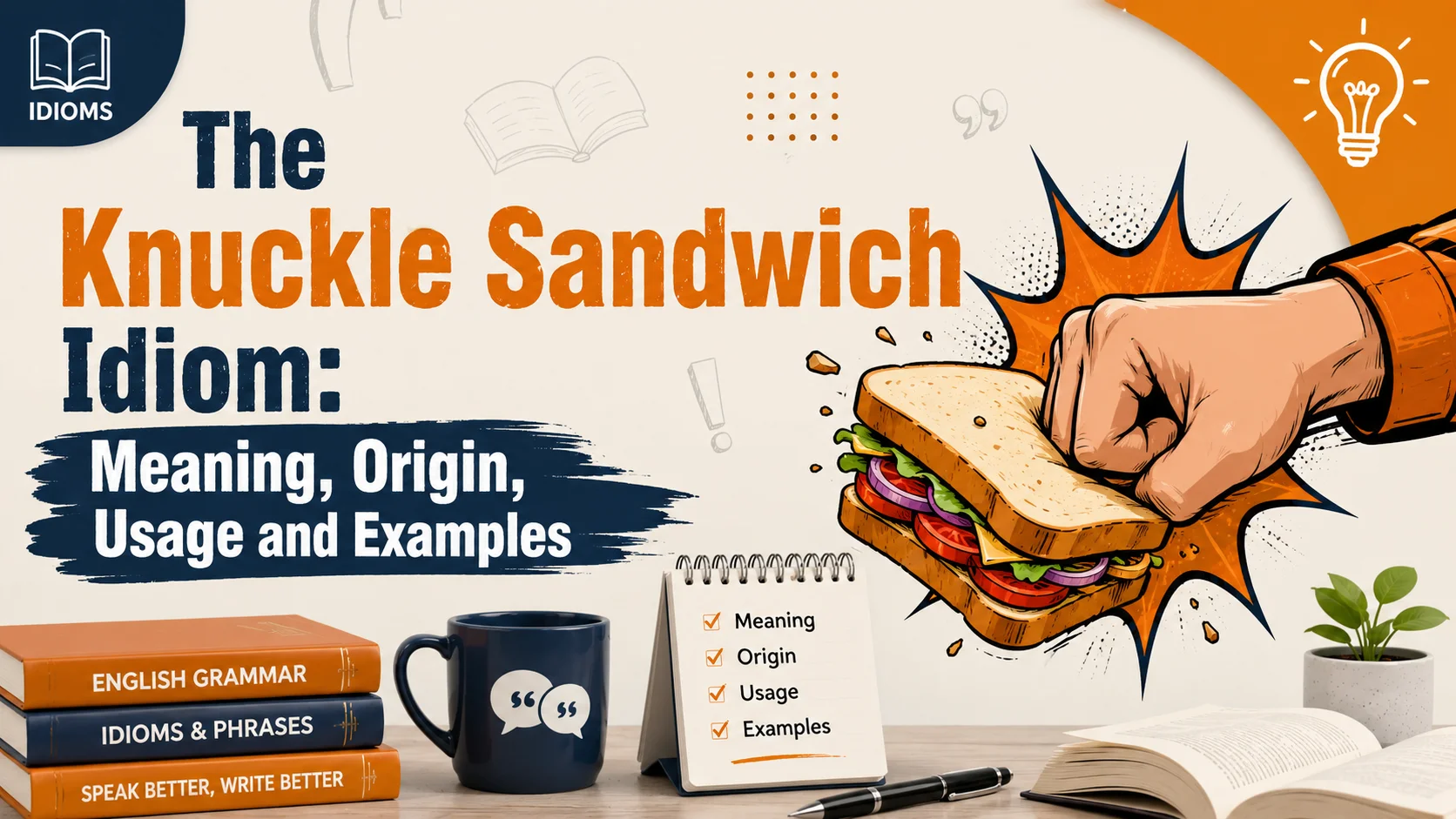
Knuckle Sandwich is a famous English idiom in American English that uses figurative language instead of literal words. The Knuckle Sandwich Idiom Definition describes a phrase, term, or expression whose meaning is not about food, a sandwich, or a real sandwich from a diner menu. Instead, the knuckle sandwich meaning refers to a punch, a punch to the mouth, a hit, or a hit to the mouth delivered with a fist or hand. .
Although the idiom suggests action and implied action, it usually expresses a threat, playful threat, exaggerated threat, playful warning, or a real threat meant to threaten someone, depending on the situation, message, and social context. The phrase often sounds humorous, uses a humorous tone, humor, jokes, joking, jokingly, or a joking gesture, making it playful, light-hearted, creative, engaging, fun, memorable, dramatic, and colorful.
The expression remains popular because it appears in slang, slang expressions, figurative language, casual conversations, conversation, everyday conversation, everyday talk, everyday words, and everyday use across culture, cultural references, pop culture, movies, American movies, TV shows, television, cartoons, and fiction. It is commonly heard between friends, a listener, readers, people, or another person who may jokingly tell someone to back off. Its common usage, being commonly used, and survival over time show how language, different words, the world of language, and every part of speech continue to evolve. Experts connect its American slang roots to the 1930s and the early twentieth century, mentioning tough street children and small-time gangsters, although some uncertainty remains.
What Does the Knuckle Sandwich Idiom Mean?
The knuckle sandwich idiom means a punch in the face or a threat to punch someone, usually expressed in a humorous, exaggerated, or old-fashioned way.
Unlike a real sandwich, a knuckle sandwich has nothing to do with food. Instead, the “sandwich” humorously represents a fist making contact with someone’s face.
Simple definition:
Knuckle sandwich (idiom): A humorous or exaggerated way of saying someone will punch another person.
In modern English, the phrase is more likely to appear in jokes, cartoons, or fictional dialogue than in serious conversations.
Literal Meaning vs. Figurative Meaning
Understanding the difference between literal and figurative language makes this idiom much easier.
| Literal Meaning | Figurative Meaning |
| A sandwich made from knuckles | A punch or the threat of a punch |
| Impossible and humorous | An expression used for dramatic effect |
| Related to food | Related to physical confrontation |
Like many English idioms, the figurative meaning cannot be understood by translating each individual word.
Why English Speakers Use This Idiom
People use the expression because it sounds vivid without sounding overly harsh.
Some common reasons include:
- Adding humor to a warning.
- Making fictional dialogue more entertaining.
- Creating colorful storytelling.
- Referencing classic American slang.
- Showing playful frustration among friends.
The phrase often softens what would otherwise sound like a direct threat.
What Is a Knuckle Sandwich?
Before understanding the idiom, it helps to examine the two words separately.
- Knuckle: The joints of your fingers.
- Sandwich: Two pieces of bread with filling inside.
When these unrelated words are combined, they create a humorous mental picture. Instead of serving food, someone is “serving” a punch.
This unusual combination makes the idiom memorable, which is one reason it has remained part of American slang for generations.
Breaking Down the Words “Knuckle” and “Sandwich”
The humor comes from replacing something pleasant—a sandwich—with something unpleasant—a fist.
That contrast surprises listeners and makes the phrase easier to remember.
Why the Phrase Creates a Memorable Image
Many English idioms survive because they paint vivid pictures.
Consider these examples:
- Piece of cake
- Spill the beans
- Hit the nail on the head
- Knuckle sandwich
Each creates an image that helps people remember its meaning even if the literal interpretation makes little sense.
Origin and History of the Knuckle Sandwich Idiom
Most language historians agree that the knuckle sandwich idiom originated in the United States during the late nineteenth or early twentieth century. By the early 1900s, newspapers, comic strips, and popular entertainment had already begun using the expression.
Although no single person invented the phrase, its rise closely followed America’s growing fascination with boxing, street slang, and comedic performances.
Earliest Known Uses
Early American newspapers and humor magazines frequently included colorful slang.
Expressions involving fists, punches, and boxing became especially popular because prizefighting attracted large audiences.
By the 1920s, “knuckle sandwich” had become widely recognized.
How American Slang Shaped the Expression
American slang often transforms ordinary objects into humorous metaphors.
Examples include:
| Slang Expression | Meaning |
| Cold shoulder | Ignore someone |
| Bite the bullet | Endure something difficult |
| Knuckle sandwich | Punch someone |
| Couch potato | Lazy person |
The phrase follows this creative tradition.
The Influence of Boxing and Street Culture
During the early twentieth century:
- Boxing became mainstream entertainment.
- Urban slang spread rapidly.
- Tough-guy language appeared in newspapers.
- Fighters became celebrities.
- Action stories influenced everyday speech.
The knuckle sandwich idiom naturally fit this environment.
Growth Through Comics, Radio, and Early Films
As entertainment expanded, writers loved expressions that sounded dramatic without being vulgar.
Comic books and radio dramas frequently used phrases like:
- “Take this!”
- “Put up your dukes!”
- “Here’s a knuckle sandwich!”
These expressions entertained audiences while avoiding explicit violence.
Why “Knuckle Sandwich” Became a Popular Idiom
Not every slang expression survives for decades. This one did because it combines several qualities that appeal to listeners.
Humor Mixed with Threat
Instead of saying:
“I’m going to punch you.”
Someone might jokingly say:
“You’re asking for a knuckle sandwich.”
The second version sounds theatrical rather than genuinely dangerous.
Easy-to-Remember Wordplay
People remember unusual combinations of words.
A “sandwich” usually represents comfort and food.
A “knuckle” represents strength.
Putting them together creates surprise.
Cultural Appeal Across Generations
The idiom remained popular because each generation encountered it through:
- Cartoons
- Movies
- Television
- Comic books
- Video games
- Children’s entertainment
Even people who rarely use the phrase usually recognize it immediately.
How the Knuckle Sandwich Idiom Is Used Today
Modern speakers generally use the idiom jokingly rather than literally.
Friendly Jokes Between Friends
Example:
“If you eat my last slice of pizza, you’re getting a knuckle sandwich!”
Nobody expects an actual fight.
Fiction, Movies, and Television
Screenwriters use the expression to establish a character’s personality quickly.
It often signals:
- Comic toughness
- Old-fashioned slang
- Friendly rivalry
- Cartoon-style aggression
Social Media and Modern Conversations
Although less common than decades ago, the phrase still appears online in memes, nostalgic posts, and humorous comments.
Situations Where It Sounds Natural
The idiom fits:
- Comedy
- Fiction
- Informal dialogue
- Friendly teasing
- Character writing
It rarely belongs in serious discussions.
Tone and Context: Is the Idiom Always Serious?
Absolutely not.
Tone determines whether listeners interpret the phrase as humorous or threatening.
Playful vs. Aggressive Meaning
Compare these examples.
Playful
“Keep stealing my fries and you’ll earn a knuckle sandwich!”
Aggressive
“Say that again and you’ll get a knuckle sandwich.”
The words are identical.
The intention changes everything.
How Voice and Context Change the Message
Factors affecting interpretation include:
- Facial expression
- Relationship
- Setting
- Body language
- Voice
Without these cues, the phrase can be misunderstood.
Avoiding Misunderstandings
If you’re speaking with people from different cultures or with English learners, choose clearer language.
Some listeners may interpret the phrase literally or view it as an actual threat.
Examples of the Knuckle Sandwich Idiom in Everyday English
Casual Conversation Examples
- “Stop poking me or you’ll get a knuckle sandwich.”
- “My brother always joked about handing out knuckle sandwiches.”
- “The coach laughed after pretending to offer a knuckle sandwich.”
Funny Examples
- “The cat looked ready to serve a knuckle sandwich after I moved it from the couch.”
- “Even the teddy bear looked tough enough to deliver a knuckle sandwich.”
Family-Friendly Examples
Parents sometimes use exaggerated expressions without intending harm.
Example:
“Keep making that funny noise and I’ll send your dad with a knuckle sandwich.”
The family understands it as playful exaggeration.
Movie-Style Examples
- “You’ve got five seconds before you get a knuckle sandwich.”
- “Nobody talks to my partner that way.”
These lines create dramatic tension.
Workplace and Professional Examples (When to Avoid)
Avoid this idiom in:
- Emails
- Meetings
- Customer service
- Interviews
- Business negotiations
Professional communication should remain respectful and unambiguous.
When You Should Not Use the Knuckle Sandwich Idiom
Although common in entertainment, it doesn’t belong everywhere.
Avoid using it:
- During workplace disagreements.
- In legal discussions.
- Around strangers.
- During customer interactions.
- In academic writing.
- In formal presentations.
Choosing simpler language reduces the risk of misunderstanding.
Similar Idioms and Expressions
English includes many expressions involving fighting or conflict.
| Idiom | Meaning |
| Put up your dukes | Prepare to fight |
| Throw hands | Start fighting |
| Duke it out | Fight until finished |
| Pack a punch | Have great impact |
| Hit below the belt | Behave unfairly |
| Knock someone for a loop | Surprise or overwhelm someone |
| Give someone a black eye | Injure someone’s face |
Each expression has its own tone and context.
Synonyms and Alternative Expressions
Instead of saying knuckle sandwich, speakers sometimes use:
- Pop someone one
- Sock someone
- Throw a punch
- Land a punch
- Smack someone
- Give someone a wallop
These alternatives range from humorous to serious.
Knuckle Sandwich Idiom vs. Similar Expressions
| Expression | Meaning | Tone |
| Knuckle sandwich | Humorous punch | Playful |
| Throw hands | Begin fighting | Modern slang |
| Put up your dukes | Prepare to fight | Old-fashioned |
| Punch someone | Literal action | Direct |
| Pack a punch | Strong impact | Neutral |
Choosing the right expression depends on your audience and purpose.
Common Mistakes English Learners Make
Many learners misunderstand this idiom because the words suggest food.
Common mistakes include:
- Translating it literally.
- Using it in formal writing.
- Assuming it always means real violence.
- Confusing it with other food-related idioms.
Learning idioms as complete expressions rather than individual words helps avoid these mistakes.
Cultural Impact of the Knuckle Sandwich Idiom
The phrase reflects an interesting part of American culture.
Instead of describing violence directly, speakers often soften it with humor.
This style appears throughout American entertainment.
Classic American Humor
Comedy has long relied on exaggerated threats that audiences never take seriously.
Classic cartoons frequently featured impossible situations where characters recovered instantly after comic fights.
Influence in Cartoons and Comics
Characters in classic animated series often used expressions like:
- “Put up your dukes!”
- “Take that!”
- “Here’s your knuckle sandwich!”
These phrases became part of popular culture.
Appearances in Movies, TV Shows, and Pop Culture
Action comedies, detective stories, superhero comics, and family cartoons have all featured the idiom.
Because audiences recognize it immediately, writers continue using it to create nostalgic humor.
Why the Idiom Remains Recognizable
Several factors explain its lasting popularity.
- It creates a vivid mental image.
- It sounds funny rather than cruel.
- It has appeared in entertainment for generations.
- It reflects classic American slang.
- It remains easy to understand after hearing it once.
Fun Facts About the Knuckle Sandwich Idiom
Did you know?
- The expression is primarily associated with American English.
- It became widely known through comics and films.
- Modern speakers often use it ironically.
- Children frequently encounter it in cartoons before learning its figurative meaning.
- It belongs to a larger family of colorful American idioms.
Other Food-Related Idioms with Unexpected Meanings
| Idiom | Meaning |
| Piece of cake | Very easy |
| Spill the beans | Reveal a secret |
| Big cheese | Important person |
| Butter someone up | Flatter someone |
| Cool as a cucumber | Very calm |
These expressions show how food vocabulary often appears in English idioms.
Quick Reference Table
| Feature | Details |
| Meaning | A humorous or exaggerated threat to punch someone |
| Type | American English idiom |
| Tone | Usually playful, occasionally aggressive |
| Origin | Early 20th-century American slang |
| Common Use | Informal conversation, fiction, cartoons, movies |
| Formal Writing | Not appropriate |
| Literal Meaning | No |
| Figurative Meaning | Yes |
Key Takeaways
- The knuckle sandwich idiom refers to a punch or a joking threat to punch someone.
- It originated in American slang during the early twentieth century.
- Boxing culture and popular entertainment helped spread the phrase.
- Today, it appears mostly in humorous conversations, movies, comics, and nostalgic media.
- Context determines whether listeners hear it as playful or threatening.
- Avoid using the expression in professional or formal settings.
Conclusion
The Knuckle Sandwich idiom is a classic example of how American English uses humor, figurative language, and vivid imagery to create memorable expressions. Although it literally sounds like food, its actual meaning is a playful or exaggerated threat of a punch, not real violence. Understanding its origin, usage, tone, and cultural context makes it easier to recognize the phrase in movies, cartoons, TV shows, and everyday conversations. Once you understand the context, you’ll know exactly when this colorful English idiom is meant as a joke and when it should be avoided.
FAQs
Q.1: What does the Knuckle Sandwich idiom mean?
A Knuckle Sandwich is an informal English idiom that refers to a punch or a playful threat to punch someone. In most situations, it is used humorously rather than as a real threat.
Q.2: Where did the Knuckle Sandwich idiom originate?
The phrase is widely believed to have originated in American English during the early twentieth century. It gained popularity through boxing culture, American slang, cartoons, and classic movies.
Q.3: Is Knuckle Sandwich considered a violent expression?
The idiom mentions a punch, but it is usually spoken as a joke or an exaggerated expression. The tone, context, and relationship between speakers determine how it is understood.
Q.4: Can you use the Knuckle Sandwich idiom in formal writing?
No. Knuckle Sandwich is considered informal slang and is best used in casual conversations, creative writing, or entertainment instead of professional, business, or academic writing.
Q.5: Why is the Knuckle Sandwich idiom confusing for English learners?
Many English learners interpret the phrase literally because it contains the word sandwich. Since it is a figurative expression, learning its meaning, usage, and context helps avoid misunderstanding.
About The Author


1 thought on “The Knuckle Sandwich Idiom: Meaning, Origin, Usage and Examples ”