
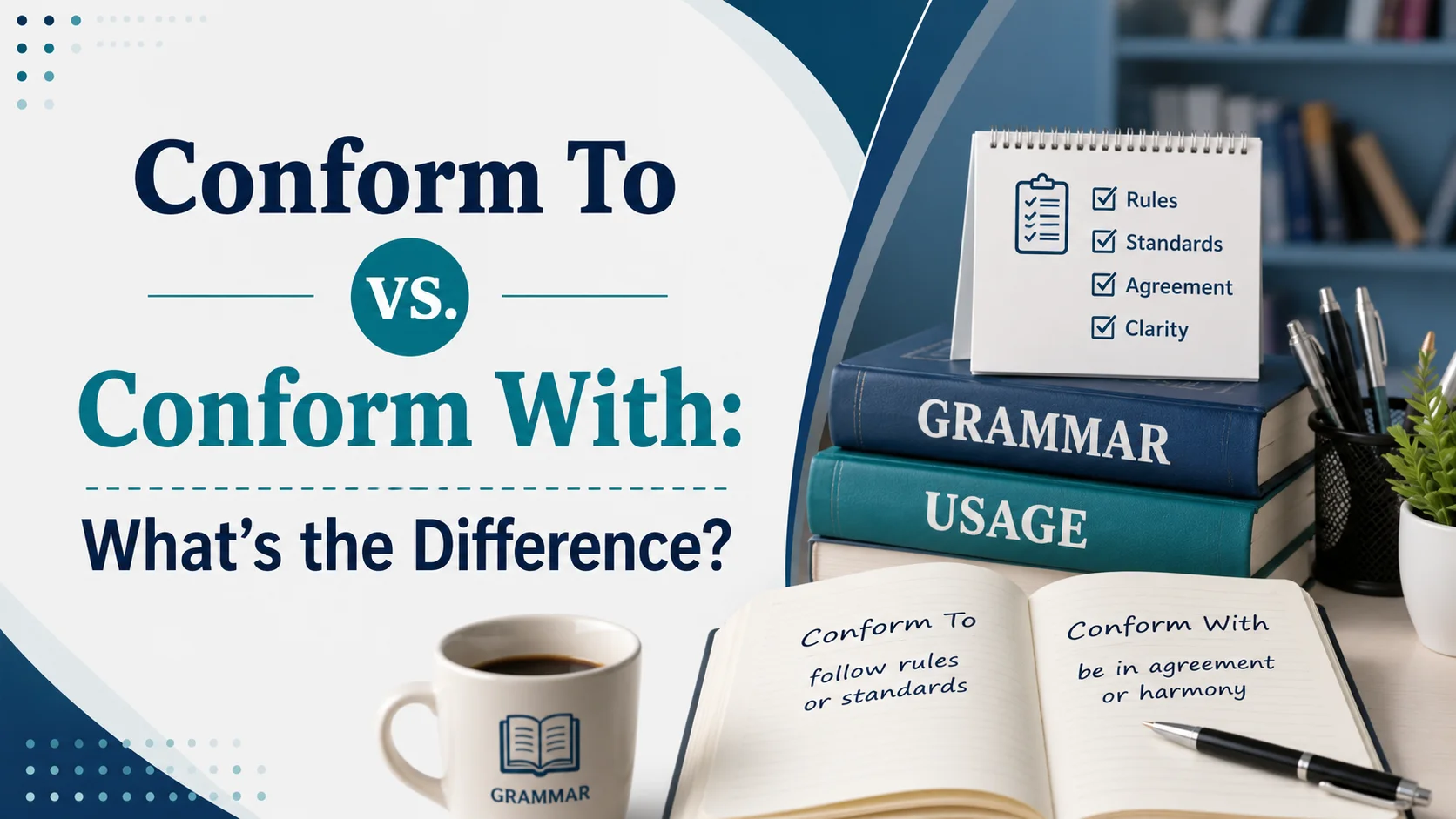
Conform With vs. Conform To becomes easier when you learn the difference through real examples instead of memorizing rules alone.After teaching English learners for years, I’ve found that strong English grammar comes from understanding grammatical distinction, not simply remembering grammar rules. In standard English, both conform to and conform with are correct, but their meaning changes with the context. Conform to usually follows a rule, rules, policy, laws, standards, requirements, or authority, showing compliance, adherence, and sometimes a firmer tone. Conform with is the preferred expression when one idea matches another through agreement, consistency, mutual understanding, harmonizing, and a softer fit between facts, evidence, observations, ideas, or expectations.
Whenever I review an academic paper, business report, or any other writing, I pay close attention to every preposition, prepositions, phrase, phrases, expression, expressions, wording, version, sentence, sentence construction, sentence meaning, grammatical choice, grammatical usage, grammatical functions, syntax, semantics, semantic meaning, semantic difference, language structure, linguistic context, linguistic nuance, contextual meaning, contextual usage, and context clues before suggesting an option or choice. A reliable grammar guide, writing guide, or guide should explain language use, usage, usage patterns, application, how each common expression applies in a real situation.
The main goal is to determine the correct relationship between two ideas by looking at the construction, structure, patterns, and interpretation of each sentence. Doing this helps you articulate your message with clear language, fluency, and growing confidence. With regular reading, choosing better words, and seeing how conformed to, conform to, and conform with work naturally, the skill becomes a habit and eventually second nature.
Quick Answer: Conform To or Conform With?
If you’re looking for a quick rule, here’s the answer.
| Expression | Best Used For | Example |
| Conform to | Rules, standards, laws, requirements, expectations | Employees must conform to company policies. |
| Conform with | Facts, evidence, data, observations, findings | The results conform with previous research. |
Which phrase is correct?
Both conform to and conform with are grammatically correct. The important question isn’t whether one is right and the other is wrong—it’s which one best fits the context.
For example:
The product conforms to safety regulations.
The evidence conforms with the witness’s statement.
Although both expressions are accepted by dictionaries and grammar references, conform to is considerably more common in everyday English.
The short rule you can remember
Here’s an easy rule:
Follow a rule? → Conform to.
Match or agree? → Conform with.
This simple distinction works in nearly every situation.
Quick comparison table
| Question | Use |
| Following a law? | Conform to |
| Meeting a standard? | Conform to |
| Following school rules? | Conform to |
| Matching scientific evidence? | Conform with |
| Agreeing with observations? | Conform with |
| Matching previous research? | Conform with |
What Does “Conform” Mean?
Before comparing the two expressions, it’s important to understand the meaning of the verb conform.
Conform means to behave, act, or be in agreement with something that is expected, required, or established.
In simple words, it means to follow, to fit, or to match, depending on the context.
Definition in everyday English
In everyday conversation, conform often refers to following social expectations or accepted behavior.
For example:
- People sometimes conform to social norms without realizing it.
- Teenagers may feel pressure to conform to their friends’ expectations.
- Employees are expected to conform to workplace policies.
In these examples, the meaning is following established expectations.
How “conform” is used in grammar and formal writing
In formal English, conform frequently appears in:
- Academic writing
- Legal documents
- Scientific research
- Technical manuals
- Government regulations
- Business communication
Here are a few examples:
- The equipment must conform to international safety standards.
- All applicants must conform to the eligibility requirements.
- The study’s findings conform with previous research.
Notice that the preposition changes depending on the meaning.
Common sentence patterns with “conform”
The verb usually follows these structures:
| Pattern | Example |
| Conform to + rule/standard | The building conforms to local regulations. |
| Conform with + evidence/facts | The findings conform with earlier studies. |
| Conform to + expectations | Students should conform to classroom rules. |
| Conform with + observations | The data conform with our predictions. |
Learning these common patterns makes it much easier to choose the correct preposition naturally.
Conform To: Meaning, Usage, and Examples
Among the two expressions, conform to is by far the more frequently used in modern English.
It describes following something that sets a requirement or standard.
Think of conform to as moving toward a rule or standard that already exists.
When to use “conform to”
Use conform to whenever someone or something follows:
- Rules
- Laws
- Standards
- Policies
- Requirements
- Expectations
- Procedures
- Guidelines
- Specifications
- Customs
- Social norms
These are all things that establish a standard for others to follow.
For example:
- Drivers must conform to traffic laws.
- Students should conform to school regulations.
- Manufacturers must conform to quality standards.
- Visitors are expected to conform to local customs.
Each sentence describes following an established rule or expectation.
Conforming to rules, standards, laws, and expectations
Let’s look at the most common contexts.
Rules
Rules tell people how they should behave.
Examples:
- Everyone must conform to classroom rules.
- Athletes must conform to tournament regulations.
- Employees must conform to company policies.
Laws
Legal documents almost always use conform to.
Examples:
- All businesses must conform to national tax laws.
- New buildings must conform to construction regulations.
- Vehicles must conform to emission standards.
Standards
Standards define minimum quality or performance.
Examples:
- The software conforms to industry standards.
- This product conforms to international safety requirements.
- Medical devices must conform to strict regulations.
Expectations
People also conform to social expectations.
Examples:
- Children often conform to family traditions.
- New employees quickly conform to workplace culture.
- Many people conform to society’s expectations without questioning them.
Example sentences
Here are more examples showing natural usage.
Education
- Students must conform to the school’s dress code.
- Teachers conform to educational guidelines.
Business
- The company conforms to international accounting standards.
- Suppliers must conform to contractual requirements.
Technology
- The software conforms to security protocols.
- Mobile apps should conform to accessibility standards.
Healthcare
- Hospitals conform to health regulations.
- Doctors conform to professional ethics.
Daily life
- Citizens should conform to public safety rules.
- Residents conform to neighborhood regulations.
Common collocations with “conform to”
Some nouns naturally appear after conform to more than others.
| Common Collocation | Example |
| Conform to regulations | Businesses must conform to regulations. |
| Conform to standards | The equipment conforms to safety standards. |
| Conform to expectations | She refused to conform to expectations. |
| Conform to policy | Staff must conform to company policy. |
| Conform to requirements | Applicants must conform to the requirements. |
| Conform to guidelines | Researchers should conform to ethical guidelines. |
| Conform to specifications | The design conforms to technical specifications. |
| Conform to the law | Everyone must conform to the law. |
| Conform to protocol | Medical staff conform to hospital protocols. |
| Conform to tradition | Many families conform to local traditions. |
Learning these collocations will make your English sound much more natural because they reflect how native speakers commonly use the verb.
Frequent mistakes to avoid
Many learners misuse conform to in situations where agree or match is intended.
Incorrect:
The evidence conforms to the witness statement.
Although this sentence is sometimes accepted, many editors and style guides prefer:
The evidence conforms with the witness statement.
Another mistake is omitting the preposition.
Incorrect:
The machine conforms international standards.
Correct:
The machine conforms to international standards.
Remember that conform almost always needs a preposition.
Grammar Tip: If you can replace the sentence with follow, obey, or meet, then conform to is almost always the correct choice.
Conform With: Meaning, Usage, and Examples
While conform to focuses on following rules and standards, conform with emphasizes agreement, consistency, or matching.
This expression is especially common in formal writing, scientific research, legal analysis, and technical reports where the goal is to compare one thing with another.
Instead of suggesting obedience, conform with suggests that two things are consistent with each other.
When to use “conform with”
Use conform with when discussing:
- Facts
- Evidence
- Research findings
- Observations
- Data
- Reports
- Predictions
- Expectations (in the sense of matching them)
- Previous studies
Here are a few examples:
- The survey results conform with earlier research.
- His explanation conforms with the available evidence.
- The laboratory findings conform with our original hypothesis.
- The witness’s testimony conforms with the video footage.
Notice that nothing is being followed. Instead, one thing matches or agrees with another.
Agreement with facts, observations, evidence, or expectations
This use is particularly common in academic and scientific English.
For example:
- The data conform with accepted scientific theories.
- The evidence conforms with what investigators observed.
- The financial report conforms with independent audit findings.
- The new statistics conform with previous estimates.
Here, conform with means to be consistent with rather than to obey.
Conform To vs. Conform With: Side-by-Side Comparison
Now that you understand the individual meanings of conform to and conform with, let’s compare them directly. Although these phrases are closely related, they emphasize different relationships between things.
The easiest way to think about them is this:
- Conform to = follow or obey
- Conform with = agree or match
Understanding this distinction will help you choose the correct expression naturally instead of memorizing grammar rules.
Differences in meaning
The biggest difference lies in what is happening.
With conform to, someone or something is following an established standard.
Examples:
- Employees conform to company policies.
- The design conforms to safety regulations.
- Students conform to classroom rules.
With conform with, two things are consistent or in agreement.
Examples:
- The evidence conforms with the witness’s account.
- The findings conform with previous studies.
- His explanation conforms with the available facts.
Notice how conform with compares one piece of information to another rather than describing obedience.
Differences in context
The context often tells you immediately which preposition is appropriate.
Use conform to when talking about:
- Laws
- Rules
- Standards
- Regulations
- Requirements
- Procedures
- Instructions
- Customs
- Expectations
Use conform with when talking about:
- Evidence
- Facts
- Data
- Research
- Findings
- Reports
- Observations
- Predictions
- Statements
Once you recognize these common contexts, choosing the correct phrase becomes much easier.
British English vs. American English usage
Both British English and American English recognize conform to and conform with, but they don’t use them equally.
In modern English:
- Conform to is the dominant expression in both British and American English.
- Conform with appears less frequently and is more common in formal or technical writing.
- Scientific papers, legal documents, and academic articles often use conform with when discussing agreement between findings or evidence.
For everyday communication, native speakers usually choose conform to unless they’re specifically describing agreement between two sets of information.
For example:
Everyday English
- Everyone must conform to the rules.
- The building conforms to local regulations.
Academic English
- The data conform with previous observations.
- These findings conform with earlier research.
Comparison table
| Feature | Conform To | Conform With |
| Primary meaning | Follow or obey | Match or agree |
| Used for | Rules, standards, laws | Evidence, facts, data |
| Common in conversation | Yes | Less often |
| Common in academic writing | Yes | Yes |
| Suggests obedience | Yes | No |
| Suggests consistency | Sometimes | Yes |
| Most common choice | ✔ | Less common |
Is “Conform With” Less Common Than “Conform To”?
Yes. In modern English, conform to is significantly more common than conform with.
This is because people more frequently talk about following rules, standards, and expectations than comparing evidence or research findings.
For example, you’ll regularly hear sentences like:
- Products must conform to safety standards.
- Students should conform to school rules.
- Companies must conform to government regulations.
These expressions appear in everyday conversations, business communication, education, healthcare, engineering, and law.
By contrast, conform with usually appears in more specialized writing.
Examples include:
- Academic journals
- Scientific reports
- Medical research
- Legal analysis
- Technical documentation
Modern usage trends
Today’s English favors simpler, clearer expressions.
As a result:
- Many writers replace conform with with agree with or be consistent with when possible.
- Conform to remains the standard phrase for compliance and adherence.
Compare these examples:
Formal:
The findings conform with previous observations.
More conversational:
The findings agree with previous observations.
Both are correct, but the second sentence sounds more natural in everyday English.
Formal vs. everyday English
Here’s how the expressions are typically used.
| Situation | Preferred Expression |
| School | Conform to |
| Workplace | Conform to |
| Government | Conform to |
| Manufacturing | Conform to |
| Scientific journal | Conform with |
| Research paper | Conform with |
| Technical report | Conform with |
| Daily conversation | Conform to |
Which should ESL learners use?
If you’re learning English as a second language, focus first on conform to.
It covers the vast majority of situations you’ll encounter.
Learn conform with as a more specialized expression used when discussing agreement between information, evidence, or research.
This approach keeps your English both accurate and natural.
Can “Conform To” and “Conform With” Ever Be Interchangeable?
Sometimes—but not always.
In certain formal contexts, both expressions can be acceptable because they express a similar idea of consistency.
However, the nuance often changes.
Situations where both sound natural
Consider this sentence:
The report conforms to company standards.
This emphasizes that the report meets the standards.
Now consider:
The report conforms with company standards.
This emphasizes that the report is consistent with those standards.
The difference is subtle, and many readers may not notice it.
Another example:
- The design conforms to industry specifications.
- The design conforms with industry specifications.
Both are understandable, although conform to is still more common.
Situations where only one is correct
There are many situations where only one expression sounds natural.
Correct:
- Everyone must conform to the law.
- Drivers must conform to traffic regulations.
- Students must conform to school policies.
Using with here sounds awkward because laws and regulations are followed rather than compared.
Likewise:
Correct:
- The evidence conforms with witness testimony.
- The results conform with previous findings.
- The data conform with the expected pattern.
Using to in these contexts is less natural because you’re describing agreement rather than obedience.
Examples showing the difference
| Sentence | Better Choice | Why |
| Employees must conform ___ company policy. | to | Policy is followed. |
| The evidence conforms ___ our theory. | with | Evidence matches the theory. |
| Products conform ___ safety standards. | to | Standards are met. |
| The findings conform ___ earlier research. | with | Findings agree with research. |
| Citizens should conform ___ the law. | to | Laws are obeyed. |
| The observations conform ___ expectations. | with | Observations match expectations. |
Common Collocations with “Conform”
One of the best ways to sound like a native speaker is to learn collocations—words that naturally occur together.
Instead of memorizing isolated grammar rules, learn these common word combinations.
Conform to a rule
Examples:
- Everyone must conform to classroom rules.
- Players must conform to tournament rules.
- Staff members conform to workplace rules.
Conform to a standard
Examples:
- The product conforms to international standards.
- Every component conforms to quality standards.
- The software conforms to accessibility standards.
Conform to regulations
Examples:
- Factories conform to environmental regulations.
- Airlines conform to aviation regulations.
- Hospitals conform to government regulations.
Conform to expectations
Examples:
- He refused to conform to social expectations.
- Children often conform to parental expectations.
- New employees quickly conform to workplace expectations.
Conform with evidence
Examples:
- The report conforms with available evidence.
- The conclusion conforms with scientific evidence.
- Their explanation conforms with all the facts.
Conform with observations
Examples:
- The measurements conform with previous observations.
- These results conform with laboratory observations.
- The findings conform with field observations.
Conform with previous findings
Examples:
- The study conforms with earlier research.
- Our results conform with previous findings.
- The latest report conforms with historical data.
Learning these expressions will greatly improve your vocabulary because they reflect authentic English usage.
Common Mistakes and How to Correct Them
Even advanced learners sometimes confuse these expressions.
Let’s examine the most frequent errors.
Using “conform with” after rules or laws
Incorrect:
Employees must conform with company policies.
Natural:
Employees must conform to company policies.
Why?
Policies establish requirements that people follow.
Using “conform to” when discussing evidence
Less natural:
The evidence conforms to previous findings.
Better:
The evidence conforms with previous findings.
Here the evidence isn’t obeying anything—it is simply consistent with earlier findings.
Omitting the preposition
Incorrect:
This product conforms international standards.
Correct:
This product conforms to international standards.
The verb conform almost always requires a preposition.
Incorrect vs. correct examples table
| Incorrect | Correct |
| Conform company rules | Conform to company rules |
| Conform regulations | Conform to regulations |
| The evidence conforms to our observations. | The evidence conforms with our observations. |
| His story conforms the facts. | His story conforms with the facts. |
| Products conform safety standards. | Products conform to safety standards. |
| Results conform previous studies. | Results conform with previous studies. |
Tips for avoiding mistakes
Keep these simple guidelines in mind whenever you use conform.
- Ask yourself what is being discussed. Is it a rule or a comparison?
- Use “to” for rules, standards, laws, and requirements.
- Use “with” for facts, evidence, observations, and research.
- Don’t forget the preposition. Writing conform standards or conform regulations is always incorrect.
- Read your sentence aloud. If you could replace conform with follow, then conform to is almost certainly the correct choice.
By building these habits, you’ll avoid one of the most common preposition errors in English.
Conform To vs. Comply With vs. Follow
Many English learners use conform, comply, and follow interchangeably because all three involve doing something according to a rule or instruction. While they are related, each verb has a different nuance and is used in different situations.
Understanding these differences will help you choose the most natural word for your sentence.
Conform vs. Comply
Both conform and comply involve acting according to rules or expectations, but they emphasize different ideas.
- Conform focuses on matching or fitting into a standard, norm, or expectation.
- Comply emphasizes obeying a specific order, law, request, or requirement.
Compare these examples:
Conform
- Students should conform to the school’s dress code.
- The design conforms to international standards.
- Many people conform to social expectations.
Comply
- Employees must comply with safety regulations.
- Drivers are required to comply with traffic laws.
- The company complied with the court’s order.
Notice that comply often suggests an official obligation, while conform can refer to both official rules and informal social expectations.
Conform vs. Follow
The verb follow is much broader and more common in everyday English.
You can follow:
- Rules
- Instructions
- Advice
- Directions
- A recipe
- A teacher
- A process
Examples:
- Follow the instructions carefully.
- Please follow the doctor’s advice.
- We followed the recipe exactly.
Using conform in these situations would sound unnatural.
For example:
Conform to the recipe.
Follow the recipe.
Likewise:
Conform to these directions.
Follow these directions.
Which verb sounds most natural?
Here’s a quick comparison.
| Situation | Best Choice | Example |
| Government regulation | Comply with | Businesses must comply with tax laws. |
| Industry standard | Conform to | The product conforms to ISO standards. |
| Recipe | Follow | Follow the recipe carefully. |
| Teacher’s instructions | Follow | Follow your teacher’s instructions. |
| Social expectations | Conform to | Teenagers often conform to peer pressure. |
| Court order | Comply with | The company complied with the court order. |
Tip: If you’re talking about official legal requirements, comply with is often the most precise choice. If you’re discussing standards or social norms, conform to is usually better. For general instructions, follow is the simplest and most natural option.
Conform vs. Confirm (A Common Confusing Pair)
Another common mistake is confusing conform with confirm.
Although these words look similar, they have completely different meanings.
Difference in meaning
| Word | Meaning |
| Conform | To follow, match, or comply with something |
| Confirm | To verify, prove, or make certain |
Examples:
Conform
- All products must conform to safety regulations.
- His explanation conforms with the available evidence.
Confirm
- Please confirm your reservation.
- The test results confirmed the doctor’s diagnosis.
- She confirmed the meeting time by email.
Pronunciation comparison
Although the words differ by only one letter, they are pronounced differently.
- Conform stresses the second syllable: kuhn-FORM
- Confirm also stresses the second syllable: kuhn-FIRM
Pay attention to the vowel sound in the second syllable:
- Form
- Firm
Mixing these words can completely change the meaning of a sentence.
Example sentences
Incorrect:
The report confirmed to company policy.
Correct:
The report conformed to company policy.
Incorrect:
Please conform your attendance.
Correct:
Please confirm your attendance.
Remember:
- Conform = follow or match.
- Confirm = verify or make certain.
Real-Life Examples in Different Contexts
One of the best ways to master grammar is by seeing it in real-world situations. The following examples show how native speakers naturally use conform to and conform with.
Academic writing
Academic writing frequently uses both expressions, especially when discussing standards and research findings.
Examples:
- All references should conform to the required citation style.
- The experiment conforms to accepted ethical guidelines.
- The results conform with previous studies conducted in Europe.
- The conclusions conform with existing research.
Notice that conform to introduces requirements, while conform with introduces agreement between findings.
Workplace communication
Businesses often use conform to because companies operate according to policies, procedures, and regulations.
Examples:
- Employees must conform to workplace safety procedures.
- Every department should conform to company policies.
- New software must conform to security requirements.
- Internal reports should conform to the approved format.
Managers often use these expressions in manuals and employee handbooks.
Legal and regulatory documents
Legal English relies heavily on conform to.
Examples:
- Buildings must conform to local building codes.
- Manufacturers must conform to consumer safety laws.
- Imported products must conform to national regulations.
- Financial institutions must conform to government requirements.
These documents describe mandatory standards rather than optional suggestions.
Science and research
Scientific writing commonly uses conform with because researchers compare data, observations, and conclusions.
Examples:
- The measurements conform with theoretical predictions.
- Laboratory observations conform with the proposed model.
- The evidence conforms with previous clinical trials.
- The statistical analysis conforms with earlier findings.
Here the focus is consistency between different sources of information.
Everyday conversation
Although the verb conform is somewhat formal, native speakers still use it in everyday situations.
Examples:
- Some people never conform to social pressure.
- He refuses to conform to fashion trends.
- Children sometimes conform to their friends’ opinions.
- You don’t have to conform to everyone else’s expectations.
In casual conversation, speakers often replace conform with fit in, depending on the context.
For example:
Instead of:
She conforms to social expectations.
Many native speakers would say:
She tries to fit in.
Grammar Pattern: How to Use “Conform” Correctly
Learning sentence patterns is often easier than memorizing definitions.
Here are the most common grammar structures.
Conform + to + noun
This is the most frequent pattern.
Structure:
Subject + conform + to + noun
Examples:
- The building conforms to safety regulations.
- Students conform to school policies.
- The product conforms to international standards.
- Staff members conform to company procedures.
Conform + with + noun
Use this structure when discussing agreement or consistency.
Structure:
Subject + conform + with + noun
Examples:
- The results conform with previous studies.
- His explanation conforms with the available evidence.
- The data conform with our predictions.
- The observations conform with historical records.
Different verb tenses
The verb conform works like a regular English verb.
| Tense | Example |
| Present Simple | The product conforms to safety standards. |
| Present Continuous | The company is conforming to new regulations. |
| Past Simple | The design conformed to every requirement. |
| Present Perfect | The software has conformed to industry standards for years. |
| Future Simple | All new models will conform to updated regulations. |
Passive voice examples
Although conform usually appears in active voice, passive constructions are possible.
Examples:
- All equipment is expected to conform to current regulations.
- Every application is required to conform to the official guidelines.
- New products are designed to conform to safety standards.
Passive voice is common in technical documents because it focuses on requirements rather than the person responsible.
Negative sentence examples
Negative sentences show when someone or something fails to meet expectations.
Examples:
- The report does not conform to company guidelines.
- The machine doesn’t conform to safety standards.
- Their explanation does not conform with the available evidence.
- The latest results do not conform with previous research.
Notice that the preposition remains unchanged in negative sentences.
Memory Trick to Never Forget the Difference
Many learners struggle because both expressions seem similar. These simple memory techniques make the distinction much easier.
Remembering “Conform To”
Think about the word toward.
When you conform to something, you’re moving toward a rule, standard, or requirement.
Imagine a student walking toward a school rulebook.
Examples:
- Conform to the law.
- Conform to company policy.
- Conform to regulations.
The idea is always following an established standard.
Remembering “Conform With”
Think about two puzzle pieces fitting together.
When two pieces fit perfectly, they match.
Likewise:
- Evidence conforms with facts.
- Results conform with observations.
- Research conforms with previous findings.
Nothing is being obeyed—everything simply agrees.
One-minute recap
Remember these two questions:
Question 1
Am I following a rule?
✔ Use conform to.
Question 2
Am I comparing two things?
✔ Use conform with.
That’s the easiest decision-making method for almost every sentence.
Practice Quiz
Test your understanding by choosing the correct preposition.
Choose the correct preposition
Fill in each blank with to or with.
- Employees must conform ___ company policies.
- The evidence conforms ___ the witness’s testimony.
- All products should conform ___ safety standards.
- The findings conform ___ earlier research.
- Drivers must conform ___ traffic laws.
- The observations conform ___ our predictions.
- Students should conform ___ classroom rules.
- The latest report conforms ___ the available data.
Take a moment to answer before checking below.
Fill in the blanks
Now try these complete sentences.
- Every applicant must ________ the admission requirements.
- The experimental results ________ previous studies.
- Manufacturers should ________ international quality standards.
- His explanation ________ all the available evidence.
- Employees are expected to ________ workplace policies.
Answer key with explanations
| Question | Correct Answer | Explanation |
| 1 | to | Policies are followed. |
| 2 | with | Testimony matches the evidence. |
| 3 | to | Standards are met or followed. |
| 4 | with | Research findings agree with earlier studies. |
| 5 | to | Laws are obeyed. |
| 6 | with | Observations match predictions. |
| 7 | to | Rules are followed. |
| 8 | with | The report agrees with the data. |
For the second exercise:
- conform to
- conform with
- conform to
- conforms with
- conform to
Mini Case Study: Choosing the Right Preposition
Imagine you’re editing two documents for a manufacturing company.
Document A: Safety Manual
“All protective equipment must conform to the company’s safety standards.”
This is correct because employees and equipment are expected to meet established standards.
Document B: Research Report
“The test results conform with the findings of the independent laboratory.”
This is also correct because the report is comparing one set of findings with another, showing consistency rather than compliance.
This simple comparison demonstrates why the choice of preposition depends on meaning, not just grammar.
Conclusion
Choosing between conform to and conform with becomes much easier once you understand the purpose of each phrase. In most everyday situations, conform to is the correct choice because it refers to following rules, laws, standards, policies, or requirements. Conform with, on the other hand, is mainly used when something agrees or matches with facts, evidence, observations, or research findings.
Instead of memorizing grammar rules, focus on the meaning of your sentence. Ask yourself whether you’re talking about following something or matching something. This simple habit will help you choose the right preposition naturally and make your writing clearer, more accurate, and more professional. With regular reading, practice, and exposure to real examples, using conform to and conform with correctly will soon become second nature.
FAQs
Q1. What is the difference between conform to and conform with?
Conform to means to follow or comply with rules, standards, laws, or requirements. Conform with means to agree or be consistent with facts, evidence, observations, or ideas. The choice depends on whether you’re describing compliance or agreement.
Q2. Is “conform with” grammatically correct?
Yes. Conform with is grammatically correct and is commonly used in formal, academic, and technical writing when discussing agreement between information, evidence, research, or observations.
Q3. Which is more common: conform to or conform with?
Conform to is much more common in both British and American English. It is widely used in everyday conversation, business writing, legal documents, and official communication, while conform with appears more often in academic and scientific contexts.
Q4. Can conform to and conform with be used interchangeably?
Sometimes, but not always. In a few formal contexts, both expressions may be acceptable. However, conform to is preferred for rules and standards, whereas conform with is better when describing agreement or consistency with facts, evidence, or research.
Q5. How can I remember when to use conform to and conform with?
A simple trick is to remember: conform to = follow, and conform with = match. If you’re following a rule or standard, use conform to. If you’re comparing information that agrees or matches, use conform with. This quick rule works correctly in most situations.
About The Author


1 thought on “Conform To vs. Conform With: What’s the Difference? ”