No Longer Exist vs. No Longer Exists: Which One Is Grammatically Correct?

No Longer Exist vs. No Longer Exists: Which One Is Grammatically Correct?

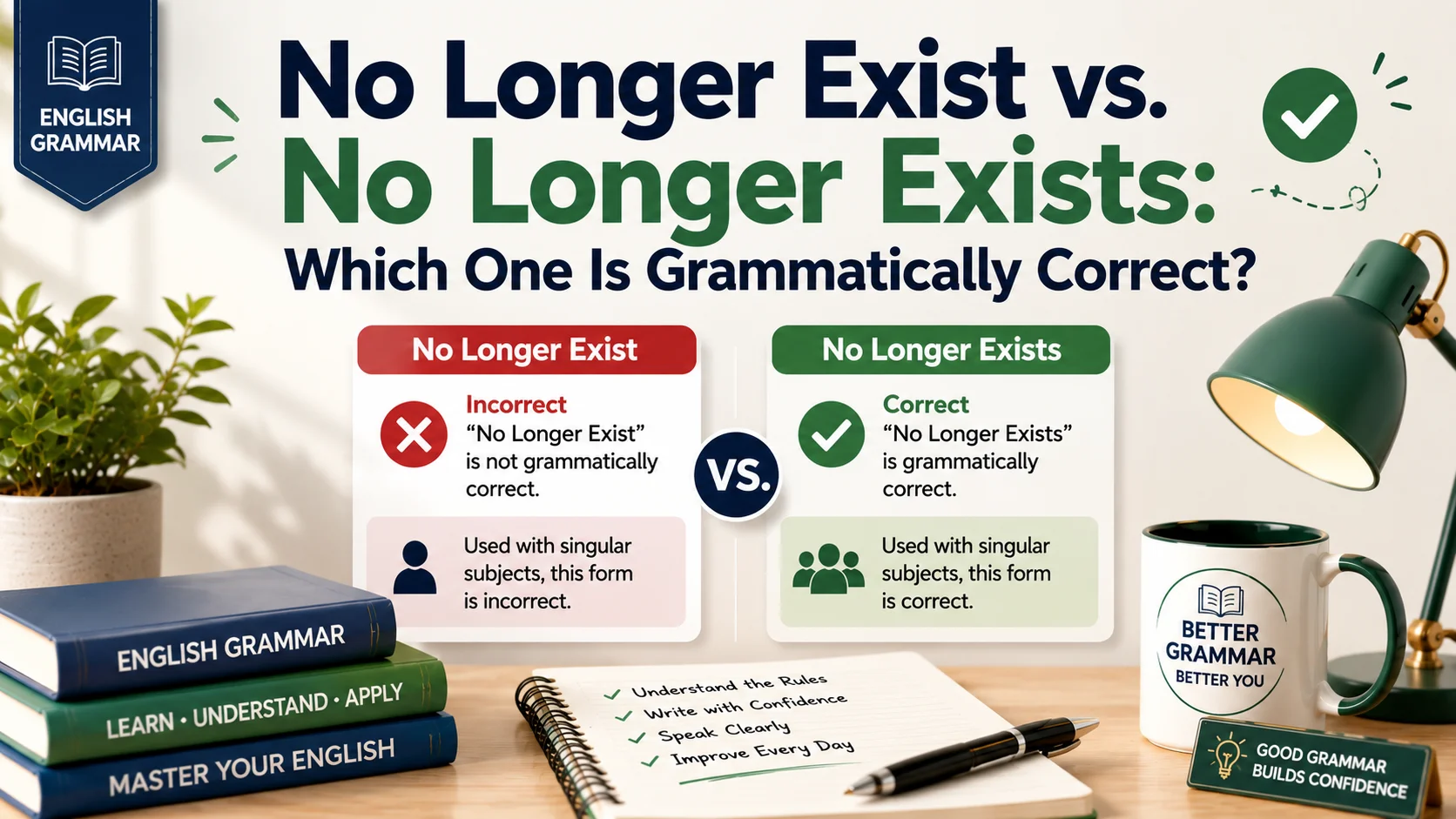
No Longer Exist vs. No Longer Exists becomes easy when you understand English grammar, subject-verb agreement, and the correct verb agreement rule. A singular subject takes No Longer Exists, while a plural subject takes No Longer Exist. This simple grammar rule improves sentence structure, clarity, fluency, and correct usage in writing, speech, and English writing. … Read more

Shed Some Light On: Meaning, Usage, Examples and Origin?

Shed Some Light On idiom meaning with practical examples

The Shed Some Light On idiom, also called Shed Some Light, shed light, or shedding light, is a common English phrase that explains the Definition, Meaning, Usage, Synonyms, and Examples of making something easier to understand. It does not refer to brightness, lamps, a flashlight, or a dark room. Instead, it helps reveal, revealing, information, … Read more

This Is She or This Is Her? Which One Is Correct?

This Is She or This Is Her? Which One Is Correct?

This Is She or This Is Her often seems like a tiny grammar choice, yet it reveals how English grammar changes between formal rules and real conversation every day. From helping English learners, I’ve noticed that this topic creates more questions than many other grammar points because both expressions sound correct in different situations. Traditional … Read more

Simple Present Tense: Rules, Uses, Structure and Examples 

Simple Present Tense: Rules, Uses, Structure and Examples

Quick Answer The simple present tense describes habits, routines, general truths, permanent situations, fixed schedules, and repeated actions. It’s one of the first English tenses learners study because native speakers use it every day in conversations, writing, work, and school. Here are a few examples: If you want to talk about something that happens regularly … Read more

In the Same Day or On the Same Day? Which Is Correct?

In the Same Day or On the Same Day? Which Is Correct?

Quick Answer “On the same day” is the correct phrase in most situations when you’re talking about a specific day or date. Native English speakers use it naturally in everyday conversations, business writing, journalism, and academic English. “In the same day” is also grammatically correct, but it has a different meaning. It emphasizes what happened … Read more

Index