
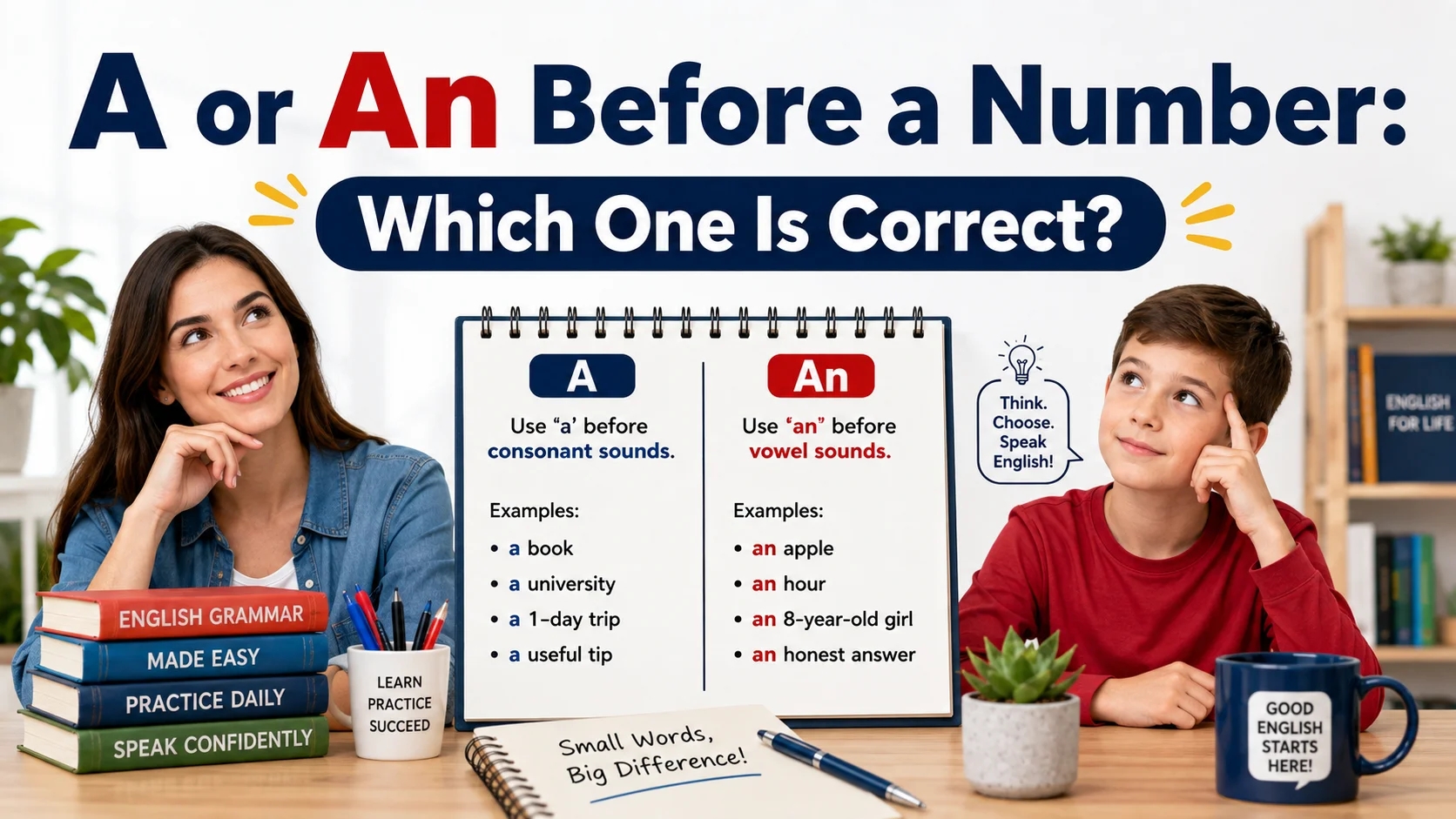
A or An Before a Number depends on pronunciation, not the written form. In English grammar, choose a before a consonant sound, such as a 10-minute break, and an before a vowel sound, such as an 8-minute break. The indefinite article, number word, digit, numeral, and initial sound guide the article choice. Say the number aloud and hear its first sound before choosing.
Real examples make the grammar rule easier to understand. Phrases such as a 10-minute break, an 8-minute shift, and a 1-year plan show how number pronunciation controls article usage. The vowel onset, consonant onset, phonetic rule, and sound pattern explain why a and an differ. This approach improves writing accuracy, grammatical accuracy, and correct usage.
In English usage, expressions involving pages, minutes, hours, and years follow the same article rule. Although the written appearance may look different, the spoken form determines the correct article. Writers can say the number, hear its first sound, and choose a or an. With real examples, the sound distinction becomes familiar, reducing hesitation and building confidence.
A or An Before a Number: The Basic Rule
English has two indefinite articles: a and an. Both can refer to one nonspecific person, thing, amount, or instance.
The choice between them depends on the initial sound of the next spoken word.
- Use a before a consonant sound.
- Use an before a vowel sound.
This rule applies to numbers too. The written digit doesn’t control the article.
| Number | Spoken form | First sound | Correct article | Example |
| 5 | five | /f/ | a | a 5-minute break |
| 8 | eight | /eɪ/ | an | an 8-minute break |
| 10 | ten | /t/ | a | a 10-mile walk |
| 11 | eleven | /ɪ/ | an | an 11-page report |
| 18 | eighteen | /eɪ/ | an | an 18-year-old student |
| 20 | twenty | /t/ | a | a 20-minute meeting |
| 80 | eighty | /eɪ/ | an | an 80% increase |
| 100 | one hundred | /w/ | a | a 100-page book |
The pattern becomes much easier once you stop looking at the number as a symbol and start hearing the number as a word.
Why Pronunciation Determines A or An Before a Number
English articles respond to speech sounds, not simply letters or digits.
Consider an hour. The word hour begins with the letter h, yet English speakers pronounce it without an initial /h/ sound. It starts with a vowel sound, so an fits naturally.
Now compare a university. The word begins with the vowel letter u, but its pronunciation starts with a /y/ sound: yoo-niversity. That /y/ sound functions as a consonant sound, so a university is correct.
Numbers follow the same principle.
The article follows the sound you pronounce, not the symbol you write.
That distinction explains why an 8-year-old and a 10-year-old are both correct.
A quick sound test
When you’re unsure, don’t stare at the number. Say it.
Number → Say it aloud → Listen to the first sound → Choose the article
For example:
- 8 → eight → vowel sound → an 8
- 11 → eleven → vowel sound → an 11
- 10 → ten → consonant sound → a 10
- 20 → twenty → consonant sound → a 20
This little trick solves most cases in seconds.
When to Use A Before a Number
Use a when the spoken number begins with a consonant sound.
Several common numbers fall into this group:
- one
- two
- three
- four
- five
- six
- seven
- nine
- ten
- twenty
- thirty
- forty
- fifty
- one hundred
- one thousand
Here are some natural examples:
- We took a 10-minute break.
- She wrote a 20-page report.
- He completed a 5-mile run.
- They signed a 1-year contract.
- The company launched a 100-day program.
- She bought a $20 ticket.
- We need a 2-hour meeting.
Notice something important about 100. The written form begins with the digit 1, but we normally pronounce it one hundred. The first sound is /w/, which is a consonant sound.
Therefore:
- a 100-page book ✓
- an 100-page book ✗
The same principle applies to larger numbers:
- a 1,000-word essay
- a 1-million-dollar project
- a 100-year-old building
When to Use An Before a Number?
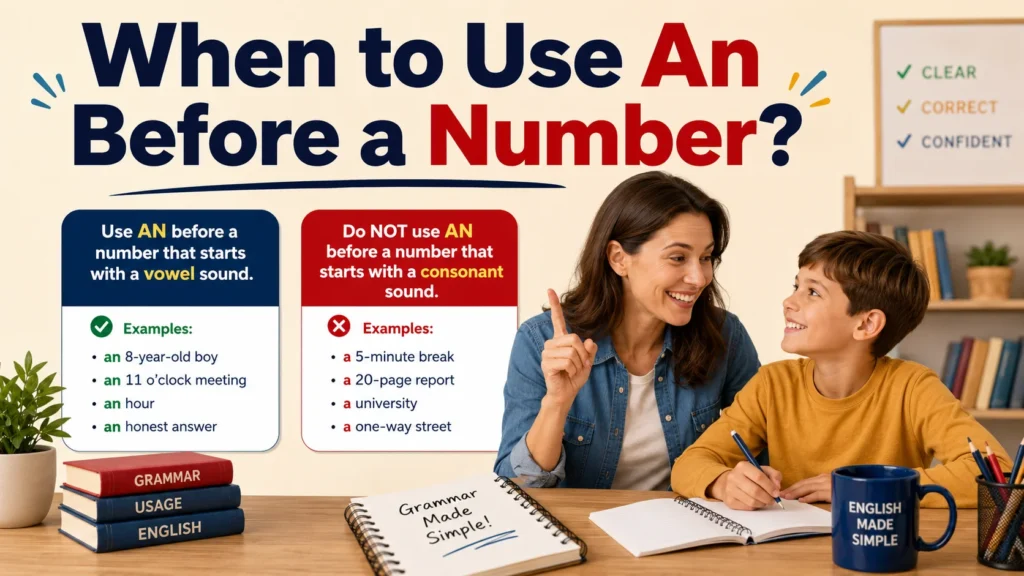
Use an when the spoken number starts with a vowel sound.
The most common examples involve numbers beginning with eight or eleven.
For example:
- an 8-hour shift
- an 8-mile hike
- an 11-day trip
- an 11-page essay
- an 18-year-old driver
- an 80% increase
- an 800-meter race
The same pattern works with larger numbers beginning with vowel-sounding forms.
| Number | Pronunciation | Correct phrase |
| 8 | eight | an 8-hour shift |
| 11 | eleven | an 11-day course |
| 18 | eighteen | an 18-page report |
| 80 | eighty | an 80% increase |
| 800 | eight hundred | an 800-meter race |
| 11,000 | eleven thousand | an 11,000-word document |
The important point is that eight, eighty, and eight hundred all begin with a vowel sound.
A or An Before Numbers in Ages
Age expressions create many opportunities to use this rule.
When a number functions as part of a compound adjective before a noun, the article still depends on pronunciation.
Compare:
- a 10-year-old child
- an 8-year-old child
- an 11-year-old student
- a 12-year-old boy
- an 18-year-old applicant
Why?
Because ten begins with /t/, while eight begins with a vowel sound.
There’s another useful detail here: when the number forms a compound adjective, year remains singular.
Correct:
- a 10-year-old
- an 18-year-old
- a 25-year-old
Not:
- a 10-years-old
- an 18-years-old
The plural years belongs in expressions such as 10 years old when the phrase isn’t functioning as a compound adjective.
Compare the two structures
Before a noun:
She is an 18-year-old student.
After the verb:
She is 18 years old.
This distinction is worth remembering because it prevents two common grammar mistakes at once.
A or An Before Numbers for Time and Duration
Time expressions follow the same pronunciation rule.
Use a when the number starts with a consonant sound:
- a 5-minute delay
- a 10-minute presentation
- a 20-minute walk
- a 30-minute lesson
- a 2-hour flight
Use an when the number begins with a vowel sound:
- an 8-minute delay
- an 11-minute presentation
- an 18-hour journey
- an 8-hour workday
For example:
The meeting lasted an 8-hour stretch with several short breaks.
In ordinary conversation, speakers may choose a simpler construction such as an eight-hour meeting. The grammar remains the same.
A or An Before Numbers for Measurements
Measurements provide another common setting for this rule.
You might see phrases involving:
- miles
- kilometers
- meters
- feet
- inches
- pounds
- kilograms
- acres
- liters
- gallons
Examples include:
- a 5-mile trail
- a 10-kilometer race
- an 8-mile trail
- an 11-meter pool
- a 20-pound package
- an 18-inch screen
Again, the measurement unit doesn’t decide whether you use a or an. The number’s pronunciation does.
A or An Before Numbers With Percentages
Percentages work in exactly the same way.
Consider these examples:
- a 5% increase
- a 10% decline
- an 8% increase
- an 11% reduction
- an 80% rise
When spoken aloud:
- 5% → five percent
- 10% → ten percent
- 8% → eight percent
- 11% → eleven percent
- 80% → eighty percent
That’s why an 80% increase is correct.
A useful shortcut
Ignore the % symbol for a moment.
Read only the number:
80 → eighty
Since eighty begins with a vowel sound, use an.
A or An Before Money Amounts
Money expressions can also require a or an.
Examples:
- a $5 fee
- a $10 charge
- a $20 bill
- an $8 fee
- an $11 charge
- an $18 payment
The dollar sign doesn’t change the pronunciation of the number.
So:
The service includes an $8 monthly fee.
But:
The service includes a $10 monthly fee.
The first begins with eight. The second begins with ten.
Cardinal Numbers vs. Ordinal Numbers
Cardinal numbers tell you how many:
- one
- two
- three
- eight
- eleven
Ordinal numbers tell you position or sequence:
- first
- second
- third
- eighth
- eleventh
The article still depends on pronunciation.
For example:
- a first attempt
- a second chance
- an eighth-grade class
- an eleventh-hour decision
Notice an eighth-grade class. Eighth begins with a vowel sound, so an is required.
Likewise:
It was an eighth-inning comeback.
The article doesn’t care whether the number is cardinal or ordinal. It cares about the sound that comes next.
When Numbers Are Read Digit by Digit
Here’s where things can become more interesting.
Numbers aren’t always pronounced as complete numbers. Sometimes speakers read individual digits.
A room number such as 804 might be pronounced:
“eight-oh-four”
In that case, the first sound is the vowel sound in eight.
So the appropriate article depends on that spoken form.
This situation can arise with:
- room numbers
- model numbers
- identification numbers
- product codes
- flight numbers
- account references
- telephone numbers
The broader principle remains unchanged: listen to the way the expression is actually spoken.
Complete number vs. digit-by-digit reading
Consider 1800.
If someone says:
eighteen hundred
the expression begins with a vowel sound, so an may be appropriate.
If the same sequence is read differently in a specific context, the article can change accordingly.
This is why blindly memorizing combinations such as “numbers beginning with 1 take a” doesn’t work. The spoken form controls the grammar.
Common Mistakes With A or An Before a Number
Choosing Based on the First Digit
A common mistake is thinking that the first digit determines the article.
It doesn’t.
For example, both of these start with the digit 1:
- a 10-minute break
- an 11-minute break
The difference comes from how you pronounce the numbers:
- ten → consonant sound
- eleven → vowel sound
Choosing Based on the Written Number
Another mistake involves treating numerals like ordinary spelling.
A reader sees 8 and thinks, “It starts with a number, so either article should work.”
English doesn’t work that way.
Read 8 aloud:
eight
Now the answer becomes obvious:
an 8
Assuming “A” Always Means One
The indefinite article a can express the idea of one, but that doesn’t mean you can replace it mechanically with the number one.
Compare:
She bought a 10-page notebook.
This means one notebook described by its length.
You could say:
She bought one 10-page notebook.
However, the emphasis changes. One highlights the quantity, while a works as an indefinite article.
A or An Before a Number: Quick Comparison
| Expression | Correct? | Why? |
| a 5-minute break | ✓ | five starts with /f/ |
| an 8-minute break | ✓ | eight starts with a vowel sound |
| a 10-mile hike | ✓ | ten starts with /t/ |
| an 11-mile hike | ✓ | eleven starts with a vowel sound |
| an 18-page report | ✓ | eighteen starts with a vowel sound |
| a 20-page report | ✓ | twenty starts with /t/ |
| an 80% increase | ✓ | eighty starts with a vowel sound |
| a 100-page book | ✓ | one starts with /w/ |
| an 800-meter race | ✓ | eight starts with a vowel sound |
| a 1,000-word essay | ✓ | one starts with /w/ |
A Simple Test for Choosing A or An
When you’re unsure about a or an before a number, use this three-step method.
Say the Number
Don’t rely on the written numeral.
Say:
8 → eight
or:
100 → one hundred
Listen to the First Sound
Ask yourself what sound you hear first.
- eight → vowel sound
- eleven → vowel sound
- eighteen → vowel sound
- ten → consonant sound
- twenty → consonant sound
- one → consonant sound
Choose the Article
Use:
A + consonant sound
AN + vowel sound
That’s the whole mechanism.
Practice Examples: Choose A or An
Try choosing the correct article before checking the answers.
- ___ 8-hour shift
- ___ 10-mile race
- ___ 11-page report
- ___ 20-minute meeting
- ___ 80% increase
- ___ 100-year-old building
- ___ 18-year-old applicant
- ___ 5-pound package
- ___ 800-meter race
- ___ 1,000-word essay
Answers
- an 8-hour shift
- a 10-mile race
- an 11-page report
- a 20-minute meeting
- an 80% increase
- a 100-year-old building
- an 18-year-old applicant
- a 5-pound package
- an 800-meter race
- a 1,000-word essay
The pattern should now be easy to spot. Eight, eleven, eighteen, and eighty begin with vowel sounds. Numbers pronounced with one, ten, twenty, and similar consonant-starting words take a.
Real-World Case Study: Choosing the Right Article
Imagine you’re writing a company report.
You need to describe three projects:
- one lasted 10 weeks
- another lasted 8 weeks
- another lasted 11 weeks
You might write:
The first project required a 10-week schedule. The second followed an 8-week schedule. The final project used an 11-week schedule.
Nothing about the project itself determines the article. The numbers do.
Now imagine changing the numbers:
The project required a 12-week schedule.
The article changes back to a because twelve starts with a consonant sound.
This small example shows why the rule is based on pronunciation rather than numerical value or spelling.
Here’s a concise conclusion and seven FAQs with the questions numbered in H3 format.
Conclusion
Choosing a or an before a number becomes much easier when you listen to the number instead of focusing on how it looks. Use a before a consonant sound, as in a 10-minute break or a 100-page report. Use an before a vowel sound, such as an 8-hour shift or an 11-page document. When you’re unsure, say the number aloud and listen to its first sound. This simple habit will help you make the right article choice with confidence.
FAQs
1. Should I use “a” or “an” before a number?
Use a before a consonant sound and an before a vowel sound. The pronunciation of the number determines the correct article.
2. Is it “a 10-minute break” or “an 10-minute break”?
The correct form is a 10-minute break because ten begins with a consonant sound.
3. Is it “a 8-hour shift” or “an 8-hour shift”?
The correct form is an 8-hour shift because eight begins with a vowel sound.
4. Should I say “a 100-page book” or “an 100-page book”?
Use a 100-page book because 100 is normally pronounced one hundred. The word one begins with a consonant sound.
5. Is it “a 11-year-old” or “an 11-year-old”?
Use an 11-year-old because eleven begins with a vowel sound.
6. Does spelling determine whether I use “a” or “an”?
No. Pronunciation determines the choice. Focus on the first sound of the number when spoken aloud.
7. What is the easiest way to choose “a” or “an” before a number?
Simply say the number aloud. If it starts with a consonant sound, use a. If it starts with a vowel sound, use an.
About The Author

