
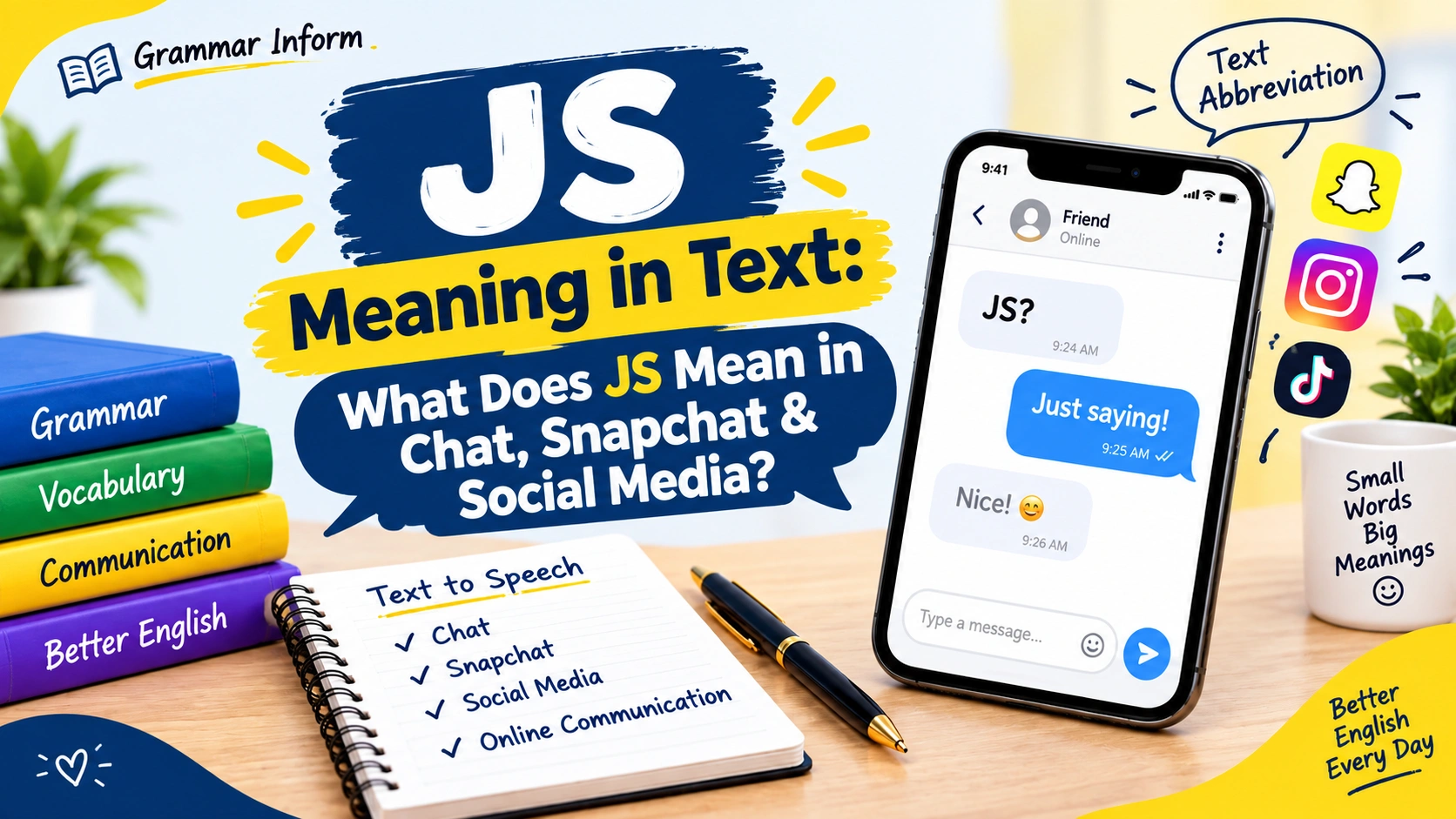
JS meaning in text usually means “just saying,” a common abbreviation and casual slang used in text messages, texting, and casual chats. People use it to share an opinion, comment, or small remark without sounding too serious or rude. You may see JS on WhatsApp, TikTok, Instagram, Snapchat, DMs, and other social media platforms. Its exact sense depends on the context, but “just saying” is the usual meaning.
In today’s online culture, people prefer short forms, shortcuts, and mini-words to save time. Along with JS, you may see LOL, BRB, IDK, and SMH in texts, apps, and comments. Teenagers and casual texters often use these terms because they’re easy to understand. However, coding and gaming may give JS different meanings, so checking the surrounding conversation helps avoid misunderstanding what the writer meant.
What Does JS Mean in Text?
In texting, JS most commonly means “just saying.” It works as a short conversational tag that people attach to an opinion, observation, suggestion, or comment.
The phrase “just saying” can communicate several slightly different ideas:
- “That’s just my opinion.”
- “I’m only pointing it out.”
- “I’m not trying to argue.”
- “Take it however you want.”
- “I’m simply being honest.”
- “I’m making a casual observation.”
For example:
“You could’ve told me earlier, JS.”
The sender isn’t necessarily starting an argument. They’re pointing something out while making the statement feel more casual.
Another example is
“That movie was actually pretty good, JS.”
Here, the person is simply emphasizing their opinion.
A Simple Example of JS in Text
Imagine this conversation:
Alex: “I think you should get the blue shoes.”
Sam: “The black ones look better, JS.”
In this situation, JS is just saying.
Sam isn’t necessarily trying to convince Alex. The abbreviation makes the comment sound more like a personal opinion than a firm judgment.
JS Full Form, Stands For, and Short Meaning
The most common texting expansion is
| Abbreviation | Meaning | Typical use |
| JS | Just saying | Texting, chats, DMs, comments |
| JS | JavaScript | Programming and technology |
| JS | Context-dependent abbreviation | Names, organizations, specialized conversations |
In casual digital communication, “just saying” is the meaning most relevant to texting and social media. Current slang references consistently describe JS this way.
The important distinction is context. If a friend writes, “That restaurant is overrated, JS,” they’re almost certainly saying “just saying.”
If a developer writes, “The JS isn’t loading,” they’re almost certainly referring to JavaScript.
Why Do People Use JS Instead of “Just Saying”?
Digital communication rewards brevity. Two letters are quicker to type than two words, especially in fast-moving chats and comment sections.
More importantly, JS has a conversational function. It can make an opinion sound less formal or less forceful.
Compare these:
“Your idea doesn’t make sense.”
and:
“Your idea doesn’t really work, JS.”
The second version still expresses criticism. Yet the abbreviation creates a softer, more casual frame around it.
How to Understand the JS Meaning Based on Context
The words around JS usually reveal what the sender intends.
If JS follows an opinion, it often means the person is emphasizing that the statement reflects their personal view.
“I think the first season was better, JS.”
If JS follows criticism, it may soften the criticism.
“You were a little harsh with him, JS.”
If JS appears with a laughing emoji, the message can become more playful.
“You really love talking about yourself, JS 😂”
That doesn’t necessarily mean the sender is angry. It could be teasing.
JS After an Opinion
This is one of the most natural uses.
“I think you should take the earlier flight, JS.”
Meaning:
“I’m just saying that the earlier flight might be better.”
JS After a Criticism
JS can also appear after something slightly blunt.
“You could’ve answered my message yesterday, JS.”
The abbreviation doesn’t erase the criticism. It simply frames the statement as a comment rather than a formal confrontation.
JS With Humor or Sarcasm
Tone becomes especially important when emojis, punctuation, or exaggerated wording appear.
“You only mentioned that story about 15 times today, JS 😂”
Here, JS may carry a playful or sarcastic tone.
The two letters haven’t changed. The surrounding language has.
How People Use JS in Everyday Conversations
People use JS mainly in informal communication. It can appear at the beginning or end of a message, although placing it at the end is especially natural.
JS at the End of a Message
“That shirt looks way better on you, JS.”
This sounds like a casual observation.
JS at the Beginning
“JS, you could’ve invited me too 😂”
Here, the abbreviation introduces the comment instead of closing it.
JS in a Group Chat
“JS, we probably should’ve booked the tickets earlier.”
The sender is offering an observation without turning it into a serious complaint.
JS When Giving Advice
“You should probably get some sleep, JS.”
The phrase can make advice feel less commanding.
JS Meaning on WhatsApp, Instagram, TikTok, and Snapchat
The basic JS meaning in text generally stays the same across major social and messaging platforms. WhatsApp, Instagram, TikTok, and Snapchat don’t give JS a separate universal definition.
What changes is the type of conversation where you encounter it.
JS on WhatsApp
WhatsApp conversations often involve friends, family, coworkers, and group chats. JS can therefore appear in casual opinions, suggestions, teasing, or criticism.
“JS, you should’ve told us you were coming 😂”
The emoji makes the message feel more playful.
JS on Instagram
On Instagram, you might see JS in comments, direct messages, captions, or replies.
“JS, this is probably your best picture.”
The sender is simply emphasizing an opinion.
JS on TikTok
TikTok comments move quickly, so short abbreviations fit naturally into the platform’s fast conversational style.
“JS, this trend is getting out of hand 😂.”
Here, JS introduces a casual observation.
JS on Snapchat
If someone sends JS through Snapchat, the meaning is generally still “just saying.”
For example:
“JS, you looked better with the old haircut.”
Whether that sounds helpful, teasing, or rude depends on the relationship and the surrounding conversation.
JS Meaning in Social Media Comments
Social media comments often lack the vocal cues people rely on during face-to-face conversations. Because of that, small additions such as JS, emojis, capitalization, and punctuation can influence how a message feels.
Consider:
“That outfit isn’t really your style.”
This sounds direct.
Now compare:
“That outfit isn’t really your style, JS 😂”
The second version can sound more casual or teasing.
However, JS doesn’t automatically make a rude statement polite. If the underlying comment is harsh, readers may still perceive it as harsh.
Is JS rude, sarcastic, or passive-aggressive?
JS isn’t inherently rude. Its tone depends heavily on what comes before it.
| Example | Likely tone |
| “You look great today, JS.” | Friendly |
| “I think you should leave earlier, JS.” | Helpful |
| “You could’ve answered me, JS.” | Mild criticism |
| “You really talk about him a lot, JS 😂” | Teasing |
| “Must be nice to have that much free time, JS.” | Potentially sarcastic |
This is why reading only the abbreviation can lead to the wrong conclusion.
A useful rule is simple: read the whole sentence before interpreting JS.
When JS Sounds Neutral
“I think the blue one looks better, JS.”
This usually sounds like a straightforward opinion.
When JS Sounds Defensive
Someone may use JS after making a statement they expect others to challenge.
“I don’t think that was a good idea, JS.”
The sender may be signaling that they’re sharing an opinion rather than claiming absolute authority.
When JS Sounds Sarcastic
Context can turn the same abbreviation into something sharper.
“Wow, another meeting that could’ve been an email, JS.”
Here, JS can reinforce the sarcasm.
Does JS Always Mean “Just Saying”?
No. JS doesn’t have one universal meaning in every context.
In ordinary texting, “just saying” is the most relevant interpretation. Yet technical conversations can point toward a completely different meaning.
There are also situations where JS may represent someone’s initials, an organization, or another context-specific abbreviation.
That doesn’t mean every possible expansion deserves equal attention. The surrounding conversation should determine the likely meaning.
JS vs. JavaScript: Two Completely Different Meanings
One of the biggest sources of confusion is JavaScript.
In programming, JS is a standard abbreviation for JavaScript. MDN describes JavaScript as a programming language used for dynamic behavior on webpages and also in server-side environments such as Node.js, Deno, and Bun.
Compare these two examples:
“JS, you should try the chocolate cake.”
Meaning: Just saying.
“I’m learning JS because I want to build interactive websites.”
Meaning: JavaScript.
The easiest clue is the subject of the conversation.
| Context | Likely JS meaning |
| Text message | Just saying |
| Instagram DM | Just saying |
| Snapchat chat | Just saying |
| TikTok comment | Just saying |
| Casual group chat | Just saying |
| Programming discussion | JavaScript |
| Web development tutorial | JavaScript |
| Developer forum | JavaScript |
JavaScript itself has nothing to do with the texting phrase “just saying.” They’re simply two unrelated uses of the same abbreviation.
Common Mistakes When Interpreting JS
Thinking JS Always Means JavaScript
Seeing “JS” doesn’t automatically mean programming.
If someone texts:
“That pizza looks amazing, JS.”
They’re not discussing a programming language.
Assuming JS Is Always Rude
JS can soften criticism, but it doesn’t automatically make a message hostile.
Look at the entire sentence and the relationship between the people involved.
Ignoring the Message Before JS
The most important clue often appears immediately before the abbreviation.
“You should probably bring a jacket, JS.”
That sounds like advice.
“You really thought that was a good idea, JS?”
That could sound sarcastic or challenging.
Treating Every Platform as Having a Different Definition
WhatsApp, Snapchat, Instagram, and TikTok don’t create separate meanings for JS. The same slang interpretation can travel across platforms.
Similar Texting Abbreviations and Related Expressions
JS belongs to a wider group of conversational shortcuts.
| Expression | Meaning | Typical purpose |
| JS | Just saying | Add an opinion or observation. |
| TBH | To be honest | Introduce honesty. |
| IMO | In my opinion | Mark a personal view. |
| IMHO | In my humble opinion | Express an opinion. |
| FYI | For your information | Provide information. |
| BTW | By the way | Add another point. |
These aren’t perfect substitutes.
For example, IMO directly identifies something as an opinion:
“IMO, the first movie was better.”
JS has a slightly different feel:
“The first movie was better, JS.”
The second sounds more conversational and less formal.
Examples of JS in Real Chat Situations
Sharing an Opinion
A: “Which phone should I buy?”
B: “I’d go with the black one, JS.”
Here, JS simply marks B’s preference.
Giving Friendly Advice
A: “I haven’t slept much this week.”
B: “You should probably take a break, JS.”
The sender is expressing concern.
Making a Mild Criticism
A: “Why didn’t anyone tell me?”
B: “You did leave the group chat, JS.”
Here, JS makes the correction sound somewhat casual.
Adding Humor
A: “I’m definitely not obsessed with this show.”
B: “You’ve watched it four times this week, JS 😂”
The abbreviation helps frame the observation as teasing.
How to Reply When Someone Says JS
You don’t need a special response every time someone uses JS. Reply to the actual statement rather than the abbreviation.
Casual Replies
“Fair enough 😂”
“I get what you mean.”
“Yeah, that’s true.”
Friendly Replies
“Honestly, I agree.”
“Good point.”
“I was thinking the same thing.”
Funny Replies
“Just saying what? 👀”
“Okay, message received 😂”
“You really had to add the JS, huh?”
When You Disagree
“I see your point, but I look at it differently.”
“Maybe, but I actually prefer the other option.”
A calm response usually works better than overanalyzing two letters.
Is JS Still Common in Texting?
JS remains recognizable as a casual abbreviation for “just saying.” Current online slang references continue to describe it as a texting and social media shorthand, particularly in informal conversations.
However, there isn’t a reliable public statistic showing exactly how many people use JS or proving that its usage is increasing or declining worldwide. Claims about a precise usage percentage should therefore be treated cautiously.
What matters more is where you encounter it. Informal chats, comments, DMs, and social media conversations are the natural environments for this type of abbreviation.
Quick Facts About JS
- Most common texting meaning: Just saying
- Common purpose: Share an opinion or observation casually
- Typical position: Beginning or end of a message
- Tone: Casual, friendly, blunt, teasing, or sarcastic depending on context
- Common platforms: Text messages, WhatsApp, Instagram, TikTok, Snapchat, and online chats
- Technical meaning: JavaScript
- Formal writing: Avoid JS when “just saying” is clearer
- Best interpretation rule: Read the surrounding message before deciding what JS means
FAQs
Q.1 What does “JS” mean in text?
JS usually means “Just Saying.” It’s commonly used in casual text messages, chats, and social media.
Q.2 Is JS a slang abbreviation?
Yes. JS is a casual slang abbreviation that people use when sharing an opinion or making a quick remark.
Q.3 What does JS mean on social media?
On social media, “JS” generally means “Just Saying.” It can make a comment sound more casual or less direct.
Q.4 Can JS have other meanings?
Yes. JS can have different meanings in areas such as coding or gaming. The correct meaning depends on the context.
Q.5 How should I use JS in a text?
You can use JS after sharing an opinion or remark. For example, “That movie was better than I expected, JS.”
Conclusion
JS usually means “Just Saying” in texting, chats, and social media. People use it to share an opinion or comment in a casual way without sounding too serious or rude. Since abbreviations can have different meanings, always check the context before deciding what JS means.
