
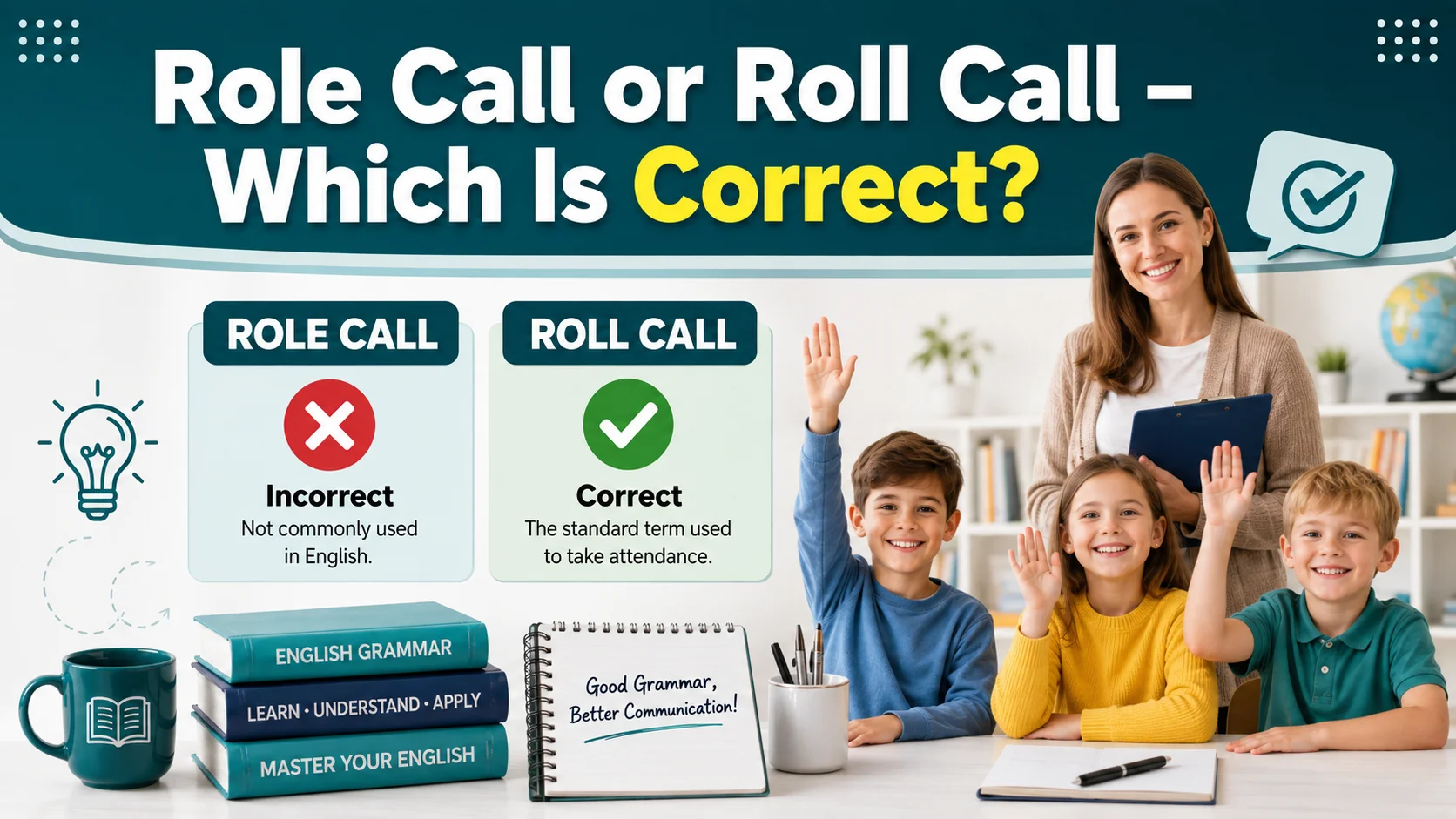
Role Call or Roll Call is a common spelling question because these homophones sound alike but have different meanings. In standard American English, roll call is the correct expression for calling a list of names to check attendance. Role call is usually a spelling mistake. A roll can mean a list of names, while a role means a function, job, responsibility, position, or part in a situation.
The same issue appears in school, work, and HR settings. Professional writers need correct spelling because incorrect usage can create confusion, misunderstanding, and mix-ups in formal writing and professional writing. Reading articles, blogs, and books can help you learn and remember the difference. When searching keywords online, look at the context. Use roll call for attendance, a list, names, and calling people’s names.
A simple memory trick makes the distinction easy: roll = list and role = function. With practice, logic, grammar, and memory, you can avoid common spelling mistakes and use the correct phrase with greater accuracy. Whether you’re tracking attendance or explaining someone’s position, the meaning tells you which word to choose. These helpful tricks make it easier to remember, apply, and understand exactly why roll call is correct for attendance while role describes what someone does.
Role Call vs. Roll Call: What’s the Difference?
The difference between role call and roll call comes down to meaning and spelling.
| Word | Meaning | Example |
| roll | A list of names, movement, or something formed into a cylinder | The teacher took the roll. |
| role | A function, position, responsibility, or character | She has an important role on the team. |
| roll call | Calling names to check who is present | The teacher started roll call. |
| role call | Not the standard spelling for attendance | ❌ The teacher started role call. |
A roll can mean an official list of people. Cambridge Dictionary specifically defines roll as an official list of names and gives take/call the roll as an American English expression for reading names aloud to determine who is present.
A role, on the other hand, describes what someone does or the part they perform. Merriam-Webster defines role as a character, a socially expected behavior pattern, or a function performed in a particular process.
So although the words sound nearly identical, they don’t belong in the same meaning category.
What Does “Roll Call” Mean?
Roll call means calling the names of people on a list to determine who is present.
It’s most commonly associated with schools, military organizations, meetings, workplaces, and other groups where knowing who is present matters.
For example:
- The teacher took roll call before starting the lesson.
- The captain conducted roll call at the beginning of the shift.
- The committee held a roll call before voting.
- The coach took roll before practice.
- The instructor called the roll to see who was absent.
The expression can describe the actual act of checking attendance. It can also refer to the formal procedure used to establish who belongs to a group or who is currently present.
A legal dictionary based on Merriam-Webster defines roll call as calling a list of names to check attendance. In legislative settings, it can also refer to calling members to determine whether a quorum exists or to record votes.
What Is the Meaning of “Roll” in “Roll Call”?
This is where the spelling becomes easier to remember.
The noun roll has a meaning that goes beyond physical movement. It can refer to an official list of names.
For example:
- electoral roll
- honor roll
- roll of members
- roll of names
- roll of voters
When you hear roll call, imagine someone holding a list of names and reading through it.
That’s the connection.
The phrase doesn’t mean that someone’s role is being called. It means that a roll, or list, is being called.
What Does “Role” Mean?
The word role refers to a person’s function, position, responsibility, or part in something.
For example:
- She plays a leadership role in the organization.
- His role is to train new employees.
- What is your role in the project?
- The actor received the leading role.
- Parents often have an important role in children’s education.
Merriam-Webster traces role to French rôle and ultimately to an Old French word associated with a roll or scroll. Its modern English meanings include a character played by an actor and a function performed in an operation or process.
That history explains why role and roll are related in a deeper way than their spelling suggests. Yet modern English treats them as separate words with separate meanings.
Role Means “Function”
One of the easiest ways to understand role is to replace it with function.
If the sentence still makes sense, role may be the right word.
For example:
Her role is to manage the department.
You could say:
Her function is to manage the department.
That works.
Now try the same test with roll call:
The teacher took the roll.
You wouldn’t say:
The teacher took the function.
That clearly doesn’t work.
The meaning gives you the answer.
Why Do People Confuse “Role” and “Roll”?
The biggest reason is simple: role and roll are homophones.
A homophone is a word that sounds the same as another word but has a different spelling and meaning.
Common examples include:
- role / roll
- right / write
- there / their / they’re
- to / too / two
- brake / break
- flower / flour
When you hear someone say roll call, you don’t see the spelling in your head. You only hear the sound.
That creates an opening for confusion.
The problem becomes even more likely when someone understands the general meaning but hasn’t encountered the written expression often. They may associate the event with people’s roles and instinctively choose role.
That’s understandable. It just isn’t the standard spelling.
Why Is It “Roll Call” Instead of “Role Call”?
The answer lies in the older meaning of roll as a list or register.
A roll can be a formal list of people. An attendance roll, for instance, contains the names of members of a group. When someone calls the roll, they read those names aloud.
The structure is therefore straightforward:
roll = list of names
call = read or announce the names
roll call = the act of calling the names on the list
You can picture the phrase as a simple process:
List of names
↓
Names are called
↓
People respond or are marked present
↓
Attendance is confirmed
The word role doesn’t perform any useful function in that sequence.
A Brief History of “Roll Call”
The history of roll call connects to the older use of roll for a list or register.
Before modern digital attendance systems, institutions relied on written records to keep track of members. A roll could contain the names of soldiers, voters, students, officials, or members of an organization.
Calling the roll meant going through that list.
That practice became especially important in military and government settings. A commander needed to know which personnel were present. A legislative body needed to know which members were present before conducting certain business.
The same basic idea eventually became common in classrooms and other organized groups.
The word roll still preserves this list-related meaning today. Cambridge Dictionary gives examples such as an electoral roll and explains that take the roll or call the roll means reading names aloud to determine who is present.
So roll call isn’t an arbitrary spelling. It reflects an older meaning of roll that remains active in English.
Roll Call in Modern Contexts
You don’t have to be in a nineteenth-century classroom or military barracks to hear roll call today.
The expression remains useful in several settings.
Roll Call in Schools and Classrooms
Schools are probably one of the first places many English speakers encounter roll call.
A teacher may begin class by reading students’ names:
“Alex?”
“Here.”
“Maria?”
“Here.”
“Jordan?”
“Absent.”
That’s a roll call.
The teacher is checking the class list against the people physically present.
In American English, you may also hear:
- take roll
- call roll
- take attendance
- check attendance
For example:
The teacher took roll before the quiz.
Ms. Carter called the roll at the beginning of class.
The instructor took attendance before the lecture.
These expressions overlap, although take attendance often sounds more general and modern.
Roll Call in the Military
Military organizations have long used roll calls as a way to account for personnel.
A roll call can establish who is present at a particular time or location. In situations where accountability matters, knowing exactly who is present can be essential.
The underlying idea remains the same:
name on the list → name called → presence confirmed
The terminology may differ depending on the organization and procedure. However, roll call remains a recognized expression for this kind of formal accounting.
Roll Call in the Workplace
Modern workplaces don’t usually conduct roll call every morning in the way a classroom might.
Still, the expression can appear in specific situations.
For example:
The supervisor conducted a roll call before the emergency drill.
We had a quick roll call before leaving for the field site.
The team leader took roll call before the overnight shift.
In an ordinary office, attendance check or attendance list may sound more natural. The phrase roll call tends to carry a more formal or organized feel.
Roll Call in Government and Organizations
Roll call has another important use in formal meetings.
A committee, council, or legislative body may call members’ names to establish who is present. In some voting procedures, members respond individually to indicate their position.
This gives roll call a meaning beyond classroom attendance.
For example:
The clerk conducted a roll call before the vote.
In this context, the names aren’t simply being checked for attendance. The procedure may establish whether enough members are present or record individual votes.
Roll Call vs. Attendance: Are They the Same?
Roll call and attendance overlap, but they aren’t always interchangeable.
Attendance is the broader concept. It refers to the fact or record of being present.
Roll call usually refers to the process of calling names to determine who is present.
| Expression | Meaning | Example |
| roll call | Calling names to check presence | We had roll call at 8 a.m. |
| attendance | The state or record of being present | Attendance was excellent today. |
| attendance list | A list showing who attended | Check the attendance list. |
| sign-in sheet | A sheet people sign to record arrival | Please sign the sign-in sheet. |
| register | An official record or list | The teacher marked the register. |
This distinction becomes useful when choosing natural wording.
You might say:
The teacher took roll call.
But you’d more likely say:
The teacher recorded attendance.
Both sentences relate to the same general activity. They simply emphasize different parts of it.
Roll Call vs. Register
Another useful comparison involves roll call and register.
In American English, roll call and take attendance are familiar expressions. In British English, register is especially common for the official attendance record or the process of checking it.
For example:
US English:
The teacher took roll.
The teacher took attendance.
British English:
The teacher took the register.
These aren’t completely different concepts. They’re different terms used within related educational systems and varieties of English.
If you’re writing specifically for an American audience, roll call and attendance will generally sound natural in school-related contexts.
Can “Role Call” Ever Be Correct?
Here’s where a little nuance matters.
Role call isn’t the standard spelling of the attendance expression. If you’re writing about checking attendance, use roll call.
However, English allows writers to create unusual phrases for specific purposes. Someone could theoretically write role call as a deliberate wordplay expression involving people’s roles.
For instance, a fictional workplace might jokingly announce:
“It’s time for our role call. What does everyone actually do around here?”
Here, the writer intentionally changes roll to role to create a pun.
That’s different from accidentally writing role call when you mean attendance.
For normal writing, schoolwork, business communication, journalism, and formal documents, stick with roll call.
Common Expressions With “Roll”
Understanding other uses of roll can make the spelling easier to remember.
Common expressions include:
- roll call
- honor roll
- roll of names
- electoral roll
- roll of members
- roll of voters
- roll the dice
- roll up
- roll over
Some of these meanings involve lists or records.
For example, an honor roll is a list of students who meet certain academic requirements. An electoral roll is a list of people eligible to vote in a particular system.
That list-related meaning connects directly to roll call.
Common Expressions With “Role”
Now look at expressions built around role.
- role model
- leading role
- supporting role
- leadership role
- job role
- role reversal
- role-playing
- key role
- important role
These expressions revolve around function, position, behavior, or character.
For example:
She has a key role in the project.
He played the leading role in the movie.
She became a role model for younger students.
Merriam-Webster similarly uses role for a character performed by an actor and for a function within a process.
That gives you a useful semantic boundary:
Role = what someone does or represents.
Roll = a list, among other meanings.
Roll vs. Role: Quick Comparison
| Feature | Roll | Role |
| Basic meaning | List, movement, or rounded form | Function, position, or character |
| Common phrase | roll call | role model |
| Attendance use | Yes | No |
| Describes a responsibility | No | Yes |
| Example | The teacher took roll. | Her role is important. |
| Pronunciation | Usually /roʊl/ | Usually /roʊl/ |
| Common confusion | Sounds like role | Sounds like roll |
The pronunciation creates the trap.
The meaning provides the escape.
How to Remember “Roll Call”
A simple memory trick can save you from this mistake permanently.
Memory Trick: A Roll Contains Names
Think of roll as a list.
Imagine a teacher holding a sheet containing thirty names.
That sheet is the roll.
When the teacher reads those names aloud, that’s roll call.
Roll = list of names → roll call
Memory Trick: Role Means Responsibility
Now connect role with responsibility.
If you’re asking what someone does, you’re asking about their role.
What is your role on the team?
If you’re asking who’s present, you’re dealing with a roll.
Who is on the roll?
This two-part rule works remarkably well:
Roll = list.
Role = function.
Use the Meaning Test
When you’re unsure, stop listening to the sound and examine the meaning.
Ask:
“Am I talking about a list of people?”
If yes, choose roll.
Ask:
“Am I talking about someone’s function or responsibility?”
If yes, choose role.
This approach works because spelling isn’t always predictable from pronunciation. Meaning often provides the stronger clue.
Common Mistakes With “Roll Call”
Several mistakes appear repeatedly around this expression.
Writing “Role Call”
This is the most common mistake.
Wrong: The teacher started role call.
Right: The teacher started roll call.
Assuming “Role” Refers to the People
Someone might reason that each person has a role, so role call seems logical.
The problem is that the phrase doesn’t ask people to identify their functions. It checks whether they’re present.
Confusing “Roll Call” With “Take Attendance”
These expressions are related, but they aren’t identical in every context.
Roll call emphasizes the calling or checking of names.
Attendance refers more broadly to presence or the attendance record.
Incorrectly Hyphenating “Roll Call”
As a standard noun phrase, roll call is normally written as two words.
For example:
The teacher took roll call.
You may encounter hyphenated forms in specialized grammatical constructions, but ordinary noun use doesn’t require a hyphen.
Is “Roll Call” One Word or Two?
The standard expression is two words: roll call.
Write:
roll call
Not:
❌ rollcall
And not:
❌ role call
For example:
We had roll call before the field trip.
The officer began roll call at six.
I missed roll call this morning.
The spacing matters because roll and call remain separate words in the ordinary expression.
Is “Roll Call” Hyphenated?
In standard everyday usage, roll call is generally written as two words.
You don’t need to write:
❌ roll-call
when using the phrase as a normal noun.
For example:
The teacher took roll call.
However, English sometimes uses hyphens when compound terms function together as modifiers. The exact treatment can depend on the sentence and style guide.
For ordinary writing, the safest form is simple:
roll call
What Does “Take Roll” Mean?
Take roll means to check attendance by calling or reviewing the names on a roll.
This expression is particularly familiar in American English.
For example:
The teacher took roll before the exam.
I’ll take roll while everyone gets settled.
Did anyone take roll today?
Cambridge Dictionary identifies take/call the roll as mainly US usage and defines it as reading the names on a list to determine who is present.
So you may encounter several related expressions:
- take roll
- call the roll
- take roll call
- conduct roll call
- take attendance
- check attendance
The exact choice depends on context and personal or regional usage.
A Practical Case Study: Choosing the Right Word
Imagine you’re writing this sentence:
“The teacher checked the students’ ___ before the exam.”
Should you use role or roll?
Start with the meaning.
The teacher isn’t asking what function each student performs. The teacher is checking a list of students.
Therefore:
“The teacher checked the students’ roll before the exam.”
Or, more naturally:
“The teacher took roll call before the exam.”
Now change the situation:
“The teacher explained each student’s ___ in the group project.”
This time, you’re discussing responsibilities.
The correct word becomes:
“The teacher explained each student’s role in the group project.”
The sounds haven’t changed.
Only the meaning has.
That’s exactly why these words cause confusion.
Conclusion
The correct expression is roll call, not role call, when you mean checking attendance or calling a list of names. Remember the simple rule: roll = list and role = function. Once you connect each word with its meaning, this common homophone confusion becomes much easier to avoid.
FAQs
Q1. Is “Role Call” Correct?
No. Roll call is the standard expression for calling names to check attendance. Role refers to a person’s function, position, or responsibility.
Q2. What Does “Roll Call” Mean?
Roll call means calling a list of names to find out who is present. It’s commonly used in schools, workplaces, military settings, and formal meetings.
Q3. Why Are Roll and Role Confused?
Roll and role are homophones, so they sound alike in American English. Their spellings and meanings, however, are different.
Q4. What Is the Difference Between Roll and Role?
Roll can mean a list of names, while role means a function, job, position, or responsibility. For example, a teacher takes roll while an employee has a specific role.
Q5. How Can I Remember “Roll Call”?
Use this simple memory trick: roll = list and role = function. If you’re checking attendance, choose roll call.
About The Author

