
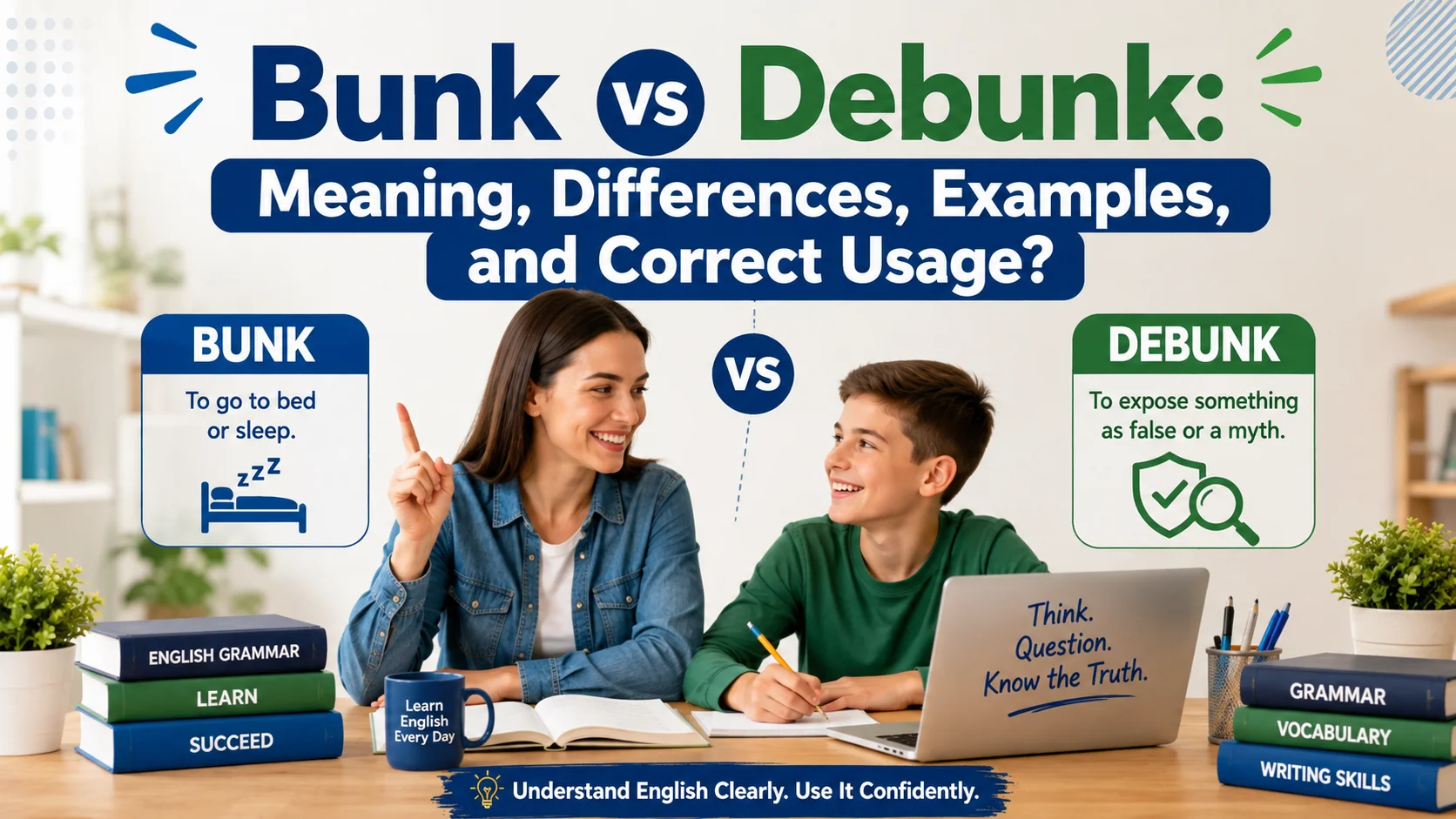
Bunk vs Debunk can confuse many English learners because the words look and sound alike. A simple comparison, clear definition, and easy examples help you understand the difference. Better vocabulary, grammar, word choice, and language learning improve your writing, communication, and everyday language, making it easier to choose the correct word with confidence.
Bunk means nonsense, false information, or a false claim without proof, evidence, or truth. Debunk means to expose, prove false, reveal, or challenge a myth, legend, belief, or public perception using fact-checking, logic, and evidence-based research. Although they seem interchangeable, they have different meanings.
The origin of Debunk goes back to William Woodward, an American writer, in 1923, while Bunk came from bunkum or buncombe. In American English, Bunk can describe a bed, sleeping berth, or the phrase do a bunk, meaning to leave or escape. Famous magicians like Houdini and Penn and Teller used illusion instead of magic to show how facts separate fiction from reality.
Bunk vs Debunk at a Glance
Although bunk and debunk share similar spelling, they belong to different parts of speech and serve different purposes. The table below highlights the key differences.
| Feature | Bunk | Debunk |
| Part of Speech | Usually a noun | Verb |
| Basic Meaning | Nonsense, foolish ideas, or false claims | To prove that a claim, myth, or belief is false |
| Common Context | Informal speech, opinions | Journalism, science, education, fact-checking |
| Example | “That’s complete bunk.” | “Researchers debunked the rumor.” |
| Tone | Informal | Neutral to formal |
The One-Sentence Difference
Think of it this way:
- Bunk is the false or meaningless claim.
- Debunk is the act of proving that claim is false.
For example:
- “The internet rumor is bunk.”
- “Scientists debunked the internet rumor.”
That single distinction solves most confusion between these two words.
When People Confuse These Words
Many learners assume debunk means “to create bunk” because of the prefix de-. In reality, the word developed as a verb meaning to remove the falsehood from a claim by exposing the truth.
Another common mistake is using bunk as a verb.
❌ The journalist bunked the rumor.
✅ The journalist debunked the rumor.
Learning this pattern helps you avoid one of the most frequent grammar errors involving these words.
What Does “Bunk” Mean?
The word bunk has more than one meaning in English. Depending on the context, it can refer to a bed, but in modern conversation it most often means nonsense, rubbish, or something that isn’t true.
When someone says, “That’s bunk,” they mean they don’t believe the statement because it lacks evidence or common sense.
Definition of Bunk
In everyday American English, bunk usually means:
- Nonsense
- False information
- Empty claims
- Worthless ideas
It often appears in informal conversations when people dismiss a statement as untrue.
For example:
- “That conspiracy theory is bunk.”
- “Everything he said sounded like bunk.”
- “Don’t believe that article. It’s complete bunk.”
Notice that the word expresses skepticism rather than simply disagreement.
Common Meanings of Bunk
The meaning changes with context.
| Meaning | Example |
| Nonsense | “That’s pure bunk.” |
| False claim | “The advertisement was full of bunk.” |
| Worthless opinion | “Most of those rumors are bunk.” |
| Sleeping berth or bed | “The sailor climbed into his bunk.” |
The “bed” meaning comes from older English and remains common in places like military housing, ships, trains, camps, and hostels.
However, if you’re reading newspapers, opinion articles, or hearing everyday conversations, bunk almost always refers to nonsense rather than furniture.
Origin and Etymology
The history of bunk is surprisingly interesting.
The word originally referred to a wooden sleeping shelf or built-in bed, especially on ships and trains during the eighteenth century. Over time, speakers began using bunkum, a humorous American political term for empty speeches that sounded impressive but lacked substance.
Eventually, bunkum was shortened to bunk.
From that point forward, the word became a quick way to describe:
- Meaningless arguments
- False claims
- Political exaggeration
- Misleading information
Today, that figurative meaning is far more common than the original one.
How “Bunk” Is Used in Modern English
Modern English speakers use bunk to reject ideas they believe have no factual support.
You’ll often hear it in discussions about:
- Politics
- Advertising
- Internet rumors
- Conspiracy theories
- Health myths
- Social media misinformation
Examples include:
- “That miracle cure is bunk.”
- “Experts say those claims are bunk.”
- “The viral post turned out to be bunk.”
Because the word is informal, it fits casual conversations much better than academic writing.
Instead of writing:
“The hypothesis is bunk.”
A research paper would usually say:
“The hypothesis is unsupported by evidence.”
Choosing the right level of formality makes your writing stronger.
Common Expressions Using “Bunk”
Several expressions have remained popular for decades.
Some examples include:
- Pure bunk
- Complete bunk
- That’s bunk
- A bunch of bunk
- Nothing but bunk
Each phrase communicates that something is false, exaggerated, or not worth believing.
For example:
- “The email promising instant wealth was nothing but bunk.”
- “His excuse sounded like complete bunk.”
- “The rumor spreading online is pure bunk.”
These expressions are especially common in spoken American English.
Example Sentences
Reading words in context makes them easier to remember.
Here are several examples.
Everyday conversation
- “I think that’s bunk, and I won’t believe it without evidence.”
- “Most of those online rumors are complete bunk.”
News
- “Officials dismissed the claims as bunk after reviewing the evidence.”
Business
- “Customers quickly realized the advertisement was bunk because the product never worked.”
Education
- “The teacher explained why the internet myth was bunk before showing reliable sources.”
Mini Case Study: Spotting Bunk Online
Imagine a social media post claims that drinking a special juice can cure every disease overnight.
At first glance, the message sounds convincing because it includes dramatic photos and emotional stories. However, the post offers no scientific evidence, cites no medical research, and links to unreliable websites.
A health expert reviews the claim and concludes that it has no factual basis.
At this stage:
- The original claim is bunk.
- The expert hasn’t debunked it yet until they publish evidence explaining why it’s false.
This distinction becomes important in journalism, education, and science.
What Does “Debunk” Mean?
Unlike bunk, which names the false claim itself, debunk describes the action of exposing that false claim with facts, logic, or reliable evidence.
You’ll often see this word in news articles, scientific research, documentaries, and fact-checking websites because those sources regularly investigate questionable claims.
Definition of Debunk
Debunk means:
- To expose a myth as false
- To prove that a claim lacks evidence
- To reveal the truth behind misinformation
- To challenge false beliefs with facts
For example:
- “Scientists debunked the myth.”
- “The documentary debunks several common misconceptions.”
- “Researchers debunked the viral rumor within days.”
Notice that debunk always involves evidence, not just opinion.
Origin and Word History
The verb debunk appeared in American English during the early twentieth century.
It developed from the noun bunk, meaning nonsense. Adding the prefix de- created a verb that meant to remove the nonsense from a claim by exposing the truth.
As newspapers grew and investigative journalism became more common, debunk gained popularity.
Today, the word appears frequently in:
- Scientific journals
- Fact-checking organizations
- History books
- Educational websites
- Investigative reporting
Its meaning has remained remarkably consistent over time.
How “Debunk” Is Used Today
Modern writers use debunk whenever they explain why a claim, rumor, or myth is inaccurate.
You’ll often encounter it in discussions about:
- Medical myths
- Historical misconceptions
- Internet hoaxes
- Viral social media posts
- Urban legends
- Fake news
Examples include:
- “Researchers debunked the health myth through clinical studies.”
- “The article debunks several misconceptions about grammar.”
- “Historians debunked the popular legend using original documents.”
Unlike bunk, debunk works well in both formal and informal writing because it describes a clear action supported by evidence.
Bunk vs Debunk: What’s the Difference?
The easiest way to remember bunk vs debunk is to think about what each word refers to.
- Bunk is the false idea, claim, or nonsense itself.
- Debunk is the process of proving that claim is false.
In other words, you identify bunk, but you debunk it.
Meaning Comparison
| Bunk | Debunk |
| Means nonsense or false information | Means to expose false information |
| Usually a noun | Always a verb |
| Describes the claim | Describes the action |
| Often informal | Used in both formal and informal writing |
| Example: “That’s bunk.” | Example: “Experts debunked the claim.” |
Grammar and Part of Speech
Grammar also separates these words.
| Word | Part of Speech | Example |
| Bunk | Noun | “That story is bunk.” |
| Debunk | Verb | “Scientists debunked the story.” |
Because debunk is a verb, it changes tense.
- Debunk
- Debunks
- Debunked
- Debunking
For example:
- “Researchers debunk myths.”
- “The journalist debunked the rumor.”
- “Fact-checkers are debunking false claims every day.”
Purpose and Context
Although both words relate to false information, they serve different purposes.
Use bunk when describing something that lacks truth.
Use debunk when talking about the act of correcting or exposing that falsehood.
For example:
“The advertisement was bunk.”
Later, investigators examined the product.
“Consumer experts debunked the advertisement with laboratory tests.”
The first sentence identifies the problem. The second explains how the problem was exposed.
Side-by-Side Comparison Table
| Situation | Correct Word | Example |
| Calling an idea nonsense | Bunk | “That rumor is bunk.” |
| Proving a rumor false | Debunk | “Police debunked the rumor.” |
| Describing fake claims | Bunk | “The article contains bunk.” |
| Explaining facts | Debunk | “Researchers debunked the myth.” |
When to Use “Bunk”
Use bunk whenever you want to dismiss a statement, opinion, or claim as false or meaningless.
It works best in casual speech, opinion writing, and everyday conversations.
Everyday Conversations
You’ll often hear native speakers use bunk when reacting to unbelievable stories.
Examples include:
- “That’s complete bunk.”
- “I don’t believe that. It’s bunk.”
- “Those rumors are nothing but bunk.”
The word adds emphasis without sounding overly formal.
Journalism and Opinion Writing
Opinion writers sometimes use bunk to criticize unsupported claims.
For example:
“Experts called the viral health advice bunk after reviewing the evidence.”
The word immediately tells readers the information shouldn’t be trusted.
Informal vs Formal Contexts
Although native speakers understand bunk, it isn’t always appropriate in formal documents.
Instead of writing:
“The report contains bunk.”
A formal report might say:
- The report contains false information.
- The report includes unsupported claims.
- The report lacks credible evidence.
Choosing language that matches your audience always improves your writing.
When to Use “Debunk”
Use debunk when someone investigates a claim and proves it false using evidence.
Unlike bunk, this word fits almost every writing style.
Academic and Research Writing
Researchers frequently debunk myths through experiments and data.
Examples:
- Scientists debunked the health myth.
- Archaeologists debunked the historical legend.
- Linguists debunked several grammar misconceptions.
Academic writing values evidence, making debunk a natural choice.
News, Science, and Media
Fact-checking organizations use this word every day.
Headlines often include phrases such as:
- Experts debunk online rumor.
- Scientists debunk climate myth.
- Historians debunk famous legend.
Readers immediately understand that someone investigated the claim rather than simply disagreeing with it.
Everyday Conversations
You don’t need to be a scientist to use debunk.
Friends often say:
- “She debunked that rumor in five minutes.”
- “He debunked the myth with real evidence.”
- “The teacher debunked the misconception during class.”
The word simply means proving something false.
Common Mistakes and How to Avoid Them
Even advanced English learners sometimes mix these words up. Fortunately, the mistakes are easy to fix once you understand the difference.
Using “Bunk” as a Verb
This is the most common error.
❌ He bunked the rumor.
✅ He debunked the rumor.
Remember that bunk usually isn’t a verb meaning “prove false.”
Confusing “Debunk” with “Disprove”
These words overlap, but they aren’t identical.
Disprove focuses on showing that something is factually incorrect.
Debunk often goes one step further by exposing myths, misconceptions, or deceptive claims.
For example:
A scientist may disprove a theory.
A journalist may debunk a conspiracy theory.
Both involve evidence, but debunk often targets beliefs that many people accept without proof.
Remembering the Difference Easily
A simple memory trick works well.
- Bunk = Bad information.
- Debunk = Destroy bad information with evidence.
If you’re exposing the truth, use debunk.
If you’re describing nonsense, use bunk.
Bunk vs Debunk Examples
Reading real examples helps the meanings stick.
Conversation Examples
- “That’s bunk. I don’t believe it.”
- “She debunked the rumor with official documents.”
- “Those online stories are complete bunk.”
- “The professor debunked several myths during the lecture.”
News and Media Examples
- “Investigators debunked the viral social media claim.”
- “Experts called the advertisement bunk.”
- “Medical researchers debunked the popular health myth.”
- “Officials dismissed the rumor as bunk.”
Writing Examples
Incorrect:
“The journalist bunked the story.”
Correct:
“The journalist debunked the story.”
Incorrect:
“The article debunk.”
Correct:
“The article debunks several common myths.”
Correct vs Incorrect Sentences
| Incorrect | Correct |
| He bunked the rumor. | He debunked the rumor. |
| That myth is debunk. | That myth has been debunked. |
| Experts said the rumor was debunk. | Experts said the rumor was bunk. |
| Researchers bunked the claim. | Researchers debunked the claim. |
Similar Words You Should Know
Expanding your vocabulary helps you choose the most accurate word.
Myth vs Fact
A myth is a widely believed story that may not be true.
A fact is supported by reliable evidence.
Debunking often turns myths into facts by revealing the truth.
Disprove vs Debunk
Although similar, these words have different shades of meaning.
| Disprove | Debunk |
| Shows something is incorrect | Exposes a false belief or myth |
| Often scientific | Common in journalism and education |
| Focuses on evidence | Focuses on correcting misinformation |
Nonsense, Baloney, Hogwash, and Bunk
These words all suggest something isn’t true.
However, each carries a different tone.
- Nonsense – neutral and common.
- Baloney – informal and humorous.
- Hogwash – old-fashioned and expressive.
- Bunk – informal and direct.
Knowing these alternatives makes your writing more varied.
Refute vs Debunk
Refute means proving an argument wrong with logic or evidence.
Debunk usually targets myths, rumors, or misleading claims.
A lawyer may refute an argument.
A fact-checker may debunk a viral hoax.
Memory Tricks to Never Mix Them Up Again
Learning becomes easier when you connect new words to simple ideas.
Easy Mnemonics
Remember this sentence:
“Bunk is the lie. Debunk tells you why.”
Another helpful reminder:
- Bunk begins with B, which can remind you of bogus.
- Debunk begins with De-, which you can associate with destroying false information.
These shortcuts work because they connect the words with their meanings.
Real-Life Association Method
Imagine reading an online post claiming that the moon is made of cheese.
The claim itself is bunk.
Then an astronomer explains the moon’s actual composition using scientific evidence.
The astronomer has debunked the claim.
Visualizing this sequence helps many learners remember the difference for years.
Conclusion
Understanding Bunk vs Debunk helps you choose the right word with confidence. Bunk refers to nonsense, false information, or an unsupported claim, while Debunk means to prove something false by using facts, evidence, and logic. Once you know this simple difference, you’ll avoid common mistakes and communicate more clearly in both speaking and writing. The more you practice these words in real situations, the more natural their correct usage becomes.
FAQs
1. What does Bunk mean in simple English?
Bunk usually means nonsense, false information, or something that is not true. It can also refer to a bed in certain contexts.
2. What does Debunk mean?
Debunk means to prove that a claim, myth, or belief is false by using evidence, facts, or logical reasoning.
3. Are Bunk and Debunk interchangeable?
No. Bunk describes false or meaningless information, while Debunk is the action of exposing that information as false.
4. Where did the word Debunk come from?
The word Debunk was introduced by William Woodward in 1923 and originally meant to “take the bunk out” of a false idea or claim.
5. How can I remember the difference between Bunk and Debunk?
A simple trick is to remember that Bunk is the false claim, while Debunk is the act of proving that claim wrong with evidence and facts.
About The Author


1 thought on “Bunk vs Debunk: Meaning, Differences, Examples, and Correct Usage? ”