
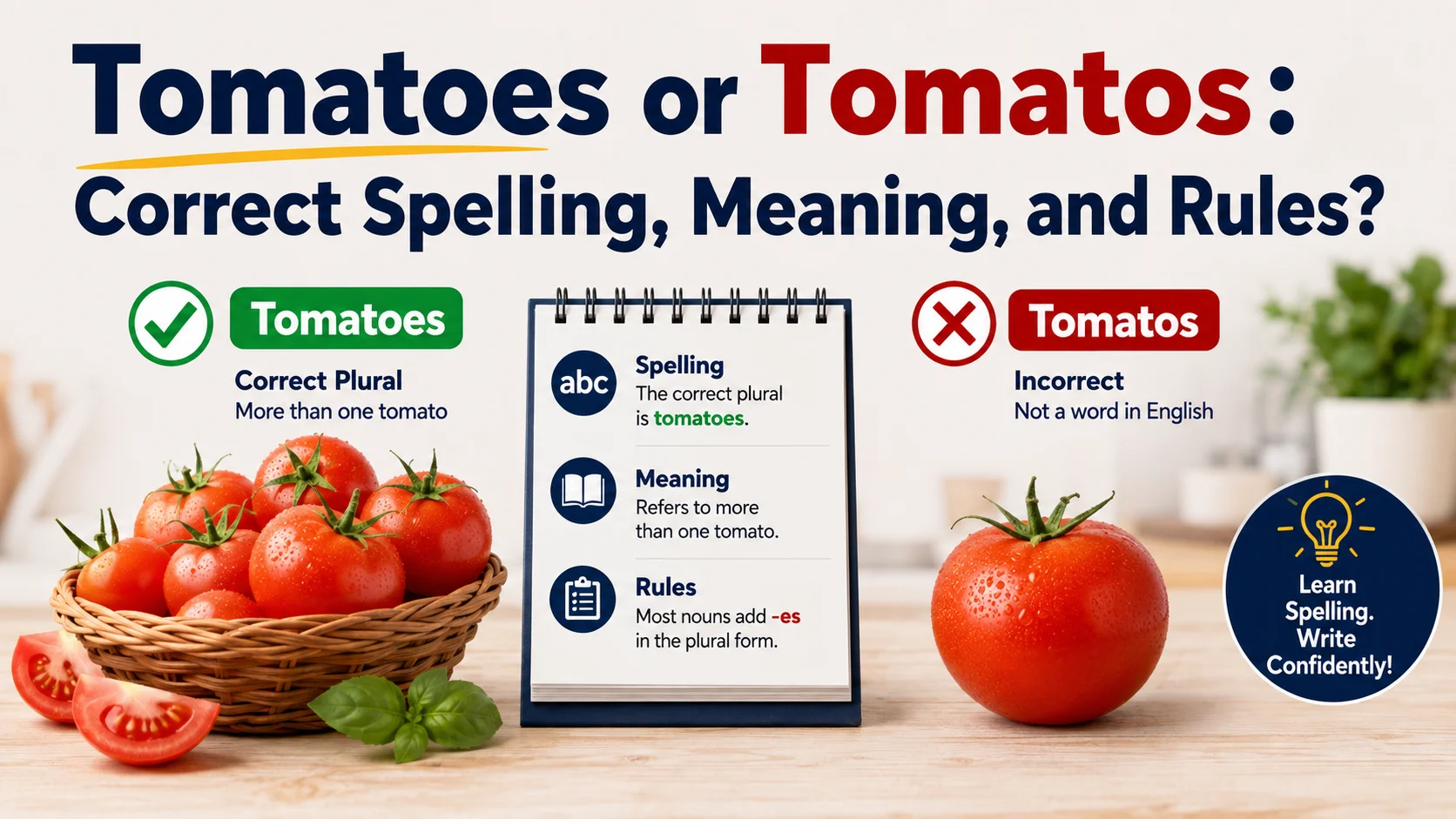
For English learners, Tomatoes or Tomatos can seem tricky, but tomatoes is the correct spelling. The plural form of tomato uses -es, giving us tomatoes, not tomatos. This simple rule explains the difference between the singular and plural forms. Although words ending in -o can follow different spelling patterns, both American English and British English use tomatoes as the standard form. Cambridge, Merriam-Webster, and Oxford also list tomatoes as the correct plural.
Tomato is a countable noun, so you can say one tomato, two tomatoes, or more tomatoes. However, tomato’s shows possessive meaning for one tomato, while tomatoes’ shows possession involving several. The apostrophe changes the meaning of a sentence, so punctuation matters. Understanding plural rules, noun forms, word formation, suffixes, and pluralization helps you avoid common spelling mistakes.
In everyday writing, typing, texts, and social media, people sometimes second-guess this word. Native speakers, learners, and writers can make the same mistake. Learning the correct form improves English writing skills, clarity, accuracy, and communication skills. When you proofreading, remember the simple pattern: tomato → tomatoes. This small trick saves time, reduces confusion, and helps you write with greater confidence.
Tomatoes or Tomatos: Which Spelling Is Correct?
Tomatoes is the correct spelling.
Tomatos isn’t the standard plural form of tomato. If you’re writing an email, article, school assignment, recipe, report, or website content, use tomatoes.
| Word | Correct? | Use |
| tomato | Yes | Singular |
| tomatoes | Yes | Plural |
| tomato’s | Yes | Singular possessive |
| tomatoes’ | Yes | Plural possessive |
| tomatos | No | Common misspelling |
For example:
- I bought one tomato.
- I bought five tomatoes.
- The tomato’s skin was damaged.
- The tomatoes’ color changed as they ripened.
Cambridge Dictionary directly lists tomatoes as the plural of tomato. Merriam-Webster does the same and also gives the word’s pronunciation and history.
So if you’re choosing between the two spellings, there’s no real contest:
Tomato → Tomatoes
Why Is “Tomatos” Incorrect?
The problem with tomatos is that it treats tomato as though every noun ending in -o simply takes -s.
English doesn’t work that neatly.
Some nouns ending in -o form plurals with -s, while others use -es. Tomato belongs to the second group.
For example:
- tomato → tomatoes
- potato → potatoes
- hero → heroes
- echo → echoes
But other words take only -s:
- photo → photos
- piano → pianos
- video → videos
- studio → studios
This distinction explains why learners sometimes write tomatos. They may know that adding -s often creates an English plural. The trouble is that tomato follows a different established spelling pattern.
English plural formation has plenty of these little traps. A rule can point you in the right direction without covering every word.
Why Does “Tomato” Become “Tomatoes”?
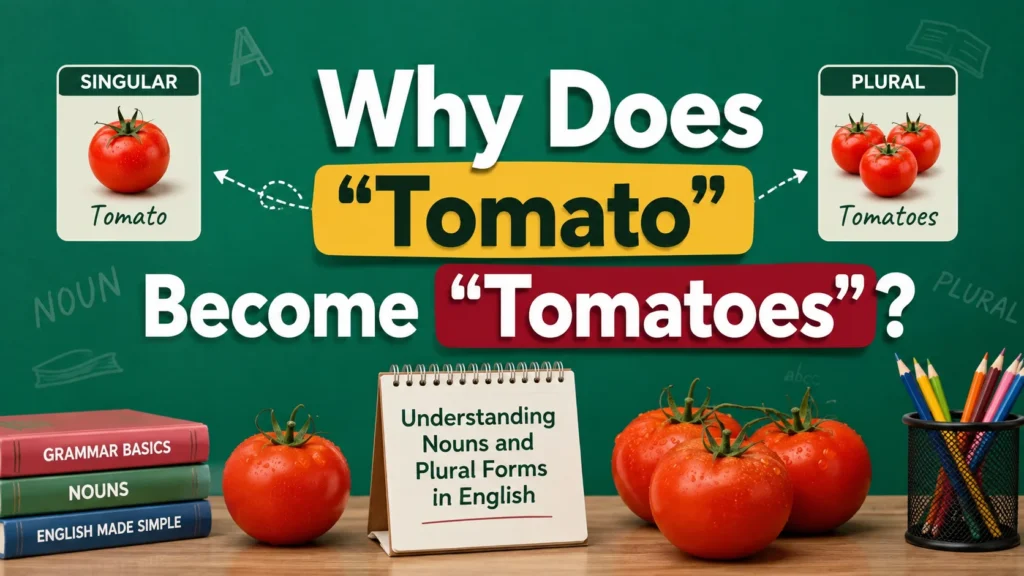
The plural of tomato is formed by adding -es:
tomato + es = tomatoes
This spelling pattern appears with several nouns ending in -o. Cambridge educational material gives tomato → tomatoes, along with examples such as potato → potatoes and hero → heroes.
The important point is that you shouldn’t remove the final o.
Incorrect:
tomato → tomatos
Correct:
tomato → tomatoes
The added -es becomes part of the standard written form. It isn’t an optional variation.
There is also a historical reason not to expect English spelling to behave perfectly. Tomato entered English through European languages and ultimately traces back to Nahuatl tomatl. Merriam-Webster dates the first known English use to 1604.
So the spelling isn’t simply the product of a modern classroom rule. It reflects the way English adopted and developed the word over time.
Tomato vs. Tomatoes: Singular and Plural Difference
The basic difference is simple:
- Tomato = one
- Tomatoes = more than one
Consider these examples:
I sliced one tomato for the sandwich.
I sliced three tomatoes for the salad.
The noun also affects the verb in a sentence.
| Singular | Plural |
| The tomato is fresh. | The tomatoes are fresh. |
| This tomato looks ripe. | These tomatoes look ripe. |
| One tomato was missing. | Several tomatoes were missing. |
This distinction matters because plural nouns normally require plural forms of verbs.
You wouldn’t normally write:
The tomatoes is fresh.
Instead, write:
The tomatoes are fresh.
Likewise, a tomato is singular, so you wouldn’t say a tomatoes.
Countable and Uncountable Use of Tomato
Tomato can function as a countable noun when you mean individual fruits. Oxford lists it as both countable and uncountable depending on context.
For example:
- We bought six tomatoes.
- She chopped two tomatoes.
- Add tomato to the sandwich.
In food-related expressions, tomato can also appear in compound nouns and mass-like expressions:
- tomato sauce
- tomato soup
- tomato paste
- tomato juice
The grammatical form depends on what you’re describing.
Tomato’s vs. Tomatoes vs. Tomatoes’: Understanding the Difference
These three forms look similar, but they don’t mean the same thing.
Tomato’s
Tomato’s is the singular possessive form.
It normally means something belongs to, relates to, or is associated with one tomato.
Example:
The tomato’s skin was unusually thick.
Here, one tomato has a skin.
Tomatoes
Tomatoes is simply the plural.
The tomatoes are ready to harvest.
No apostrophe is needed because the sentence only refers to multiple tomatoes.
Tomatoes’
Tomatoes’ is the plural possessive form.
The tomatoes’ color varied from yellow to deep red.
The apostrophe comes after the s because several tomatoes possess or are associated with something.
| Form | Meaning | Example |
| tomato | One tomato | The tomato is ripe. |
| tomatoes | More than one | The tomatoes are ripe. |
| tomato’s | Belonging to one | The tomato’s skin is thin. |
| tomatoes’ | Belonging to several | The tomatoes’ skins are thin. |
Is “Tomatos” Ever Correct?
For the ordinary plural of tomato, no.
Standard English uses tomatoes.
You might still encounter tomatos online, in user-generated content, informal posts, old documents, usernames, or spelling exercises. Its appearance doesn’t make it a standard spelling.
Think of it like a typo that has wandered into public view. Seeing it repeatedly doesn’t turn it into the accepted plural.
For formal or edited writing, stick with:
tomatoes
not:
tomatos
Pronunciation of Tomato and Tomatoes
The spelling is consistent across major varieties of English, but pronunciation varies.
In American English, tomato is commonly pronounced approximately:
tuh-MAY-toh
Cambridge gives the US pronunciation as /təˈmeɪ.t̬oʊ/. In British English, a common pronunciation is approximately:
tuh-MAH-toh
with Cambridge giving /təˈmɑː.təʊ/.
Merriam-Webster also notes that both major pronunciation patterns are accepted in standard English. It explains that the pronunciation history reflects different stages of the word’s anglicization.
The plural adds the -z sound at the end:
tomatoes
So pronunciation can vary by region, but the standard spelling doesn’t change.
Common Mistakes When Writing Tomatoes
The biggest spelling mistake is obvious:
❌ tomatos
✅ tomatoes
However, writers also confuse plural and possessive forms.
Mistake: Using an apostrophe for the plural
❌ I bought five tomato’s.
✅ I bought five tomatoes.
An apostrophe doesn’t normally make an English noun plural.
Mistake: Using the plural possessive unnecessarily
❌ The tomatoes’ are fresh.
✅ The tomatoes are fresh.
Nothing belongs to the tomatoes in the first sentence. The apostrophe serves no purpose.
Mistake: Mixing singular and plural forms
❌ I bought three tomato.
✅ I bought three tomatoes.
Mistake: Using the wrong verb
❌ The tomatoes is ripe.
✅ The tomatoes are ripe.
These errors may look small, but they can make otherwise polished writing appear careless.
Examples of Tomatoes in Everyday Sentences
Here are natural examples showing how tomatoes works in different contexts:
- We bought fresh tomatoes at the grocery store.
- The recipe calls for three tomatoes.
- She chopped the tomatoes before adding them to the sauce.
- These tomatoes taste sweeter than the ones we bought yesterday.
- The gardener planted several tomato plants.
- I added diced tomatoes to the salad.
- The farmer harvested hundreds of tomatoes.
- Keep the tomatoes in a cool place.
- The soup contains roasted tomatoes and garlic.
- Those tomatoes are finally turning red.
Notice how the word changes according to the meaning.
If you’re talking about one fruit, use tomato. If you’re talking about several, use tomatoes.
Easy Memory Trick to Remember “Tomatoes”
Here’s a simple way to lock the spelling into memory:
Tomato ends in -o, but its plural adds -es.
Think:
potato → potatoes
tomato → tomatoes
You can remember them as a pair because both follow the same common pattern.
Another quick trick is to picture the ending:
TOMATO + ES = TOMATOES
Don’t write:
TOMATO + S = TOMATOS
When proofreading, look at the final three letters. If the plural of tomato ends in only -os, you’ve missed the e.
Words Similar to Tomato That Follow the Same Rule
Several familiar nouns ending in -o form plurals with -es.
| Singular | Plural |
| tomato | tomatoes |
| potato | potatoes |
| hero | heroes |
| echo | echoes |
| torpedo | torpedoes |
However, don’t turn this into an absolute rule.
English also has many -o words that take only -s:
| Singular | Plural |
| photo | photos |
| piano | pianos |
| video | videos |
| studio | studios |
| solo | solos |
Cambridge teaching material specifically contrasts these two patterns and includes tomato → tomatoes alongside photo → photos and piano → pianos.
That’s why the safest approach is to learn common words individually while recognizing the broader pattern.
American English vs. British English Usage
There is no spelling difference between American and British English for the plural of tomato.
Both use:
tomatoes
The pronunciation is where you’ll notice a more obvious difference.
| Variety | Common pronunciation of tomato | Plural spelling |
| American English | tuh-MAY-toh | tomatoes |
| British English | tuh-MAH-toh | tomatoes |
Cambridge lists both US and UK pronunciations while giving tomatoes as the plural in both varieties.
So don’t assume that tomatos is a British alternative. It isn’t.
Tomatoes in Context: Grammar and Sentence Agreement
Spelling is only one part of using tomatoes correctly. The noun also needs to fit the grammar of the sentence.
Compare:
The tomato is on the counter.
with:
The tomatoes are on the counter.
The singular noun pairs with a singular verb. The plural noun pairs with a plural verb.
Quantifiers also make the difference clear:
- one tomato
- two tomatoes
- several tomatoes
- many tomatoes
- some tomatoes
- a few tomatoes
A useful pattern is:
number + plural noun
So:
She bought four tomatoes.
Not:
She bought four tomato.
And never:
She bought four tomatos.
The correct form handles both spelling and grammar at once.
Tomatoes vs. Other -O Plurals: Why the Rule Isn’t Absolute
One of the most misleading pieces of advice is that every noun ending in -o takes -es.
That’s simply not true.
English has developed different plural patterns for words ending in -o. Some take -es, while others take -s. Loanwords, word history, pronunciation, and established usage all play a role.
Consider this comparison:
| Word | Correct plural | Pattern |
| tomato | tomatoes | -es |
| potato | potatoes | -es |
| hero | heroes | -es |
| echo | echoes | -es |
| photo | photos | -s |
| piano | pianos | -s |
| video | videos | -s |
| studio | studios | -s |
This is why tomatoes needs to be learned as the established plural rather than guessed from a universal rule.
The rule is useful. It just isn’t bulletproof.
FAQs
Q1. Is “tomatoes” or “tomatos” correct?
Tomatoes is correct. Tomatos is not the standard plural spelling of tomato.
Q2. What is the plural of “tomato”?
The plural of tomato is tomatoes. For example, you can say, “I bought three tomatoes.”
Q3. Why does tomato become “tomatoes”?
The word tomato forms its plural by adding -es rather than simply -s. Therefore, tomato → tomatoes.
Q4. Is “tomatoes” correct in American and British English?
Yes. Tomatoes is the standard plural form in both American English and British English.
Q5. What is the difference between “tomatoes” and “tomato’s”?
Tomatoes is the plural form, meaning more than one tomato. Tomato’s is a possessive form that shows something belongs to one tomato. For example, “The tomato’s skin was damaged.”
Conclusion
Tomatoes is the correct plural spelling of tomato, while tomatos is incorrect in standard English. The key spelling rule is simple: tomato → tomatoes. Although some nouns ending in -o form plurals with only -s, tomato follows the -es pattern. Remembering this small difference can help you avoid common spelling mistakes and write with greater accuracy and confidence.
About The Author

