
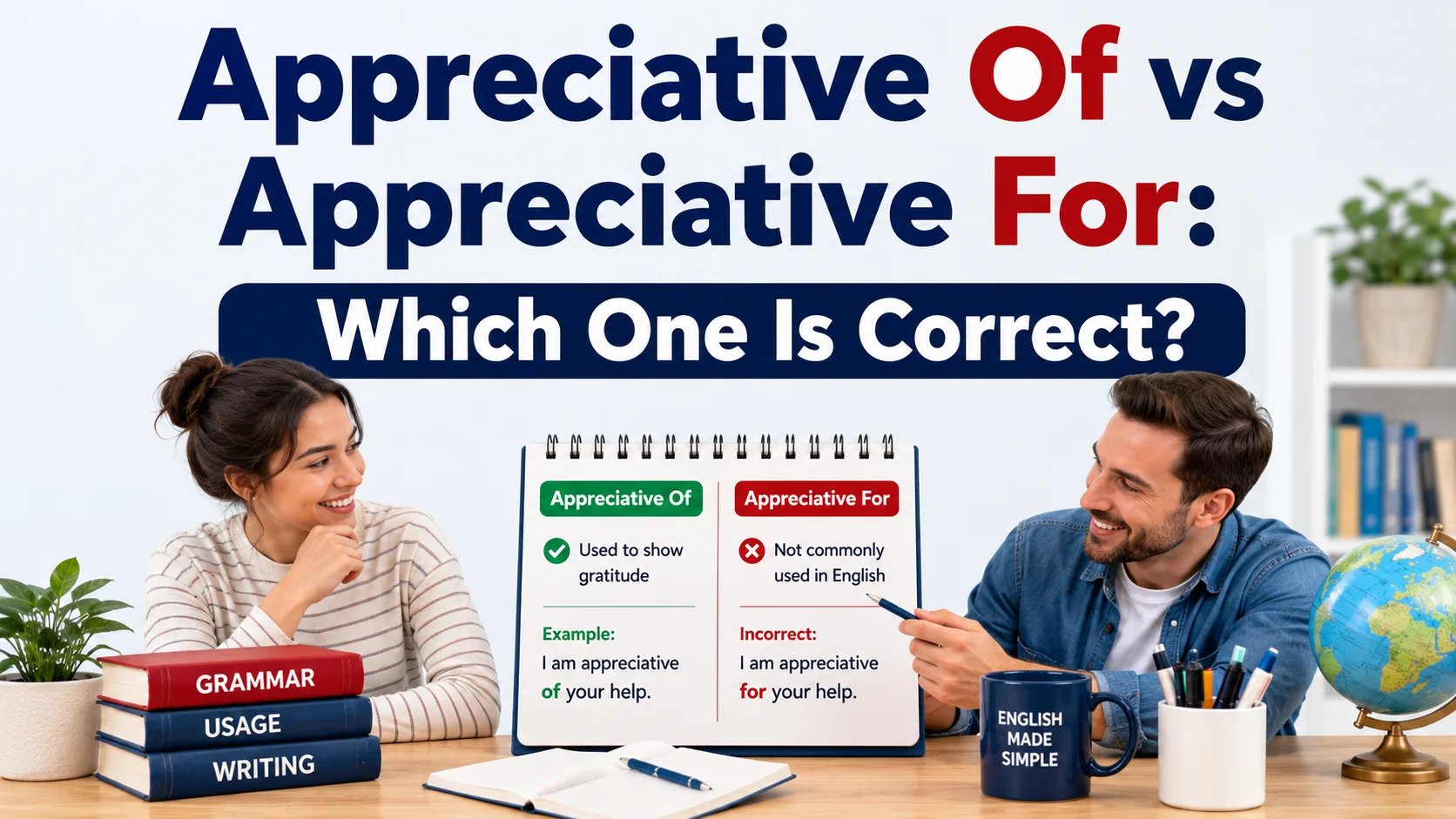
The difference between Appreciative Of vs Appreciative For becomes clear when you look at normal English usage. I am appreciative of your help sounds natural and correct in standard English, while I am appreciative for your help sounds uncommon and awkward. Use appreciative of when you want to show that you value a person, thing, action, or quality.
The easiest grammar rule is to use appreciative of for the thing you value. For example, I’m appreciative of your help sounds clear and natural. Although grateful for, thankful for, and appreciation for are common expressions, they follow different patterns. Mixing these phrases can cause confusion, especially for English learners.
A few examples make the rule easier to remember. You can say you’re appreciative of someone’s patience, support, effort, kindness, or time. However, appreciative for is usually better replaced with grateful for or thankful for. Once you understand this simple distinction, you can use the phrase with greater confidence and avoid common mistakes.
Appreciative Of vs Appreciative For: The Quick Answer
When you’re using the adjective appreciative, the standard construction is:
appreciative of + something
Examples include:
- I’m appreciative of your support.
- She’s appreciative of your kindness.
- We’re appreciative of the opportunity.
- He was appreciative of their patience.
The word for belongs naturally with related expressions such as grateful for, thankful for, and appreciation for.
| Expression | Standard Usage | Example |
| appreciative of | Yes | I’m appreciative of your help. |
| appreciative for | Usually avoid | I’m appreciative for your help. |
| grateful for | Yes | I’m grateful for your help. |
| thankful for | Yes | I’m thankful for your help. |
| appreciate + object | Yes | I appreciate your help. |
| appreciation for | Yes | I expressed my appreciation for your help. |
So, if you’re unsure, remember this:
Appreciative of. Grateful for. Appreciate something.
That simple trio will cover most situations.
What Does “Appreciative” Mean?
Appreciative is an adjective that describes someone who recognizes the value, benefit, quality, effort, or kindness of something.
It can express gratitude, but its meaning isn’t limited to saying “thank you.”
For example:
She was appreciative of his kindness.
Here, she recognizes and values his kindness.
You can also appreciate effort:
The manager was appreciative of the team’s hard work.
You can appreciate an opportunity:
He was appreciative of the opportunity to learn.
You can even appreciate qualities:
She’s appreciative of his honesty.
Major English dictionaries list appreciative of as the normal pattern for expressing this idea. Oxford Learner’s Dictionaries, for example, gives appreciative of something as the standard construction.
Appreciative vs Grateful
Appreciative and grateful often overlap, but they aren’t perfect substitutes in every context.
Grateful usually focuses on thankfulness for something received or something someone did.
I’m grateful for your help.
Appreciative can emphasize recognizing the value or quality of something.
I’m appreciative of your help.
Both sentences communicate thanks. The biggest difference for learners is the preposition.
- appreciative of
- grateful for
Don’t assume that because the meanings overlap, their prepositions must also match.
Common Grammatical Patterns With “Appreciative”
The most useful structure is:
be + appreciative of + noun phrase
For example:
I’m appreciative of your patience.
You can also use a pronoun:
We’re appreciative of you.
Another option is a gerund:
She’s appreciative of having the opportunity.
You may also encounter a that-clause:
I’m appreciative that you took the time to help.
Still, appreciative of remains the most useful pattern to learn.
Appreciative Of: The Standard and Natural Construction
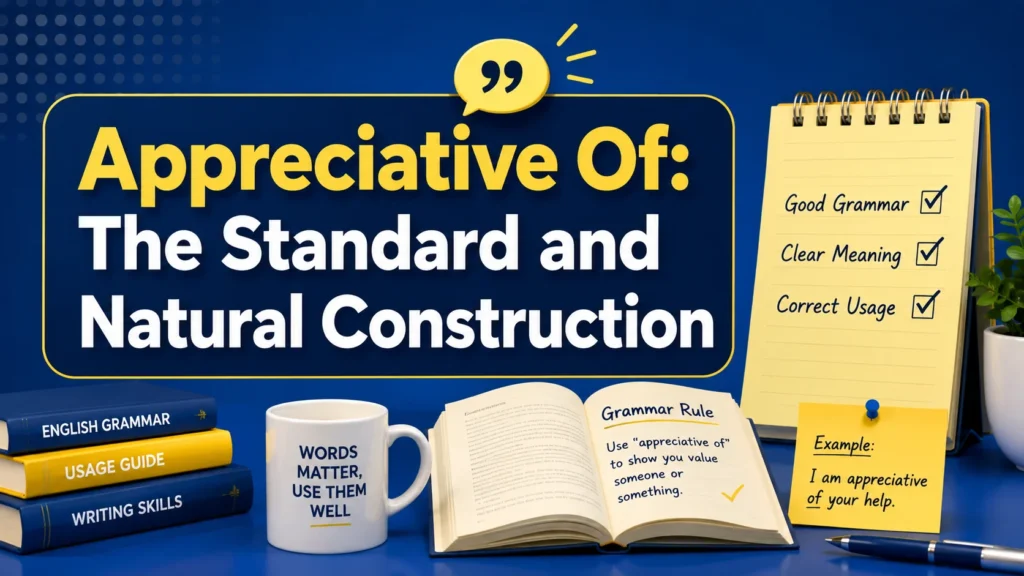
If you’re writing standard American English, appreciative of should be your default choice.
The structure is straightforward:
Subject + be + appreciative of + object
For example:
I’m appreciative of your assistance.
She was appreciative of the extra time.
The construction works in both formal and everyday settings.
What “Appreciative Of” Means
The word after of identifies what the person recognizes, values, or feels thankful for.
Consider:
I’m appreciative of your patience.
The speaker values the listener’s patience.
Now compare:
I’m appreciative of the opportunity.
Here, the speaker values an opportunity.
The basic meaning stays consistent even though the object changes.
When Should You Use “Appreciative Of”?
Use appreciative of when discussing:
- Help
- Support
- Kindness
- Patience
For example:
We’re appreciative of your cooperation.
She’s appreciative of the advice you gave her.
Sentence Examples Using “Appreciative Of”
Here are several natural examples:
I’m appreciative of everything you’ve done for me.
She was genuinely appreciative of the thoughtful gift.
We’re appreciative of your continued support.
The students were appreciative of their teacher’s guidance.
He’s appreciative of the chance to work with the team.
The company is appreciative of its employees’ dedication.
These examples show why of fits naturally after appreciative.
Why Does “Appreciative” Use “Of”?
English has many adjective-preposition combinations that follow established patterns.
For example:
- proud of
- aware of
- afraid of
- capable of
- interested in
- responsible for
- familiar with
- dependent on
- appreciative of
You generally can’t swap these prepositions simply because another one seems logical.
For example, English speakers say:
I’m proud of my work.
They don’t normally say:
I’m proud for my work.
Likewise, standard English uses:
I’m appreciative of your help.
This is called an adjective-preposition collocation. Learning these combinations as complete phrases can make English much easier.
Is “Appreciative For” Correct?
This question needs a careful answer.
Appreciative for does appear in real English usage. It isn’t an expression that no English speaker ever uses. However, appreciative of is the established and much safer pattern for standard American English.
Cambridge lists appreciative of prominently in its dictionary examples.
Therefore, if you’re an English learner or you’re writing something formal, use:
I’m appreciative of your help.
rather than:
I’m appreciative for your help.
The second sentence may be understood, but it doesn’t sound as natural to many speakers.
Why “Appreciative For” Sounds Awkward
The confusion usually comes from other common expressions.
You probably already know:
I’m grateful for your help.
You may also know:
I’m thankful for your help.
And:
I appreciate your help.
Because these expressions all communicate gratitude, it’s easy to combine their patterns accidentally.
That produces:
I’m appreciative for your help.
However, English doesn’t always let related words share the same preposition.
Appreciative For vs Grateful For
Compare these sentences:
I’m appreciative of your support.
I’m grateful for your support.
Both are natural.
The problem appears when you combine them:
I’m appreciative for your support.
For standard usage, change it to appreciative of or grateful for.
Appreciative Of vs Appreciative For: Does the Meaning Change?
For most practical purposes, the difference isn’t a major change in meaning.
The main issue is grammatical pattern and natural usage.
When someone says:
I’m appreciative of your kindness.
the person is expressing gratitude and recognition.
If someone says:
I’m appreciative for your kindness.
the intended meaning is still clear. The sentence simply doesn’t follow the standard pattern most learners should use.
So don’t think of of and for as two equally common choices that create different meanings.
Instead, learn:
appreciative of
as one standard expression.
Appreciative Of vs Grateful For
These two phrases are especially easy to confuse.
| Phrase | Meaning | Example |
| appreciative of | Recognizing or valuing something | I’m appreciative of your effort. |
| grateful for | Feeling thankful for something | I’m grateful for your effort. |
| thankful for | Feeling gratitude or relief | I’m thankful for your help. |
| appreciate + object | Directly recognizing value | I appreciate your effort. |
The tone can also differ slightly.
I’m grateful for your help often sounds warm and heartfelt.
I’m appreciative of your help can sound a little more measured or professional.
I appreciate your help is usually the most direct.
Appreciative Of vs “I Appreciate”
Another common mistake involves confusing the adjective appreciative with the verb appreciate.
These structures are different.
I’m appreciative of your help.
Here, appreciative is an adjective.
I appreciate your help.
Here, appreciate is a verb.
You shouldn’t insert of after the verb:
❌ I appreciate of your help.
Instead, write:
✅ I appreciate your help.
This distinction is especially useful in professional writing because I appreciate… often sounds more natural and concise.
Appreciative Of in Professional Writing
The phrase works well in business emails, workplace messages, academic communication, and formal correspondence.
For example:
I’m appreciative of your flexibility while we worked through the issue.
That’s correct and professional.
However, a shorter version may sound even more natural:
I appreciate your flexibility while we worked through the issue.
Good writing isn’t about choosing the longest or most formal expression. The goal is to communicate your meaning clearly.
Professional Examples
Workplace email:
I’m appreciative of your assistance with the presentation.
Client communication:
We’re appreciative of your patience while we resolve the issue.
Academic writing:
The researchers were appreciative of the reviewers’ detailed comments.
Employee feedback:
I’m appreciative of the effort you put into completing the project.
Each sentence uses appreciative of correctly.
Common Mistakes With Appreciative Of and Appreciative For
Mistake: Copying “Grateful For”
Incorrect or awkward:
I’m appreciative for your support.
Standard:
I’m appreciative of your support.
Alternative:
I’m grateful for your support.
Mistake: Confusing “Appreciative” With “Appreciate”
Incorrect:
I appreciate of your help.
Correct:
I appreciate your help.
Or:
I’m appreciative of your help.
Mistake: Assuming Related Words Use the Same Preposition
English learners sometimes reason like this:
grateful → for
thankful → for
appreciative → for
Unfortunately, English doesn’t work that neatly.
Each adjective has its own conventional pattern.
Mistake: Using “Appreciative” When “Appreciate” Sounds Better
Compare:
I’m appreciative of your quick response.
I appreciate your quick response.
The second is shorter and often more natural in an everyday email.
Both are useful. Choose based on the tone you want.
Easy Rules to Remember
Rule #1: Use “Appreciative Of”
When appreciative describes what you value or appreciate, use of.
I’m appreciative of your support.
Rule #2: Use “Grateful For”
When using grateful, use for in the normal gratitude pattern.
I’m grateful for your support.
Rule #3: Use “I Appreciate” Without “Of”
When appreciate is the verb, place the object directly after it.
I appreciate your support.
Rule #4: Remember “Appreciation For”
The noun appreciation commonly takes for.
We expressed our appreciation for your support.
Cambridge documents appreciation for as a standard construction.
Rule #5: Learn the Whole Phrase
Instead of memorizing appreciative alone, remember:
appreciative of
This approach works for many English adjective-preposition combinations.
Appreciative Of vs Appreciative For: Quick Comparison
| Sentence | Best Choice? | Explanation |
| I’m appreciative of your help. | Yes | Standard construction |
| I’m appreciative for your help. | Usually avoid | Uncommon and less natural |
| I’m grateful for your help. | Yes | Standard construction |
| I’m thankful for your help. | Yes | Standard construction |
| I appreciate your help. | Yes | Direct and natural |
| I appreciate of your help. | No | Appreciate takes a direct object |
| I expressed my appreciation for your help. | Yes | Standard noun construction |
The most important point is that appreciation for and appreciative of are both standard, even though they use different prepositions.
That difference is perfectly normal in English.
FAQs
Q.1 What is the correct phrase: appreciative of or appreciative for?
Appreciative of is the standard and more natural phrase in English. For example, “I’m appreciative of your help.”
Q.2 Is “appreciative for” grammatically correct?
“Appreciative for” is uncommon and can sound awkward in standard English. In most situations, use appreciative of instead.
Q.3 Can I say “grateful for” instead of “appreciative of”?
Yes. Grateful for is completely natural. For example, “I’m grateful for your support.” The preposition changes because grateful normally works with for.
Q.4 What is an easy way to remember the difference?
Remember this simple pattern: appreciative of, but grateful for and thankful for. This quick rule can help you avoid common mistakes.
Conclusion
Understanding appreciative of vs appreciative for becomes much easier once you remember one simple rule: appreciative normally takes of. Use appreciative of when talking about something you value, such as help, support, kindness, or effort. If you want to use for, choose grateful for or thankful for instead. This small distinction can make your English sound more natural and confident.
About The Author

