
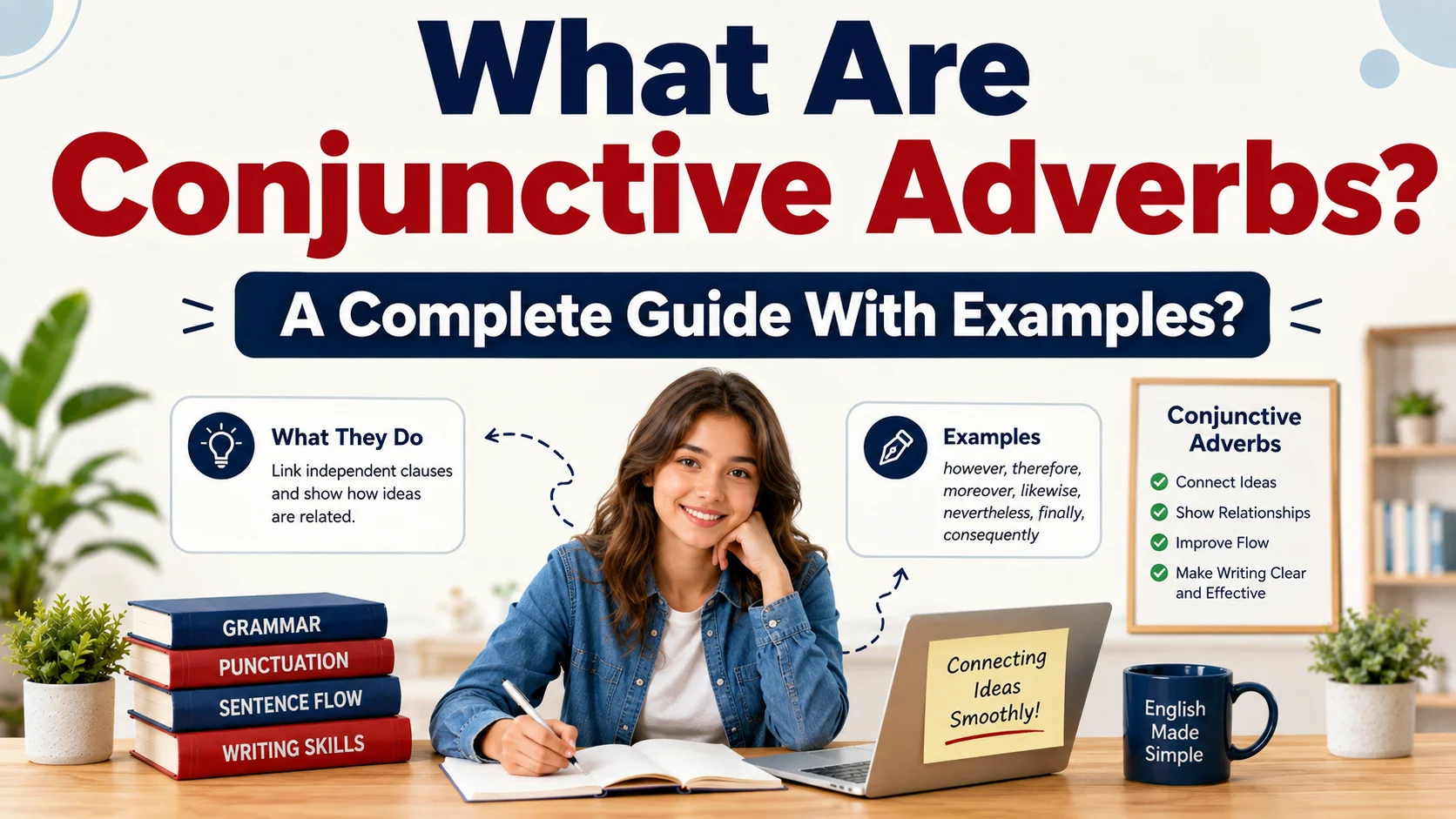
What Are Conjunctive Adverbs? They are adverbs that connect ideas and show a relationship between independent clauses. Words such as however, therefore, moreover, nevertheless, and consequently help show contrast, cause and effect, and addition. They make writing smoother and help guide the reader from one thought to another.
Conjunctive adverbs work differently from conjunctions such as but and or. However can introduce contrast, therefore can show a result, and moreover can add information. Meanwhile shows time, while otherwise presents an alternative. Choosing the right word depends on the meaning and context of your sentence.
When a conjunctive adverb connects two independent clauses, use a semicolon before it and a comma after it. For example: The task was difficult; however, we finished it. This simple grammar rule keeps your sentences clear, improves flow, and makes the connection between your ideas easier to understand.
What Is a Conjunctive Adverb?
A conjunctive adverb is an adverb that connects ideas by showing the logical relationship between clauses, sentences, or larger pieces of writing.
Common examples include:
- however
- therefore
- moreover
- furthermore
- nevertheless
- consequently
- otherwise
- instead
- meanwhile
- similarly
- likewise
- thus
- subsequently
- accordingly
The key word is relationship.
Consider these sentences:
The restaurant was expensive. However, the food was excellent.
The word however tells you that the second idea contrasts with the first.
Now compare:
The restaurant was expensive. Therefore, we decided to eat somewhere else.
Here, therefore signals a result. The high price caused or contributed to the decision.
Merriam-Webster notes that adverbs can modify entire clauses or sentences rather than only individual verbs. Some adverbs also function in ways that connect ideas and express relationships between clauses.
What Does a Conjunctive Adverb Do?
A conjunctive adverb tells readers how the next idea relates to the previous one.
It can express:
- Contrast: however, nevertheless, nonetheless
- Cause and effect: therefore, consequently, thus
- Addition: moreover, furthermore, additionally
- Similarity: similarly, likewise
- Time or sequence: meanwhile, subsequently, afterward
- Alternative: otherwise, instead
- Emphasis: indeed, certainly
Think of a conjunctive adverb as a road sign for your reader.
Without one, the reader may have to figure out the relationship. With one, the direction becomes obvious.
Why Are They Called Adverbs?
The name can seem strange because these words often connect clauses.
The reason is grammatical rather than visual. A conjunctive adverb doesn’t function like a coordinating conjunction such as and, but, or so. Instead, it acts as an adverbial element that expresses the relationship between ideas.
That’s why however and but can have similar meanings while behaving differently in a sentence.
How Conjunctive Adverbs Connect Ideas?
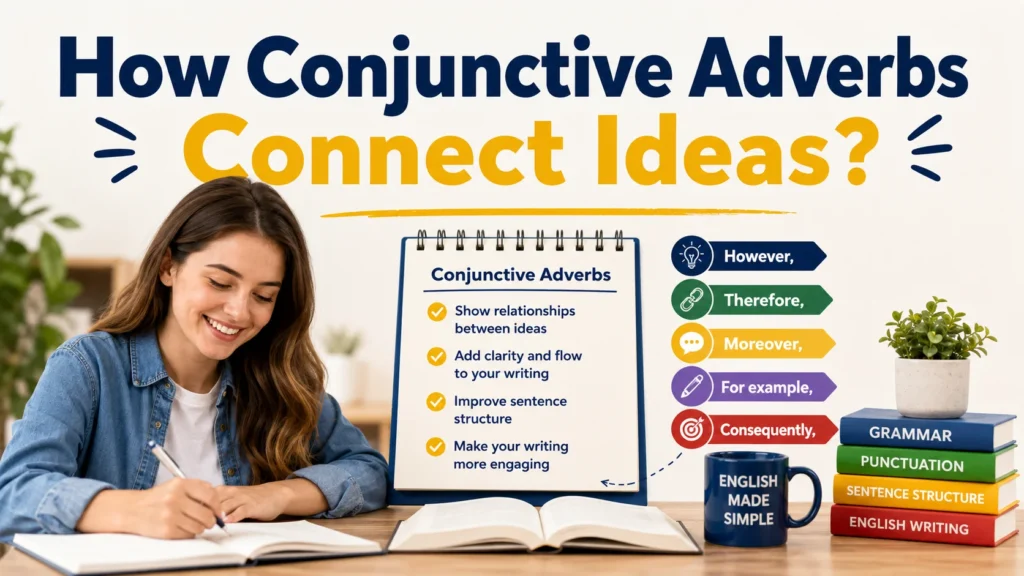
Conjunctive adverbs commonly appear between two independent clauses.
An independent clause contains a subject and a predicate and can stand alone as a complete sentence.
For example:
The deadline was approaching.
That’s a complete thought.
So is:
We increased the team’s workload.
When you connect them with a conjunctive adverb, the standard structure looks like this:
Independent clause; conjunctive adverb, independent clause.
For example:
The deadline was approaching; therefore, we increased the team’s workload.
The semicolon separates the two independent clauses. Therefore then shows that the second clause expresses the result of the first.
This distinction matters because a conjunctive adverb doesn’t function as a coordinating conjunction. Grammar references commonly describe words such as however, therefore, consequently, and nonetheless as elements that can connect main clauses when the appropriate punctuation separates those clauses.
Basic Structure With Two Independent Clauses
The most useful pattern to remember is:
Independent clause + semicolon + conjunctive adverb + comma + independent clause
Examples:
The store was closing; therefore, we hurried.
The instructions looked simple; however, the task was difficult.
Maya finished the report; meanwhile, her colleague prepared the presentation.
The first approach failed; nevertheless, the team tried again.
You can also separate the clauses into two sentences:
The store was closing. Therefore, we hurried.
Both structures can work. The choice depends partly on rhythm, emphasis, and how closely you want to connect the ideas.
How to Punctuate Conjunctive Adverbs
Punctuation causes most of the confusion surrounding conjunctive adverbs.
The simplest rule is this:
When a conjunctive adverb connects two independent clauses, use a semicolon before it and usually a comma after it.
For example:
The road was flooded; therefore, the drivers turned around.
Here, therefore sits between two complete clauses.
The first clause is:
The road was flooded.
The second is:
The drivers turned around.
The semicolon keeps them together while still separating them grammatically.
The CDC gives the same distinction when explaining however. It points out that but is a coordinating conjunction, while however is a conjunctive adverb. Therefore, the punctuation differs: The results were clear, but the team debated them versus The results were clear; however, the team debated them.
Using a Semicolon Before a Conjunctive Adverb
Use a semicolon when the conjunctive adverb connects two independent clauses.
Correct:
The forecast predicted sunshine; however, heavy rain arrived.
Incorrect:
The forecast predicted sunshine, however, heavy rain arrived.
The second version uses a comma where stronger punctuation is needed.
A comma can’t adequately separate two independent clauses in this construction.
Using a Comma After a Conjunctive Adverb
When the conjunctive adverb introduces the second independent clause, a comma usually follows it.
The machine stopped working; therefore, the technician inspected it.
The evidence was incomplete; nevertheless, the committee continued its review.
The hotel was expensive; however, it offered excellent service.
This gives readers a clean visual structure:
Clause 1 ; transition , Clause 2
Grammar.com gives the same standard pattern for conjunctive adverbs used between independent clauses: semicolon, conjunctive adverb, then comma.
When a Comma Alone Creates an Error
One of the most common mistakes looks like this:
The project was difficult, however, we completed it.
This construction creates a comma splice because two independent clauses are being joined without appropriate punctuation.
Correct it in one of several ways:
The project was difficult; however, we completed it.
Or:
The project was difficult. However, we completed it.
Or, if the meaning permits:
The project was difficult, but we completed it.
The last version works because but is a coordinating conjunction.
Conjunctive Adverbs vs. Coordinating Conjunctions
This distinction is worth learning because it solves many punctuation problems.
The seven coordinating conjunctions are:
for, and, nor, but, or, yet, so
You can remember them with the acronym FANBOYS.
Compare but with however:
The plan was expensive, but we approved it.
The plan was expensive; however, we approved it.
Both sentences express contrast. The grammatical structure differs.
| Feature | Conjunctive Adverb | Coordinating Conjunction |
| Examples | however, therefore, moreover | and, but, or, so |
| Shows relationship | Yes | Yes |
| Functions as a coordinating conjunction | No | Yes |
| Commonly follows a semicolon between clauses | Yes | No |
| Comma after it in the standard two-clause pattern | Yes | No |
| Example | We left; therefore, we arrived early. | We left, so we arrived early. |
The important lesson isn’t simply memorizing punctuation. Learn what job the word performs.
Conjunctive Adverb vs. “But”
But directly coordinates two grammatical elements.
I wanted to go, but I was tired.
However doesn’t work the same way.
I wanted to go; however, I was tired.
You can also place however inside the second clause:
I wanted to go. I was, however, too tired.
The punctuation changes because however has a different position and function.
Conjunctive Adverb vs. “So”
Consider:
The roads were icy, so school closed.
Now compare:
The roads were icy; therefore, school closed.
Both sentences express cause and effect. So functions as a coordinating conjunction. Therefore functions as a conjunctive adverb.
Common Types of Conjunctive Adverbs
Different conjunctive adverbs express different logical relationships. Choosing the right one makes your writing more precise.
Conjunctive Adverbs That Show Contrast
Use these when the second idea differs from, limits, or challenges the first.
- however
- nevertheless
- nonetheless
- still
- instead
- conversely
Examples:
The apartment was small; however, its location was excellent.
The evidence was limited; nevertheless, the researchers continued.
The first solution was expensive; instead, the company chose a simpler option.
However is especially common because it works naturally in both formal and general writing.
Conjunctive Adverbs That Show Cause and Effect
Use these when the second statement results from the first.
- therefore
- consequently
- thus
- accordingly
- hence
Examples:
The payment arrived late; therefore, the order shipped later than expected.
The bridge was damaged; consequently, traffic was diverted.
The data showed a clear trend; thus, the researchers changed their approach.
These words make cause-and-effect relationships explicit rather than leaving readers to infer them.
Conjunctive Adverbs That Add Information
Use these when the second idea builds on the first.
- moreover
- furthermore
- additionally
- also
Examples:
The software is affordable; moreover, it’s easy to use.
The course covers grammar; furthermore, it includes practical exercises.
Moreover and furthermore often appear in formal or academic writing. In casual conversation, also or and usually sounds more natural.
Conjunctive Adverbs That Show Similarity
These indicate that two ideas resemble each other.
- similarly
- likewise
- correspondingly
Examples:
The first experiment produced strong results; similarly, the second test succeeded.
Daniel enjoys hiking; likewise, his sister spends most weekends outdoors.
Conjunctive Adverbs That Show Time or Sequence
These help readers follow events in chronological order.
- meanwhile
- afterward
- subsequently
- then
- finally
Examples:
Sarah prepared the presentation; meanwhile, James reviewed the data.
The company changed its policy; subsequently, customer complaints declined.
These transitions can be particularly useful in narratives, reports, instructions, and explanations.
Conjunctive Adverbs That Show an Alternative
Two particularly useful examples are instead and otherwise.
We didn’t take the highway; instead, we used the back roads.
Leave now; otherwise, you’ll miss the train.
The relationship differs slightly. Instead presents an alternative that replaces another possibility. Otherwise often warns about what will happen if a condition isn’t met.
Complete List of Common Conjunctive Adverbs
| Function | Conjunctive Adverbs | Example |
| Contrast | however, nevertheless, nonetheless, still | The task was hard; however, we finished it. |
| Result | therefore, consequently, thus, accordingly | It rained; therefore, the game was canceled. |
| Addition | moreover, furthermore, additionally | The plan saves money; moreover, it saves time. |
| Similarity | similarly, likewise, correspondingly | The first test worked; similarly, the second succeeded. |
| Alternative | instead, otherwise | Take the bus; otherwise, you’ll arrive late. |
| Time | meanwhile, subsequently, afterward, then | She studied; meanwhile, her brother worked. |
| Emphasis | indeed, certainly | The decision was difficult; indeed, nobody agreed immediately. |
This table works as a quick reference, but context still matters. A transition should express the actual relationship between your ideas.
Conjunctive Adverb Examples With Explanations
Contrast
The laptop was expensive; however, it lasted for years.
However signals a contrast between cost and durability.
Cause and Effect
The roads were icy; therefore, the school closed early.
Therefore introduces the result of the icy conditions.
Addition
The apartment has a large kitchen; moreover, it includes free parking.
Moreover adds another positive feature.
Sequence
The manager approved the request; subsequently, the team began the project.
Subsequently shows that the second event happened later.
Alternative
You can submit the form online; otherwise, you’ll need to visit the office.
Otherwise presents what happens if the first option isn’t chosen.
Similarity
The first model performed well; similarly, the newer model exceeded expectations.
Similarly shows that the second situation resembles the first.
Conclusion
Conjunctive adverbs make your writing clearer by showing how ideas relate. Words such as however, therefore, moreover, nevertheless, and consequently can express contrast, results, addition, and other relationships. When you use them correctly, your sentences become smoother and easier to follow. Remember the key punctuation rule: when a conjunctive adverb connects two independent clauses, use a semicolon before it and usually a comma after it.
FAQs
Q1. What are conjunctive adverbs?
Conjunctive adverbs are words that show the relationship between ideas or independent clauses. Common examples include however, therefore, moreover, nevertheless, and consequently.
Q2. What is the most common conjunctive adverb?
However is one of the most common conjunctive adverbs. It usually shows contrast between two ideas.
Q3. Do you use a comma before a conjunctive adverb?
When a conjunctive adverb connects two independent clauses, use a semicolon before it rather than a comma.
The weather was cold; however, we went outside.
Q4. Do you put a comma after a conjunctive adverb?
Usually, yes, when it introduces the second independent clause.
The task was difficult; therefore, we asked for help.
However, punctuation can change when the conjunctive adverb appears elsewhere in the sentence.
Q5. What is the difference between a conjunctive adverb and a conjunction?
A conjunctive adverb shows the relationship between ideas, while a coordinating conjunction grammatically connects them. For example, however is a conjunctive adverb, while but is a coordinating conjunction.
Q6. Can a conjunctive adverb start a sentence?
Yes. A conjunctive adverb can introduce a sentence.
However, the team continued working.
Therefore, we changed our plans.
Q7. What are some common conjunctive adverbs?
Common examples include however, therefore, moreover, furthermore, nevertheless, consequently, meanwhile, similarly, likewise, instead, and otherwise.
About The Author

