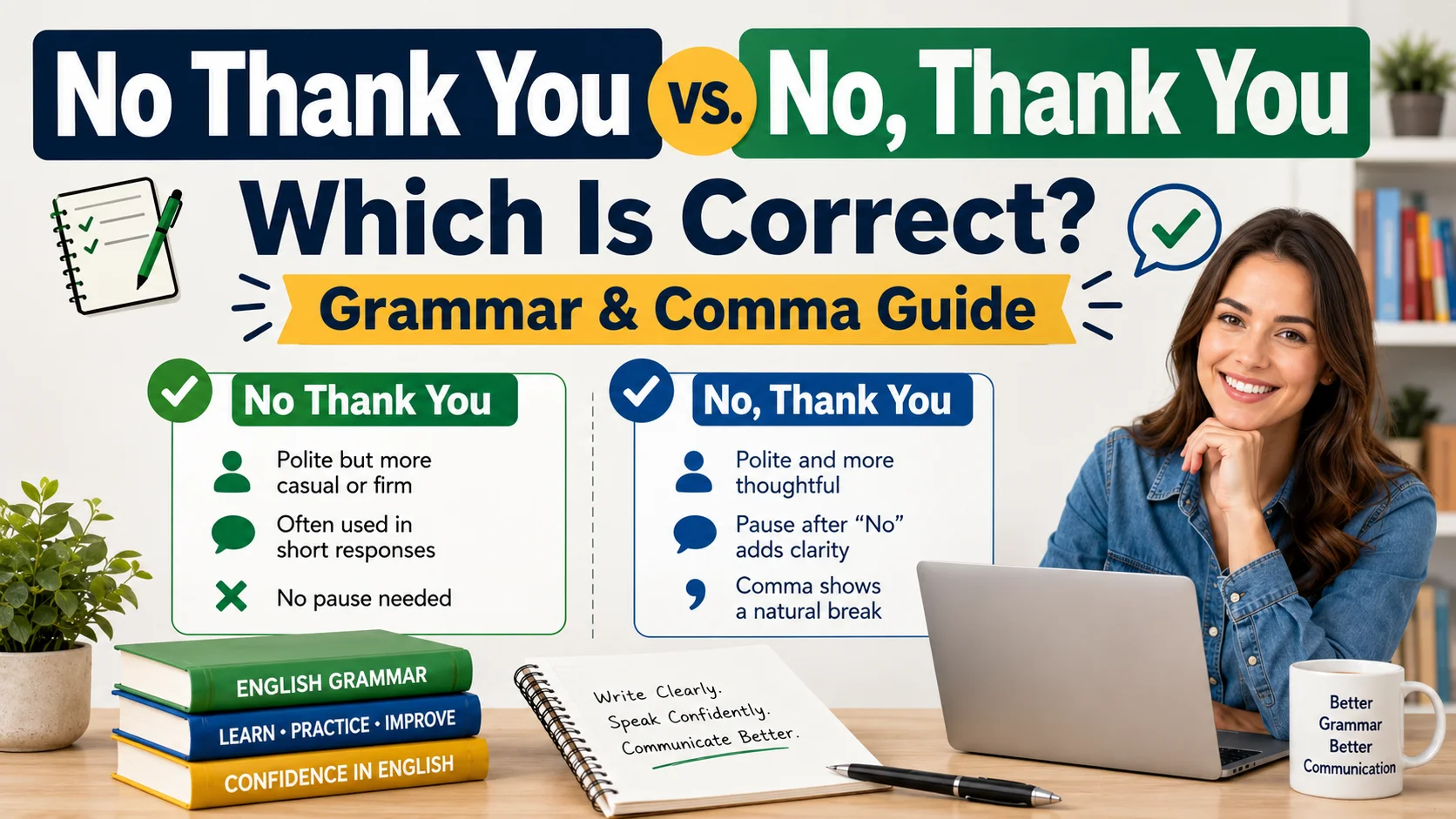
No Thank You vs. No, Thank You shows how one comma changes meaning, tone, and clarity in everyday English writing. The difference between No Thank You, No thank you, No, Thank You, and No, thank you may seem small, but one comma follows a grammar rule and proper punctuation rules. Using the correct version makes your writing more grammatically correct, improves readability, and strengthens communication.
In standard grammar, No, thank you is the preferred expression because the comma creates a brief pause and adds courtesy to a polite refusal. However, No thank you is common in casual writing, conversation, emails, letters, advertisements, menus, signs, and digital interfaces where simplified punctuation helps readers scan text quickly. Choosing the right usage, context, and word choice makes your message more natural.
Strong writing skills come from understanding when to use each form. In formal writing and professional writing, the comma creates a warm and respectful sentence tone, while informal writing and conversational writing often treat No Thank You as a fixed expression or phrasal noun. Learning this English grammar rule through practical examples and simple rules helps kids, adults, parents, teachers, and readers communicate more effectively in everyday communication, whether writing an email or giving a speech.
What Is the Difference Between “No Thank You” and “No, Thank You”?
The main difference between “No thank you” and “No, thank you” is the comma.
The phrase “No, thank you” is the standard grammatical form because the comma separates the refusal (No) from the polite expression (thank you). It tells readers to pause briefly before continuing.
For example:
- No, thank you. I’m not hungry.
- No, thank you. I already have one.
- No, thank you. I appreciate the offer.
Without the comma, the phrase becomes more informal.
Examples include:
- No thank you.
- No thank you, I’m fine.
- No thank you—we’re just looking.
Although many people write it this way, especially in text messages or online conversations, most grammar experts recommend using the comma in formal writing.
The Short Answer
| Expression | Grammatically Correct | Best Used In |
| No, thank you | ✔ Yes | Formal writing, emails, books, school assignments |
| No thank you | ✔ Acceptable | Casual conversations, texting, signs, buttons |
In other words, both forms exist, but one follows standard punctuation more closely.
Why the Comma Matters
A comma may seem insignificant, but punctuation shapes meaning. Readers rely on commas to understand where one thought ends and another begins.
When someone says:
No, thank you.
They are expressing two connected ideas:
- No — the refusal.
- Thank you — the polite acknowledgment.
The comma separates these ideas naturally.
Without it:
No thank you
the phrase feels more like a single expression. That’s why you’ll often see it on:
- Store signs
- Website buttons
- Restaurant menus
- Mobile apps
- Customer surveys
These situations prioritize quick reading over perfect grammatical punctuation.
Think of It Like a Pause
Imagine someone offers you another slice of cake.
You respond:
No, thank you.
You naturally pause after saying No before adding thank you.
That pause is exactly what the comma represents.
Good punctuation often mirrors natural speech.
Why Writers Should Care
Using the correct punctuation helps you:
- Improve clarity
- Sound more professional
- Avoid ambiguity
- Follow standard English grammar
- Create polished business communication
Even a small comma tells readers that you pay attention to detail.
Understanding “No, Thank You”
Among editors, teachers, and professional writers, “No, thank you” is considered the preferred version.
The comma separates the refusal from the courteous phrase, making the sentence easier to read.
Consider these examples.
Someone asks:
Would you like some coffee?
A natural response is:
No, thank you.
The answer sounds respectful without feeling cold.
Everyday Examples
- No, thank you. I’m driving today.
- No, thank you. I’ve already eaten.
- No, thank you. That’s very kind of you.
- No, thank you. Maybe next time.
- No, thank you. I’m good.
Each sentence begins with a clear refusal followed by appreciation.
Professional Examples
You’ll also find this form in business writing.
Examples include:
- No, thank you. We’ve decided to move forward with another proposal.
- No, thank you. I appreciate your invitation.
- No, thank you. Our schedule is already full.
- No, thank you. Please keep us in mind for future opportunities.
Notice how the comma makes every sentence easier to process.
Why It Sounds More Polite
English speakers often soften refusals by adding appreciation.
Instead of saying only:
No.
they say:
No, thank you.
That small addition transforms a blunt response into a courteous one.
Understanding “No Thank You”
Even though grammar books prefer “No, thank you,” you’ll frequently encounter “No thank you” without a comma.
This isn’t necessarily wrong.
Instead, it’s usually a stylistic choice.
Many companies simplify punctuation to make text easier to scan quickly.
For example, you may see buttons that say:
- No Thanks
- No Thank You
- Maybe Later
- Skip
- Continue
These aren’t complete sentences in the traditional sense. They’re interface labels.
Where You’ll Commonly See It
The version without a comma often appears in:
- Mobile apps
- Website pop-ups
- Advertising copy
- Product packaging
- Restaurant signs
- Retail displays
- Marketing campaigns
For example:
- No Thank You
- No Thanks
- No Sugar
- No Plastic Bags Please
The goal here isn’t grammatical perfection. It’s visual simplicity.
Should You Use It?
That depends on your audience.
If you’re writing:
- an academic paper,
- a professional email,
- a business proposal,
- a published article,
choose “No, thank you.”
If you’re creating:
- app buttons,
- marketing graphics,
- social media captions,
- quick text messages,
“No thank you” is widely accepted.
Knowing the difference allows you to match your writing to the situation.
Grammar Rule Behind the Comma
The punctuation in “No, thank you” isn’t random. It follows a long-established grammar principle.
The comma separates an interjection from the rest of the sentence.
In this expression:
- No functions as an interjection expressing refusal.
- Thank you functions as a polite expression directed toward the other person.
Because the two elements perform different grammatical jobs, standard punctuation places a comma between them.
The Rule in Simple Words
When an introductory word like yes, no, well, oh, or indeed begins a sentence, it is often followed by a comma before the main thought continues.
Examples include:
- Yes, I’ll help you.
- No, I can’t attend.
- Well, that’s surprising.
- Oh, I didn’t notice.
- Indeed, you’re correct.
The same pattern applies to:
No, thank you.
Compare Similar Expressions
| Correct Expression | Why It Works |
| Yes, please. | Comma follows the introductory response. |
| No, thanks. | Separates refusal from courtesy. |
| Yes, thank you. | Standard punctuation. |
| No, thank you. | Preferred grammatical form. |
| Well, thank you. | Introductory word followed by a comma. |
Notice the pattern. The comma consistently separates the introductory response from the polite phrase that follows.
A Simple Memory Trick
Whenever you can pause naturally after “No”, include the comma.
Read these aloud:
- No, thank you.
- No, I’m fine.
- No, I don’t need help.
If your voice naturally pauses after No, your writing should usually include the comma as well.
That’s one reason professional editors almost always choose “No, thank you.” It reflects both natural speech and standard English punctuation while keeping your writing clear, polite, and easy to read.
Real-Life Examples of No Thank You vs. No, Thank You
Understanding the grammar rule is only the first step. The best way to remember it is to see how these expressions work in real situations. Whether you’re replying to a friend, writing a business email, or declining an invitation, choosing the correct punctuation helps your message sound natural and polite.
Everyday Conversations
In everyday speech, most people naturally pause after saying “No.” That pause is reflected by the comma in formal writing.
Examples:
- Would you like another cup of coffee?
- No, thank you. I’m good.
- Can I help you with those bags?
- No, thank you. I can manage.
- Would you like some dessert?
- No, thank you. I’m full.
- Can I offer you a seat?
- No, thank you. I’ll stand.
These examples follow standard English punctuation while keeping the response friendly and respectful.
Emails and Business Communication
Professional communication should always prioritize clarity, courtesy, and correct grammar. Using “No, thank you” creates a polished impression.
Examples:
- No, thank you. We appreciate your proposal but have selected another vendor.
- No, thank you. Our hiring process has already concluded.
- No, thank you. I appreciate your invitation and hope the event goes well.
- No, thank you. Please keep us in mind for future opportunities.
A polite refusal helps preserve professional relationships even when the answer is negative.
Customer Service Responses
Businesses often teach employees to decline requests respectfully.
Example Conversation
Customer: Can I return this item without a receipt?
Employee: No, thank you. Unfortunately, our return policy requires proof of purchase.
Another example:
Customer: I’d like a refund today.
Representative: No, thank you. Let me explain the available options first.
Notice how the phrase softens the refusal while maintaining professionalism.
Invitations and Social Situations
Declining invitations politely is an important communication skill.
Examples:
- No, thank you. I already have plans.
- No, thank you. Maybe another time.
- No, thank you. That’s very thoughtful of you.
- No, thank you. I appreciate the invitation.
Adding a brief explanation is optional, but it often makes the response feel warmer.
No Thank You vs. No, Thank You Side by Side
The following table shows which version works best in different situations.
| Situation | Preferred Form | Why |
| Business email | No, thank you | Standard grammar and professional tone |
| Academic writing | No, thank you | Correct punctuation |
| Formal letter | No, thank you | Clear and polished writing |
| Text message | No thank you | Casual communication |
| Social media comment | No thank you | Informal style |
| Website button | No Thank You | UI design favors simplicity |
| Mobile app prompt | No Thank You | Easier to scan quickly |
| Marketing graphic | No Thank You | Visual consistency |
Quick Tip: If you’re writing something that will be edited, published, or graded, choose “No, thank you.”
Formal vs. Informal Usage of No Thank You and No, Thank You
The level of formality determines which version is most appropriate.
Formal Writing
Formal writing follows established grammar conventions, so “No, thank you” is almost always the better choice.
You’ll commonly see it in:
- Business emails
- Cover letters
- Academic papers
- Books
- Newspapers
- Professional reports
- Official correspondence
Using the comma makes your writing appear more polished and grammatically accurate.
Informal Writing
Casual communication allows more flexibility.
Examples include:
- Text messages
- Social media posts
- Online chats
- Personal emails
- Notes to friends
You’ll often find expressions like:
- No thank you
- No thanks
- Nope thanks
Although these are acceptable in informal settings, they shouldn’t replace the standard form in professional writing.
Marketing and User Interface Text
Many companies intentionally remove commas from short interface labels because users scan them quickly.
Common examples include:
- No Thanks
- No Thank You
- Skip
- Maybe Later
- Continue
These are design decisions, not grammar rules.
American vs. British English
Many writers wonder whether American and British English treat this expression differently.
The answer is not really.
Both varieties generally recommend:
No, thank you.
American English
American style guides typically use the comma because it reflects standard punctuation and natural speech.
You’ll see it in:
- Books
- Newspapers
- Educational materials
- Business documents
- Government publications
British English
British English follows essentially the same rule.
Professional publications, educational resources, and formal correspondence also prefer:
No, thank you.
While spelling and punctuation conventions sometimes differ between American and British English, this particular comma rule remains largely the same.
Common Mistakes and Misconceptions
Small punctuation mistakes can affect how polished your writing appears.
Omitting the Comma in Formal Writing
Incorrect
No thank you for your invitation.
Correct
No, thank you for your invitation.
The comma separates the refusal from the expression of gratitude.
Adding Unnecessary Commas
Incorrect
No, thank you, for inviting me.
Correct
No, thank you for inviting me.
Only one comma is needed.
Assuming Signs Follow Grammar Rules
Many people believe No Thank You is always correct because they see it on signs and websites.
In reality, designers often remove punctuation to improve readability and save space.
Being Too Direct
Compare these two responses:
Abrupt
No.
Polite
No, thank you.
Adding thank you softens the refusal and creates a friendlier interaction.
Similar Expressions That Follow the Same Comma Rule
Once you understand “No, thank you,” you’ll recognize the same punctuation pattern in many everyday expressions.
| Expression | Standard Form |
| Yes, please. | ✔ Correct |
| Yes, thank you. | ✔ Correct |
| No, thanks. | ✔ Correct |
| No, sir. | ✔ Correct |
| No, ma’am. | ✔ Correct |
| Well, thank you. | ✔ Correct |
| Oh, thanks! | ✔ Correct |
| Certainly, thank you. | ✔ Correct |
Examples
- Yes, please. I’d love another cup.
- No, thanks. I’m driving today.
- Well, thank you. That means a lot.
- Oh, thanks! I really appreciate it.
- Yes, thank you. Everything looks perfect.
Recognizing this pattern makes it easier to punctuate similar expressions correctly.
Examples in Literature and Everyday Writing
Professional writers use commas to reflect the natural rhythm of speech. Seeing the rule in context helps reinforce when it should be applied.
Dialogue
“Would you like to join us for dinner?”
“No, thank you,” Sarah replied with a smile.
The comma signals the natural pause after No, making the dialogue sound realistic.
Business Communication
A professional email might read:
No, thank you. We appreciate your interest and wish you continued success.
The punctuation creates a respectful and polished response.
Classroom Example
Teacher: Would anyone like to present first?
Student: No, thank you.
Even in a short reply, the comma improves readability and follows standard grammar.
Public Signs and Notices
Signs often simplify punctuation for visual reasons rather than grammatical accuracy.
Examples include:
- No Thank You
- No Smoking
- No Outside Food
- No Soliciting
These examples are design choices, not models for formal writing. Understanding the difference helps you decide which version fits your audience and purpose.
Conclusion
Understanding the difference between No Thank You and No, Thank You can make your writing clearer and more professional. While both forms appear in everyday English, No, thank you is the preferred choice in formal writing because it follows standard grammar and punctuation rules. The version without a comma is common in casual writing, signs, and digital interfaces where simplicity is often the goal.
By learning when to use each form, you can improve your writing style, enhance clarity, and communicate with greater confidence. A small comma may seem unimportant, but it plays a big role in creating a polite and natural expression.
FAQs
Q1. Is “No, thank you” grammatically correct?
Yes. “No, thank you” is the standard grammatical form because the comma separates the refusal from the polite expression. It is the preferred choice in formal writing and professional communication.
Q2. Can I write “No thank you” without a comma?
Yes. “No thank you” is widely used in informal writing, text messages, advertisements, and user interfaces. However, “No, thank you” is generally recommended for standard written English.
Q3. Why is there a comma in “No, thank you”?
The comma represents a natural pause after “No” and follows standard punctuation rules. It helps improve clarity and makes the response sound more polite.
Q4. Which version should I use in professional writing?
For business emails, academic work, and official documents, use “No, thank you.” It follows accepted English grammar rules and gives your writing a more polished appearance.
Q5. Does removing the comma change the meaning?
The basic meaning stays the same, but the tone and level of formality can change. “No, thank you” sounds more polished and grammatically correct, while “No thank you” feels more casual and conversational.
About The Author


2 thoughts on “No Thank You vs. No, Thank You: Which Is Correct? Grammar & Comma Guide”